

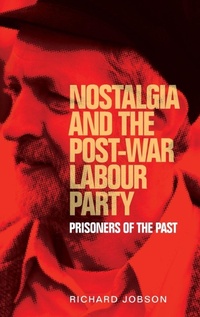
Nostalgia and the Post-War Labour Party
Prisoners of the Past
Published on 8. January 2018
Book
Hardback
232 pages
978-1-5261-1330-6 (ISBN)
Description
This book examines the impact that nostalgia has had on the Labour Party's political development since 1951. In contrast to existing studies that have emphasised the role played by modernity, it argues that nostalgia has defined Labour's identity and determined the party's trajectory over time. Jobson outlines how Labour, at both an elite and a grassroots level, has been and remains heavily influenced by a nostalgic commitment to an era of heroic male industrial working-class struggle.
This commitment has hindered policy discussion, determined the form that the modernisation process has taken and shaped internal conflict and cohesion. More broadly, Labour's emotional attachment to the past has made it difficult for the party to adjust to the socioeconomic changes that have taken place in Britain. In short, nostalgia has frequently left the party out of touch with the modern world. In this way, this study offers an assessment of Labour's failures to adapt to the changing nature and demands of post-war Britain and will be of interest to both students and academics working in the field of British political history and to those with a more general interest in Labour's history and politics. -- .
This commitment has hindered policy discussion, determined the form that the modernisation process has taken and shaped internal conflict and cohesion. More broadly, Labour's emotional attachment to the past has made it difficult for the party to adjust to the socioeconomic changes that have taken place in Britain. In short, nostalgia has frequently left the party out of touch with the modern world. In this way, this study offers an assessment of Labour's failures to adapt to the changing nature and demands of post-war Britain and will be of interest to both students and academics working in the field of British political history and to those with a more general interest in Labour's history and politics. -- .
Reviews / Votes
'The struggle to try and get the Labour Party "face the future", as our 1945 manifesto was titled, has - irony of ironies - its own rich history. Richard Jobson's fascinating study, Nostalgia and the post-war Labour Party, documents this thoroughly.'Bridget Phillipson MP, New Statesman
'A serious contribution to the understanding of struggles within the Labour Party [which] raises significant questions about how parties engage with their own past to their advantage and disadvantage and how the past informs and sometimes perhaps restricts current politics. Most importantly, it shows that nostalgia is not simply an issue for the right, for Brexit and Trump voters, but is a charge that the left too has to deal with.'
Tobias Becker, History Workshop Journal -- .
More details
Series
Language
English
Place of publication
Manchester
United Kingdom
Target group
College/higher education
Professional and scholarly
Dimensions
Height: 240 mm
Width: 161 mm
Thickness: 17 mm
Weight
517 gr
ISBN-13
978-1-5261-1330-6 (9781526113306)
Copyright in bibliographic data and cover images is held by Nielsen Book Services Limited or by the publishers or by their respective licensors: all rights reserved.
Schweitzer Classification
Other editions
Additional editions
E-Book
01/2018
1st Edition
Manchester University Press
from
€44.99
Available for download
E-Book
01/2018
1st Edition
Manchester University Press
€44.99
Available for download
Person
Richard Jobson is a Lecturer in Twentieth-Century British History at the University of Exeter -- .
Content
1 Introduction - Labour, nostalgia and 'nostalgia-identity'
2 Revisionism and the battle over clause IV - 1951-63
3 White heat and the Labour party 1963-70
4 Labour's alternative economic strategy 1970-83
5 Reinventing the Labour party 1983-92
6 The New Labour era 1992-2010
7 Back to the past? 2010 to the present
8 Conclusion
Bibliography
Index -- .
2 Revisionism and the battle over clause IV - 1951-63
3 White heat and the Labour party 1963-70
4 Labour's alternative economic strategy 1970-83
5 Reinventing the Labour party 1983-92
6 The New Labour era 1992-2010
7 Back to the past? 2010 to the present
8 Conclusion
Bibliography
Index -- .