

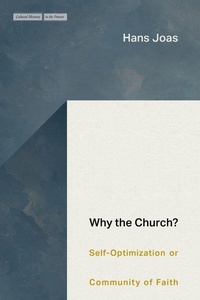
Why the Church?
Self-Optimization or Community of Faith
Published on 1. October 2024
Book
Hardback
200 pages
978-1-5036-3803-7 (ISBN)
Description
Why did Christianity produce the special organizational form "church" in the first place? Is it possible to be a Christian without the church? To what extent is Christian faith in community with other believers an alternative to the mere self-optimization of individuals?
In this accessible and questioning new work, Hans Joas traverses theological, church-historical, sociological, and ethical territory in search of a viable conception of the church adequate to contemporary globalized societies. Across eleven essays that draw on work by Ernst Troeltsch, Max Weber, Emile Durkheim, H. Richard Niebuhr, Leszek Kolakowski and others, Joas reflects on key debates-from the failure of so-called secularization theory to explain religiosity in modern society, to the role of Christianity and the church in relation to rampant nationalism and refugee crises, and to the question of whether or not human dignity ever was, or still is, the highest value in the West. Addressing the sociology of the church as the distinctive communal formation of Christianity for the last two millennia, Joas underscores the need for Christian conceptions of church to balance theological sensibility with concrete sociological grounding. In the process, he considers the relation of a community of faith to contemporary ideas about the optimization of life.
In this accessible and questioning new work, Hans Joas traverses theological, church-historical, sociological, and ethical territory in search of a viable conception of the church adequate to contemporary globalized societies. Across eleven essays that draw on work by Ernst Troeltsch, Max Weber, Emile Durkheim, H. Richard Niebuhr, Leszek Kolakowski and others, Joas reflects on key debates-from the failure of so-called secularization theory to explain religiosity in modern society, to the role of Christianity and the church in relation to rampant nationalism and refugee crises, and to the question of whether or not human dignity ever was, or still is, the highest value in the West. Addressing the sociology of the church as the distinctive communal formation of Christianity for the last two millennia, Joas underscores the need for Christian conceptions of church to balance theological sensibility with concrete sociological grounding. In the process, he considers the relation of a community of faith to contemporary ideas about the optimization of life.
Reviews / Votes
"The modes of thought deployed here give this book a complexity of insight without sacrifice of coherence in argument. Joas is one of the leading sociologists of religion today and this is a testimony to the comprehensiveness of his thought."-William Schweiker, The University of Chicago "With Why the Church?, Joas further burnishes his status as one of our finest sociologists of religion. The book richly weaves together many of the principal strands of his thought."
-William Barbieri, The Catholic University of America "Joas offers one of the most significant social-theoretical reflections on the Christian 'church' since Ernst Troeltsch. Highly recommended for anybody interested in moral universalism, civic cosmopolitanism, or the fate of the religious and secular options in the modern world."
-Jose Casanova, Georgetown University
More details
Series
Edition
New edition
Language
English
Place of publication
Palo Alto
United States
Target group
Professional and scholarly
Edition type
New edition
Product notice
Cloth
Dimensions
Height: 231 mm
Width: 155 mm
Thickness: 20 mm
Weight
454 gr
ISBN-13
978-1-5036-3803-7 (9781503638037)
Copyright in bibliographic data and cover images is held by Nielsen Book Services Limited or by the publishers or by their respective licensors: all rights reserved.
Schweitzer Classification
Other editions
Additional editions
E-Book
10/2024
Stanford University Press
€52.99
Available for download
Person
Hans Joas is Ernst Troeltsch Professor for the Sociology of Religion at the Humboldt University of Berlin. For more than twenty years he was a Visiting Professor of Sociology and in the Committee on Social Thought at the University of Chicago. He is the author of many books including The Power of the Sacred (2021) and Faith as an Option: Possible Futures for Christianity (Stanford, 2014).
Content
1. Introduction
2. Why the Church?
3. Problematic Predictions
4. Do We Need Religion?
5. Faith or Self-Optimization?
6. A Christian through War and Revolution
7. Christianity without the Church?
8. Human Dignity
9. Is Human Dignity Still Our Supreme Value?
10. The Church as Moral Agency?
11. The Church's Global Responsibility and Particular Obligations
2. Why the Church?
3. Problematic Predictions
4. Do We Need Religion?
5. Faith or Self-Optimization?
6. A Christian through War and Revolution
7. Christianity without the Church?
8. Human Dignity
9. Is Human Dignity Still Our Supreme Value?
10. The Church as Moral Agency?
11. The Church's Global Responsibility and Particular Obligations