

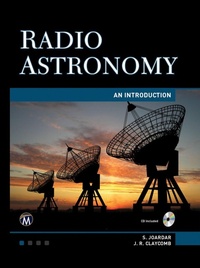
Radio Astronomy
An Introduction
1st Edition
Published on 22. July 2015
Book
Hardback
500 pages
978-1-936420-35-3 (ISBN)
Description
Designed for a course in radio astronomy or for use as a reference for practicing engineers and astronomers, this book provides a comprehensive overview of the topic. It begins with the history of radio astronomy then explains the fundamentals, polarization, designing radio telescopes, understanding radio arrays, interferometers, receiving systems, mapping techniques, image processing and propagation effects in relation to radio astronomy. A special chapter in the end presents the GMRT radio array as an example of the explained techniques. Two supplemental chapters have been added that describe the coordinate systems used in radio astronomy and minimum basics of antenna theory. The review questions at the end of each chapter contain direct hints for easy solutions.
More details
Edition
1. Auflage
Language
English
Place of publication
Herndon, VA
United States
Target group
College/higher education
Professional and scholarly
US School Grade: College Graduate Student
Illustrations
color illus
color illus
Dimensions
Height: 235 mm
Width: 183 mm
Thickness: 30 mm
Weight
931 gr
ISBN-13
978-1-936420-35-3 (9781936420353)
Copyright in bibliographic data and cover images is held by Nielsen Book Services Limited or by the publishers or by their respective licensors: all rights reserved.
Schweitzer Classification
Other editions
Additional editions
E-Book
05/2015
1st Edition
Mercury Learning and Information
€41.49
Available for download
Persons
Shubhendu Joardar is the senior engineer and scientific officer at the Tata Institute of Fundamental Research. He is a fellow of the Institute of the Electronics and Telecommunication Engineers and his major field of work has been in microwaves, antennas, astronomical radio spectrographs, RFI instrumentations, and data analysis for radio astronomy.
Content
1. Foundations of Radio Astronomy.
2. Fundamentals of Radio Astronomy.
3. Polarization Analysis.
4. Designing Single Dishes and Phased Arrays.
5. Interferometry and Radio Arrays.
6. Receiving Systems.
7. Interferometer Aperture Synthesis and Radio Mapping.
8. Interferometer Data Calibration and Image Processing.
9. Propagation Effects in Radio Astronomy.
10. The GMRT Radio Array.
A. Coordinate Systems Used in Radio Astronomy.
B. Antenna Terminology for Radio Telescopes.
C. Radiation Potential Formulation.
D. Radio Spectral Lines.
E. Radio Telescopes.
Bibliography.
Index.