

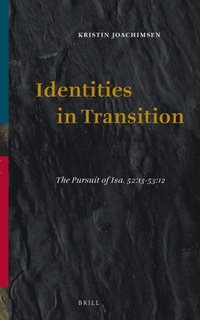
Identities in Transition
The Pursuit of Isa. 52:13-53:12
Published on 5. March 2011
Book
Leather / fine binding
464 pages
978-90-04-20106-4 (ISBN)
Description
Isa. 52:13-53:12 has occupied a special position within Jewish and Christian traditions, as well as within biblical scholarship. This book focuses particularly on different ways of reading this text. Historical-critical readings in the tradition after Bernhard Duhm are challenged. In Duhmian readings of Isa. 52:13-53:12, Gottesknecht has become a technical term, Ebed-Jahwe-Lied a genre, Stellvertretung an established theological concept and "servant song research" a separate discipline within biblical scholarship. After a critical presentation of the Duhmian readings, three other ways of reading Isa. 52:13-53:12 based on variations of linguistic theory are presented: one linguistic, one narratological and one intertextual. These show in different manners how the text is unstable, heterogeneous and composite. In these readings, the trope of personification is central.
More details
Series
Language
English
Place of publication
Leiden
Netherlands
Target group
Professional and scholarly
Product notice
Cloth
With dust jacket
Dimensions
Height: 235 mm
Width: 155 mm
Thickness: 25 mm
Weight
821 gr
ISBN-13
978-90-04-20106-4 (9789004201064)
Copyright in bibliographic data and cover images is held by Nielsen Book Services Limited or by the publishers or by their respective licensors: all rights reserved.
Schweitzer Classification
Person
Kristin Joachimsen, Dr. theol. (2007) in Biblical Studies, University of Oslo, is an Associate Professor of Religious Studies at theUniversity of Tromso.
Content
PART I. IN PURSUIT OF ISA. 52:13-53:12
1. INTRODUCTION
1.1. Histories of Isa. 52:13-53:12
1.2. Identities of Isa. 52:13-53:12
1.3. Identities in Transition
2. PERSONIFYING READING
2.1. Bernhard Duhm
2.2. Odil Hannes Steck
2.3. Evaluation and Further Prospectives
2.4. Visions of Isaiah
PART II. ISA. 52:13-53:12: IDENTITIES IN TRANSITION
3. TEXT
3.1. Linguistics
3.2. Sign
3.3. La langue and La parole
3.4. Synchronic and Diachronic
3.5. Syntagmatic and Paradigmatic
3.6. Parallelism
3.7. Structure and Differance
3.8. Reading and Writing
3.9. Reading Isa. 52:13-53:12
3.10. Text
4. NARRATIVE
4.1. On Narratology
4.2. Narrative
4.3. Story
4.4. Narration
4.5. Telling, Showing, Writing
4.6. Structure and Differance
4.7. On Personification
4.8. Isa. 52:13-53:12: Narrative
5. INTERTEXTUALITY
5.1. On Intertextuality
5.2. Dialogicity
5.3. Intertextuality
5.4. Genre
5.5. Discourse
5.6. Identifying Intertextuality
5.7. Intertextual Identification of Isa. 52:13-53:12
5.8. "As many were appalled at you...so kings shall shut their mouth"
5.9. "Who believes what we hear?
5.10. "He grew up like a shoot..."
5.11. "A man caught by sicknesses..."
5.12. "...and thus YHWH struck him by the iniquity of all of us"
5.13. "...like a sheep led to slaughtering...he did not open his mouth..."
5.14. "He was given his grave with wicked ones..."
5.15. "...he shall see offspring"
5.16. "The righteous one, my servant, will cause the many to be righteous..."
5.17. "See, my servant shall prosper"
6. SUMMING UP
6.1. Identifications of Isa.. 52:13-53:12
6.2. Isaiah 52:13-53 12 on a Linguistic Level
6.3. Isaiah 52:13-53:12 on a Narrative Level
6.4. Isaiah 52:13-53:12 on an Intertextual Level
6.5. Personification Once More
6.6. Concluding Remarks
1. INTRODUCTION
1.1. Histories of Isa. 52:13-53:12
1.2. Identities of Isa. 52:13-53:12
1.3. Identities in Transition
2. PERSONIFYING READING
2.1. Bernhard Duhm
2.2. Odil Hannes Steck
2.3. Evaluation and Further Prospectives
2.4. Visions of Isaiah
PART II. ISA. 52:13-53:12: IDENTITIES IN TRANSITION
3. TEXT
3.1. Linguistics
3.2. Sign
3.3. La langue and La parole
3.4. Synchronic and Diachronic
3.5. Syntagmatic and Paradigmatic
3.6. Parallelism
3.7. Structure and Differance
3.8. Reading and Writing
3.9. Reading Isa. 52:13-53:12
3.10. Text
4. NARRATIVE
4.1. On Narratology
4.2. Narrative
4.3. Story
4.4. Narration
4.5. Telling, Showing, Writing
4.6. Structure and Differance
4.7. On Personification
4.8. Isa. 52:13-53:12: Narrative
5. INTERTEXTUALITY
5.1. On Intertextuality
5.2. Dialogicity
5.3. Intertextuality
5.4. Genre
5.5. Discourse
5.6. Identifying Intertextuality
5.7. Intertextual Identification of Isa. 52:13-53:12
5.8. "As many were appalled at you...so kings shall shut their mouth"
5.9. "Who believes what we hear?
5.10. "He grew up like a shoot..."
5.11. "A man caught by sicknesses..."
5.12. "...and thus YHWH struck him by the iniquity of all of us"
5.13. "...like a sheep led to slaughtering...he did not open his mouth..."
5.14. "He was given his grave with wicked ones..."
5.15. "...he shall see offspring"
5.16. "The righteous one, my servant, will cause the many to be righteous..."
5.17. "See, my servant shall prosper"
6. SUMMING UP
6.1. Identifications of Isa.. 52:13-53:12
6.2. Isaiah 52:13-53 12 on a Linguistic Level
6.3. Isaiah 52:13-53:12 on a Narrative Level
6.4. Isaiah 52:13-53:12 on an Intertextual Level
6.5. Personification Once More
6.6. Concluding Remarks