

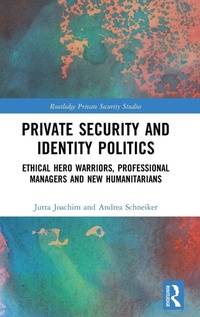
Private Security and Identity Politics
Ethical Hero Warriors, Professional Managers and New Humanitarians
1st Edition
Published on 2. August 2018
Book
Hardback
144 pages
978-1-138-19573-8 (ISBN)
Description
This book examines the self-representation and identity politics of Private Military and Security Companies (PMSCs).
PMSCs have become increasingly important over the past few decades. While their boom is frequently explained in functional terms, such as their cost-efficiency and effectiveness, this book offers an alternative explanation based on an analysis of the online self-presentations of forty-two US- and UK-based companies. PMSCs are shaping how they are perceived and establishing themselves as acceptable and legitimate security actors by eclectically appropriating identities more commonly associated with the military, businesses and humanitarian actors. Depending on their audience and clients' needs, they can be professional hero warriors, or promise turn-key security solutions based on their exceptional expertise, or, in a similar way to humanitarians, reassure those in need of relief and try to make the world a better place. Rather than being merely public relations, the self-referential assertions of PMSCs are political. Not only do they contribute to a normalization of private security and reinforce an already ongoing blurring of lines between the public and private sectors, they also change what we deem to be 'security' and a 'security actor'.
This book will be of much interest to students of private military companies, critical security studies, military studies, security studies and IR.
PMSCs have become increasingly important over the past few decades. While their boom is frequently explained in functional terms, such as their cost-efficiency and effectiveness, this book offers an alternative explanation based on an analysis of the online self-presentations of forty-two US- and UK-based companies. PMSCs are shaping how they are perceived and establishing themselves as acceptable and legitimate security actors by eclectically appropriating identities more commonly associated with the military, businesses and humanitarian actors. Depending on their audience and clients' needs, they can be professional hero warriors, or promise turn-key security solutions based on their exceptional expertise, or, in a similar way to humanitarians, reassure those in need of relief and try to make the world a better place. Rather than being merely public relations, the self-referential assertions of PMSCs are political. Not only do they contribute to a normalization of private security and reinforce an already ongoing blurring of lines between the public and private sectors, they also change what we deem to be 'security' and a 'security actor'.
This book will be of much interest to students of private military companies, critical security studies, military studies, security studies and IR.
Reviews / Votes
'In Private Security and Identity Politics, Joachim and Schneiker offer us important new insights into the global politics of security privatization. They convincingly move the focus beyond ongoing debates on private versus public, and the services PMSCs provide. Instead, the authors offer a detailed analysis of the multiple (gendered) identities that private security actors wield to gain economic and political power and re-shape our understandings of security. Their findings have crucial implications for theory and policy making on private security. By bringing the politics of identity construction into the field of private security studies, Joachim and Schneiker also illuminate broader contemporary trends in global security. This book will be of great interest to scholars of private security and anyone working on issues of security and international relations today.'-- Maya Eichler, Editor of Gender and Private Security in Global Politics'This highly innovative study makes a distinct and important contribution to the literature on private security. Examining the identity politics through which PMSCs represent themselves as ethical hero warriors, professional security experts, and benevolent humanitarians, Joachim and Schneiker show how PMSCs not only influence security practices, but also our understanding of what it means to be a humanitarian and a soldier.' -- Rita Abrahamsen, University of Ottawa, Canada
More details
Series
Language
English
Place of publication
London
United Kingdom
Publishing group
Taylor & Francis Ltd
Target group
College/higher education
Dimensions
Height: 240 mm
Width: 161 mm
Thickness: 13 mm
Weight
391 gr
ISBN-13
978-1-138-19573-8 (9781138195738)
Copyright in bibliographic data and cover images is held by Nielsen Book Services Limited or by the publishers or by their respective licensors: all rights reserved.
Schweitzer Classification
Other editions
Additional editions
Jutta Joachim | Andrea Schneiker
Private Security and Identity Politics
Ethical Hero Warriors, Professional Managers and New Humanitarians
Book
06/2020
1st Edition
Routledge
€52.07
Shipment within 15-20 days
Jutta Joachim | Andrea Schneiker
Private Security and Identity Politics
Ethical Hero Warriors, Professional Managers and New Humanitarians
E-Book
07/2018
1st Edition
Routledge
€59.49
Available for download
Jutta Joachim | Andrea Schneiker
Private Security and Identity Politics
Ethical Hero Warriors, Professional Managers and New Humanitarians
E-Book
07/2018
1st Edition
Routledge
€59.49
Available for download
Persons
Jutta Joachim is Senior Lecturer of International Relations at Radboud University, the Netherlands. She is author of Agenda Setting, the UN, and NGOs (2007) and co-editor of International Organizations and Implementation (Routledge 2007) and Transnational Activism in the UN and the EU (Routledge 2008).
Andrea Schneiker is Professor of Political Science at the University of Siegen, Germany. She is the author of Humanitarian NGOs, (In)Security and Identity (Routledge 2015) and co-editor of Researching Non-State Actors in International Security (Routledge 2017).
Andrea Schneiker is Professor of Political Science at the University of Siegen, Germany. She is the author of Humanitarian NGOs, (In)Security and Identity (Routledge 2015) and co-editor of Researching Non-State Actors in International Security (Routledge 2017).
Content
Introduction Chapter 1: Identities, Identity Politics, and PMSCs Chapter 2: Professional Hero Warriors Chapter 3: Security Experts and Business Managers Chapter 4: Do-Gooders and Humanitarians Chapter 5: From Mercenary to Hero Warrior, Security Professional, and Humanitarian: Summary and Discussion of Findings