

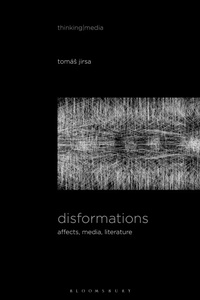
Disformations
Affects, Media, Literature
Published on 11. February 2021
Book
Hardback
168 pages
978-1-5013-6234-7 (ISBN)
Description
What happens when forms fall apart? And how do affects such as fear, shock, fascination, and desire drive and shape formal disturbances in modern literature, cinema, and contemporary art? Opening an interdisciplinary dialogue between cultural affect theory, media philosophy, and literary studies, Tomas Jirsa explores how specific affective operations disrupt form only to generate new formations. To demonstrate the importance of the structural work of mutually interacting affects, Disformations provides close readings of four intermedia figures stretched out across modernist fictions, contemporary video art, and posthuman visual experiments-the faceless face, the wallpaper pattern, the garbage dump, and the empty chair. Analyzing a wide range of texts, images, and audiovisual works, from Vincent van Gogh and Charlotte Perkins Gilman to Rainer Maria Rilke, Gaston Leroux, and Richard Weiner, to Francis Bacon, Michel Tournier, Ingmar Bergman, Eugene Ionesco, Vladimir Nabokov, Joseph Kosuth, and Jan Serych, this book opens up a new avenue for addressing how aesthetic forms desubjectify affects to mobilize their mediality and performative qualities. Jirsa's innovative theoretical framework and incisive readings offer a fresh inquiry into how artistic media produce their own figural thinking and in so doing compel us to think with them anew.
Reviews / Votes
Through a series of intriguing examples from literature, cinema, and contemporary arts, Jirsa's book takes readers on a delightful cross-disciplinary journey into affectively driven generative deformations. Passionate and erudite, Disformations's claim about the performative force of affects will be much debated in the contemporary media theory. * Pietro Conte, Associate Professor in Aesthetics, Ca' Foscari University of Venice, Italy * In this astonishingly inventive and wide-ranging book, Jirsa expertly traverses the domains of literature, painting, cinema, and video art for figures that push the formal limits of representation-the face destroyed by war, wallpaper patterns, the garbage dump, the empty chair-and thus reveal the dynamic force of affect at work in the secret heart of all formation. Arriving in the turbulent wake of the so-called affective and formal turns, Jirsa's media-philosophical concept of disformation brilliantly shows us a new way through the all-too familiar impasses of both. This book should be read by anyone interested in thinking deeply about the affective operations of form in our contemporary mediated moment. * Abraham Geil, Senior Lecturer of Film Studies, University of Amsterdam, The Netherlands * The central project of Disformations: Affects, Media, Literature is to reactivate the vital question of the affective operations of aesthetic objects. Through close readings of a range of fascinating figures-from empty chairs to wallpaper patterns-Jirsa insists on treating representational limits neither as ineffable nor as deficient, but instead as generative processes that expose the speculative potential of disturbances to form. * Eugenie Brinkema, Associate Professor of Contemporary Literature and Media, Massachusetts Institute of Technology, USA * Disformations is admirable for its erudite close readings and unexpected comparisons that illuminate one another in a manner likely to engage both specialized and nonspecialized readers with different degrees of familiarity with literary and media studies, art history, and cinema. * Discourse: Journal for Theoretical Studies in Media and Culture *More details
Series
Language
English
Place of publication
New York
United States
Publishing group
Bloomsbury Publishing Plc
Target group
College/higher education
Illustrations
19 bw illus
Dimensions
Height: 222 mm
Width: 145 mm
Thickness: 13 mm
Weight
351 gr
ISBN-13
978-1-5013-6234-7 (9781501362347)
Copyright in bibliographic data and cover images is held by Nielsen Book Services Limited or by the publishers or by their respective licensors: all rights reserved.
Schweitzer Classification
Other editions
Additional editions
E-Book
01/2021
1st Edition
Bloomsbury Academic USA
€35.49
Available for download
Person
Tomas Jirsa is Associate Professor of Literary Studies at Palacky University Olomouc, Czech Republic. Interested in relations between literature and the visual arts, affect studies, and music video, he recently co-edited (with Ernst van Alphen) How to Do Things with Affects: Affective Triggers in Aesthetic Forms and Cultural Practices (2019). In 2015 and 2017, he was awarded a fellowship from IKKM in Weimar; in 2019, he was Visiting Scholar at the Amsterdam School for Cultural Analysis.
Content
List of Figures
Acknowledgements
When Forms Fall Apart: An Introduction
Disformations Open Form to New Formations
Formal Disturbances Are Grounded in the Affective Operations that Rewrite Form
Aesthetic Forms Think with and through Intermedia Figures
Chapter 1
Facing the Faceless: Modernism, War, and the Work of Disfiguration
Shattering the Face in Modernism
Toward the Affective Work of the Formless
Inflicting Wounds upon Language: Gueules Cassees
Rewriting the Faceless Experience
Chapter 2
Curves that Break the Frame: On the Relentless Absorption of the Wallpaper Pattern
Nabokov's Unruly Geometry of Wallpaper
Rococo, or the Broken Frame
Boredom, Fascination, and the Screen of Hallucination
For a Morphological Reading of Gilman's Wallpaper
Between Excess and Absence: The Patterns of Madness
Chapter 3
How Text Becomes Diatext: Gemini and Performativity of the Garbage Dump
Speaking for Rubbish: Tournier's Dandy Garbage Man versus Waste Studies
The Media Archaeology of Garbage
Reading a Figure, Trashing the Subject
From Metatext to Diatext
Chapter 4
The Portrait of Absence, or When the Empty Chairs Get Crowded
Chairs without Sitters: Weiner, Kosuth, and the Missing Subject
Tracing the Present Absence with Van Gogh, Derrida, and Nancy
Chairing Not Sharing, Shifting Not Sitting: A Media Swap in Ionesco's The Chairs
Decentered, Not Vanished
Coda: Affective Compounds Make a Media Excess
Notes
Bibliography
Index
Acknowledgements
When Forms Fall Apart: An Introduction
Disformations Open Form to New Formations
Formal Disturbances Are Grounded in the Affective Operations that Rewrite Form
Aesthetic Forms Think with and through Intermedia Figures
Chapter 1
Facing the Faceless: Modernism, War, and the Work of Disfiguration
Shattering the Face in Modernism
Toward the Affective Work of the Formless
Inflicting Wounds upon Language: Gueules Cassees
Rewriting the Faceless Experience
Chapter 2
Curves that Break the Frame: On the Relentless Absorption of the Wallpaper Pattern
Nabokov's Unruly Geometry of Wallpaper
Rococo, or the Broken Frame
Boredom, Fascination, and the Screen of Hallucination
For a Morphological Reading of Gilman's Wallpaper
Between Excess and Absence: The Patterns of Madness
Chapter 3
How Text Becomes Diatext: Gemini and Performativity of the Garbage Dump
Speaking for Rubbish: Tournier's Dandy Garbage Man versus Waste Studies
The Media Archaeology of Garbage
Reading a Figure, Trashing the Subject
From Metatext to Diatext
Chapter 4
The Portrait of Absence, or When the Empty Chairs Get Crowded
Chairs without Sitters: Weiner, Kosuth, and the Missing Subject
Tracing the Present Absence with Van Gogh, Derrida, and Nancy
Chairing Not Sharing, Shifting Not Sitting: A Media Swap in Ionesco's The Chairs
Decentered, Not Vanished
Coda: Affective Compounds Make a Media Excess
Notes
Bibliography
Index