

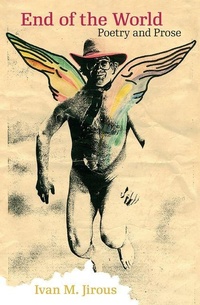
End of the World
Poetry and Prose
Will be published approx. on 20. July 2023
Book
Paperback/Softback
400 pages
978-80-246-4527-8 (ISBN)
Description
Sometimes called the Czech Bukowski, and more widely known by the epithet "Magor" (which translates roughly to "fool" or "madman"), Ivan Jirous was one of the most significant figures in the Czechoslovak cultural underground of the 1960s through the '80s. Although trained as an art historian and famed for his poetry, Jirous was convinced that it was actually rock and roll music that held the greatest potential to enact change under the repressive regime of communist Czechoslovakia. He designated himself as the artistic director of the dissident rock band The Plastic People of the Universe, legendary for psychedelic music that was heavily influenced by nonconformist Western acts like Frank Zappa and The Velvet Underground. Alongside other figures from the musical underground, Jirous was arrested in 1976-the second of five prison sentences he would serve for his dissent-which helped bring about the landmark civil rights initiative known as Charter 77. In the wake of 1989's Velvet Revolution, Va?lav Havel-the first president of the Czech Republic-was to say that Jirous and his unwavering commitment to liberation played "no small part" in casting off the yoke of Soviet oppression.
End of the World is the first major collection in English of the works of this legendary Czech "madman." Although nicknamed for his aggressive and rebellious behavior, Jirous's writing reveal a refined, sophisticated, and even tender sensibility. Translated in part by Paul Wilson, an original member of the Plastic People, the book gathers his poems and letters from prison, as well as his book-length prose work, The True Story of the Plastic People, alongside critical essays on Jirous's life and work. End of the World is an ideal introduction to the raucous writer who playwright Tom Stoppard referred to as one of the most interesting personalities in modern Czech history.
End of the World is the first major collection in English of the works of this legendary Czech "madman." Although nicknamed for his aggressive and rebellious behavior, Jirous's writing reveal a refined, sophisticated, and even tender sensibility. Translated in part by Paul Wilson, an original member of the Plastic People, the book gathers his poems and letters from prison, as well as his book-length prose work, The True Story of the Plastic People, alongside critical essays on Jirous's life and work. End of the World is an ideal introduction to the raucous writer who playwright Tom Stoppard referred to as one of the most interesting personalities in modern Czech history.
More details
Series
Language
English
Place of publication
Ovocny
Czech Republic
Illustrations
35 halftones
Dimensions
Height: 203 mm
Width: 152 mm
Weight
454 gr
ISBN-13
978-80-246-4527-8 (9788024645278)
Copyright in bibliographic data and cover images is held by Nielsen Book Services Limited or by the publishers or by their respective licensors: all rights reserved.
Schweitzer Classification
Persons
Ivan M. Jirous (1944 - 2011) was a Czech dissident, critic, essayist, and poet. Along with Vaclav Havel, Ivan "Magor" Jirous was one of the most important dissident figures in Communist Czechoslovakia, but where Havel represented the intellectuals and writers, Jirous as artistic director of The Plastic People of the Universe, represented the underground rock scene. The alliance Havel and Jirous formed in 1976 would soon lead to Charter 77, when Jirous and members of The Plastic People were arrested. Jirous would go on to serve five different prison sentences during communism. For the book of poetry he wrote in prison, Magor's Swan Songs, Jirous was awarded the Tom Stoppard Prize in 1985. Paul Wilson is a renowned Canadian-born translator of Czech and former member of The Plastic People of the Universe. Justin Quinn is a poet and translator of Czech poetry. Timothy West is a translator of Czech.
Content
1. Introduction2. Letters from Prison3. Magor as a Cultural Icon4. The True Story of the Plastic People 5. Magor as a Poet6. Magor's Swan Songs, selection7. Additional Poems8. Magor the Critic9. Photography