

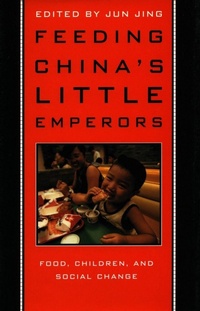
Feeding China's Little Emperors
Food, Children, and Social Change
Published on 1. February 2000
Book
Hardback
296 pages
978-0-8047-3133-1 (ISBN)
Description
Until recently, Chinese children ate what their parents fed them and were not permitted to influence, much less dictate, their own diet. The situation today is radically different, especially in cities and prosperous villages, as a result of a notable increase in people's income and a fast-growing consumer culture. Chinese children, with spending money in their pockets, arguably have become the most determined consumers-usually of snack foods, soft drinks, and fast foods from such Western outlets as McDonald's and Kentucky Fried Chicken. With many children, especially pampered only children, now controlling not only their own but also their family's choice of staples, snacks, and restaurants, a major reformation in the concept of childhood is occurring in China.
This book focuses on how the transformation of children's food habits, the result of China's transition to a market economy and its integration into the global economic arena, has changed the intimate relationship of childhood, parenthood, and family life. Since the early 1980s, a drastic decline in fertility and a steady rise in family income have been accompanied by a profusion of new products successfully advertised on television and in other media as "children's food." This commercialization of children's diet has become so pervasive that even children in remote villages surprise their parents with demands for particular trendy foods and soft drinks. Many Chinese parents, reared very differently, anxiously question whether their children are eating well and growing up healthy.
The contributors to this book, drawn from the fields of anthropology, sociology, political economy, and nutrition, examine a wide variety of topics: the effects of new foods on children's health; the consumption of "prestige" foods; the social implications of commercialized children's food on a Chinese Islamic community; the adaptations of Kentucky Fried Chicken in response to indigenous fast-food companies; the generation gap in attitudes toward food consumption; the significance of religion and nutrition in feeding and healing children; the creation of baby-friendly hospitals to promote breastfeeding and scientific childcare methods; the special role of nationalism and traditional Chinese medicine in children's food production; and the business promotion of having fun as an aspect of eating well.
This book focuses on how the transformation of children's food habits, the result of China's transition to a market economy and its integration into the global economic arena, has changed the intimate relationship of childhood, parenthood, and family life. Since the early 1980s, a drastic decline in fertility and a steady rise in family income have been accompanied by a profusion of new products successfully advertised on television and in other media as "children's food." This commercialization of children's diet has become so pervasive that even children in remote villages surprise their parents with demands for particular trendy foods and soft drinks. Many Chinese parents, reared very differently, anxiously question whether their children are eating well and growing up healthy.
The contributors to this book, drawn from the fields of anthropology, sociology, political economy, and nutrition, examine a wide variety of topics: the effects of new foods on children's health; the consumption of "prestige" foods; the social implications of commercialized children's food on a Chinese Islamic community; the adaptations of Kentucky Fried Chicken in response to indigenous fast-food companies; the generation gap in attitudes toward food consumption; the significance of religion and nutrition in feeding and healing children; the creation of baby-friendly hospitals to promote breastfeeding and scientific childcare methods; the special role of nationalism and traditional Chinese medicine in children's food production; and the business promotion of having fun as an aspect of eating well.
Reviews / Votes
"Jun Jing's edited volume is an important step forward on a controversial subject-only children in China's one-child families-that has often generated more heat than light. . . . There are no weak chapters. . . . [James L.] Watson is correct in concluding that the book may be unique because it attempts to track a profound historical transformation in social attitudes toward children during the early stages of that transformation."-Pacific Affairs "A rich description of cultural and dietary change in action, pointing to possibilities in research as well as the future of health studies in China."-Nutritional AnthropologyMore details
Edition
New edition
Language
English
Place of publication
Palo Alto
United States
Target group
College/higher education
Professional and scholarly
Edition type
New edition
Product notice
Cloth
Illustrations
7 figures, 3 tables
Dimensions
Height: 225 mm
Width: 149 mm
Thickness: 2 mm
Weight
41 gr
ISBN-13
978-0-8047-3133-1 (9780804731331)
Copyright in bibliographic data and cover images is held by Nielsen Book Services Limited or by the publishers or by their respective licensors: all rights reserved.
Schweitzer Classification
Person
Jun Jing is Assistant Professor of Social Anthropology at the City University of New York. He is the author of The Temple of Memories: History, Power, and Morality in a Chinese Village (Stanford, 1996).
Content
List of figures and tables Introduction: food, children, and social change in contemporary China Jun Jing 1. Paradoxes of plenty: China's infant and child-feeding transition Georgia S. Guldan 2. Eating snacks and biting pressure: only children in Beijing Bernadine W. L. Chee 3. Children's food and Islamic Dietary restrictions in Xi'an Maris Boyd Gillette 4. Family relations: the generation gap at the table Guo Yuhua 5. Globalized childhood?: kentucky fried chicken in Beijing Eriberto P. Lozada, Jr 6. Food, nutrition, and cultural authority in a Gansu village Jun Jing 7. A baby-friendly hospital and the science of infant feeding Suzanne K. Gottschang 8. State, children, and the Wahaha group of Hangzou Zhao Yang 9. Food as a lens: the past, present, and future of Family life in China James L. Watson Appendix Notes Index.