

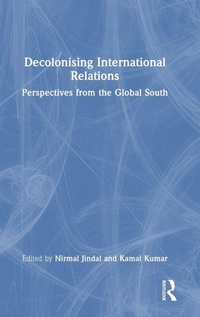
Decolonising International Relations
Perspectives from the Global South
1st Edition
Published on 12. September 2025
Book
Hardback
334 pages
978-1-032-98575-6 (ISBN)
Description
This volume critically analyses the theories and concepts of international relations (IR), which will be instrumental in understanding IR from a non-western perspective. Owing to its emphasis on the need to decolonise the discipline of IR, alternate perspectives from the global South have been explored and discussed in detail.
The book provides new insights to make the discipline more inclusive, universal and contributory to world peace and security. It lucidly enumerates on the concepts of state, sovereignty, power, conflict, security, diplomacy, human rights, development, market, inequalities, and migration from a non-Eurocentric lens, bringing distinct perspectives and experiences to the fore. Expanding on the Indian foreign policy of Vasudev Kutumbakam, it highlights India's policy of multi-alliances and multilateralism and, also refers to India's contributions during the COVID-19 pandemic and its drive to champion the cause of marginalised nations by reforming international institutions and pressing for development with sustainability. It is testament to India's commitment to global security through cooperation and collective action.
This book will be useful to the Departments of Political Science, Global Studies, International Studies, and South Asian studies. It will be an indispensable resource for researchers, social scientists and general readers interested to understand the theories and key concepts of IR, especially from an Indian perspective.
The book provides new insights to make the discipline more inclusive, universal and contributory to world peace and security. It lucidly enumerates on the concepts of state, sovereignty, power, conflict, security, diplomacy, human rights, development, market, inequalities, and migration from a non-Eurocentric lens, bringing distinct perspectives and experiences to the fore. Expanding on the Indian foreign policy of Vasudev Kutumbakam, it highlights India's policy of multi-alliances and multilateralism and, also refers to India's contributions during the COVID-19 pandemic and its drive to champion the cause of marginalised nations by reforming international institutions and pressing for development with sustainability. It is testament to India's commitment to global security through cooperation and collective action.
This book will be useful to the Departments of Political Science, Global Studies, International Studies, and South Asian studies. It will be an indispensable resource for researchers, social scientists and general readers interested to understand the theories and key concepts of IR, especially from an Indian perspective.
More details
Language
English
Place of publication
London
United Kingdom
Publishing group
Taylor & Francis Ltd
Target group
College/higher education
Postgraduate
Illustrations
3 s/w Tabellen, 6 s/w Zeichnungen, 6 s/w Abbildungen
3 Tables, black and white; 6 Line drawings, black and white; 6 Illustrations, black and white
Dimensions
Height: 240 mm
Width: 161 mm
Thickness: 24 mm
Weight
696 gr
ISBN-13
978-1-032-98575-6 (9781032985756)
Copyright in bibliographic data and cover images is held by Nielsen Book Services Limited or by the publishers or by their respective licensors: all rights reserved.
Schweitzer Classification
Other editions
Additional editions
Book
09/2025
1st Edition
Routledge
€64.40
Shipment within 10-20 days
E-Book
09/2025
Routledge
€55.49
Available for download
E-Book
09/2025
Routledge
€55.49
Available for download
Persons
Nirmal Jindal is a former Officiating Principal and Professor of Political Science at Satyawati College, University of Delhi, India. She has been a recipient of Fulbright Scholarship at CSIA, Harvard University, 1984-1985; Advanced International Programme, Uppsala University, Sweden, 1991; 'Best College Lecturer Award', Directorate of Higher Education, Delhi Government, 2017. She has authored several books and articles on issues of international relations. She has participated in hundreds of national and international conferences and participated in panel discussion on foreign policy and security issues in Zee News, NDTV and other channels like 'Nation UpToDate' several times.
Kamal Kumar is Assistant Professor of Global Studies at Dr. B. R. Ambedkar University Delhi. He has received the Academic Excellence Award in graduation at the Hindu College and secured a University Position at Delhi University. He is a recipient of the All-India Postgraduate Scholarship (2011), UGC-JRF (2013), and also ICSSR International Travel Grant (2018) to attend the MPSA Annual Conference held in April 2018 in Chicago, US. He has attended U21 MASTERS INTENSIVE MODULE 2012 organized in collaboration by University of Birmingham, University of Delhi and University of Melbourne in 2012. He has published several research articles in popular journals and co-edited three books titled 'Global Politics' (SAGE, 2018), 'International Relations' (SAGE, 2020) and 'Understanding Globalisation' (Routledge, 2024). His research interests include indigenous knowledge systems, environmental and climate justice, global politics, environmental politics in South Asia, and social movements.
Kamal Kumar is Assistant Professor of Global Studies at Dr. B. R. Ambedkar University Delhi. He has received the Academic Excellence Award in graduation at the Hindu College and secured a University Position at Delhi University. He is a recipient of the All-India Postgraduate Scholarship (2011), UGC-JRF (2013), and also ICSSR International Travel Grant (2018) to attend the MPSA Annual Conference held in April 2018 in Chicago, US. He has attended U21 MASTERS INTENSIVE MODULE 2012 organized in collaboration by University of Birmingham, University of Delhi and University of Melbourne in 2012. He has published several research articles in popular journals and co-edited three books titled 'Global Politics' (SAGE, 2018), 'International Relations' (SAGE, 2020) and 'Understanding Globalisation' (Routledge, 2024). His research interests include indigenous knowledge systems, environmental and climate justice, global politics, environmental politics in South Asia, and social movements.
Content
PART I - DISCIPLINARY HISTORY AND THEORIES OF IR 1. Making Sense of the World: Disciplinary History of IR and Its Contested Origins 2. Realism and Neo-Realism 3. Kautilya's Realpolitik: Reflections from the Global South 4. Revisiting Liberalism and Neoliberalism: Decolonial Insights and Challenges 5. Marxist and Neo-Marxist Approaches 6. Feminist Perspective in International Relations 7. Constructivism PART II - INSTITUTION, STRUCTURES AND PROCESSES 8. State, Nation and Market 9. Empire and International Order: Decolonial Perspective 10. Decolonizing the Concept of Power: Perspectives from the Global South 11. The Praxis of Buddhist Diplomacy and Soft Power in International Relations: Reflections from the Global South 12. Knowing our Virtual and Creative World: The Visual Turn in International Relations PART III - KEY ISSUES IN INTERNATIONAL RELATIONS: PERSPECTIVES FROM THE GLOBAL SOUTH 13. War, Conflicts and International Security 14. Political and Economic Inequalities 15. Human Rights 16. Understanding Migration PART IV - INTERNATIONAL RELATIONS: FUTURE AND TRAJECTORIES 17. Exploring the Future Trajectories of IR: Decolonizing the Imperial Narrative 18. India's Contribution to the IR: Insights for Future Trajectories