

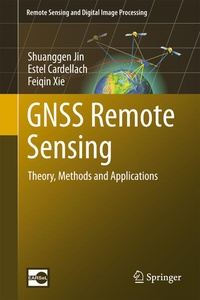
GNSS Remote Sensing
Theory, Methods and Applications
Published on 15. October 2013
Book
Hardback
XVI, 276 pages
978-94-007-7481-0 (ISBN)
Description
The versatile and available GNSS signals can detect the Earth's surface environments as a new, highly precise, continuous, all-weather and near-real-time remote sensing tool. This book presents the theory and methods of GNSS remote sensing as well as its applications in the atmosphere, oceans, land and hydrology. Ground-based atmospheric sensing, space-borne atmospheric sensing, reflectometry, ocean remote sensing, hydrology sensing as well as cryosphere sensing with the GNSS will be discussed per chapter in the book.
Reviews / Votes
From the book reviews:
"The book shows the possibility of using GNSS technology for multidisciplinary research, which is addressed here to a wide audience, representing the community of GNSS, meteorologists, hydrologists and others, from the area of earth sciences. I highly recommend this book to students and researchers who wish to learn about how to think about new possibilities of using GNSS technology in monitoring of the earth." (Jaroslaw Bosy, Pure and Applied Geophysics, Vol. 172, 2015)
More details
Series
Language
English
Place of publication
Dordrecht
Netherlands
Target group
Professional and scholarly
Research
Illustrations
46 s/w Abbildungen, 56 farbige Abbildungen
XVI, 276 p. 102 illus., 56 illus. in color.
Dimensions
Height: 241 mm
Width: 160 mm
Thickness: 22 mm
Weight
606 gr
ISBN-13
978-94-007-7481-0 (9789400774810)
DOI
10.1007/978-94-007-7482-7
Schweitzer Classification
Other editions
Additional editions
Book
08/2016
Springer
€160.49
Shipment within 15-20 days
E-Book
10/2013
1st Edition
Springer
€149.79
Available for download
Persons
Prof. Dr. Shuanggen Jin is employed at the Shanghai Astronomical Observatory, Chinese Academy of Sciences, Shanghai, China. He obtained his Ph.D. in GNSS and remote sensing in 2003 at the Chinese Academy of Sciences. His areas of expertise include satellite navigation and positioning, remote sensing and climate change and space/planetary sensing and dynamics. As of July 2011, he is a Fellow of the International Association of Geodesy (IAG). He works as an editor for a lot of journals, and acts as the Editor-in-Chief for International Journal of Geosciences.
Content
Introduction to GNSS.- Atmospheric delays and Multipath.- Ground-based GNSS Atmospheric Sensing.- Space-borne GNSS Atmospheric Sensing.- GNSS Reflectometry.- GNSS Ocean Remote Sensing.- GNSS Hydrology Sensing.- GNSS Cryosphere Sensing.