

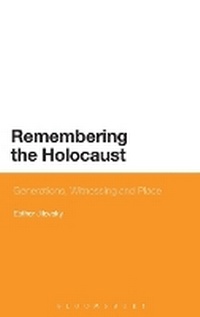
Remembering the Holocaust
Generations, Witnessing and Place
Published on 27. August 2015
Book
Hardback
240 pages
978-1-78093-633-8 (ISBN)
Description
An intriguing analysis of how place constructs memory and how memory constructs place, Remembering the Holocaust shows how visiting sites such as Auschwitz shapes the transfer of Holocaust memory from one generation to the next. Through the discussion of a range of memoirs and novels, including Landscapes of Memory by Ruth Kluger, Too Many Men by Lily Brett, The War After by Anne Karpf and Everything is Illuminated by Jonathan Safran Foer, Remembering the Holocaust reveals the pivotal yet complicated role of place in each generation's writing about the Holocaust.
This book provides an insightful and nuanced investigation of the effect of the Holocaust upon families, from survivors of the genocide to members of the second and even third generations of families involved. By deploying an innovative combination of generational and literary study of Holocaust survivor families focussed on place, Remembering the Holocaust makes an important contribution to the field of Holocaust Studies that will be of interest to scholars and anyone interested in Holocaust remembrance.
This book provides an insightful and nuanced investigation of the effect of the Holocaust upon families, from survivors of the genocide to members of the second and even third generations of families involved. By deploying an innovative combination of generational and literary study of Holocaust survivor families focussed on place, Remembering the Holocaust makes an important contribution to the field of Holocaust Studies that will be of interest to scholars and anyone interested in Holocaust remembrance.
Reviews / Votes
Esther Jilovsky's monograph focuses on literary texts by survivors of the Holocaust, and by children and grandchildren of survivors. She intertwines literary analysis with the study of generations, memory and place, the discourses on place providing the anchor for the discussions about memory and its relationship to generations of the Holocaust. Jilovsky's book is wide-ranging in its theoretical scope, which she handles in a refreshingly clear and engaging style. I warmly recommend this important study not only to specialists in the field, but also to those looking for new readings for their students in courses on Holocaust literature, representation, memorialization and education. * Hannah Holtschneider, Senior Lecturer in Jewish Studies, University of Edinburgh, UK * Remembering the Holocaust: Generations, Witnessing and Place explores how encounters with the historical sites of the Holocaust are constitutive for descendants of Holocaust survivors, functioning as a touchstone for memory and identity and fueling a wave of generational writing about the Holocaust's abiding legacy. These public spaces of historical suffering (most prominently the locus of the former concentration and death camp Auschwitz) not only have become sites of pilgrimage for a globalized Holocaust memory, they also function in the contemporary literary imagination as proxies for the experience of the Holocaust. Jilovsky insightfully argues that recent generational writing on touristic encounters with Holocaust sites marks a shift in the focus of memory from the testimony of the survivors to the geographical place of their experiences. By virtue of their spatial contiguity, such sites are expected to grant particularly immediate and authentic access to the events of the Holocaust. As Jilovsky shows, however, these iconic places are unable to offer the fervently desired connection to the past, for they remain inexorably anchored in the present. * Erin McGlothlin, Associate Professor of German and Jewish Studies, Washington University in St. Louis, USA * Remembering the Holocaust pulls together an impressive body of current Holocaust research to draw our attention to the role of place in Holocaust narratives. Investigating the gap between place and narration, the book boldly illuminates the incongruity in our approach to former sites of terror that are expected to convey Holocaust memories but simultaneously acknowledge the very impossibility of doing so. Jilovsky carefully elucidates texts by the first, second, and third generation to highlight the complexity of memory places and critically shed light on various kinds of travel to such sites. Her work thus underscores the importance of physical sites in literary representations while precisely examining the entanglements between place and memory. * Caroline Schaumann, Associate Professor of German Studies, Emory University, USA *More details
Language
English
Place of publication
London
United Kingdom
Publishing group
Bloomsbury Publishing PLC
Target group
Professional and scholarly
College/higher education
Dimensions
Height: 234 mm
Width: 156 mm
Weight
500 gr
ISBN-13
978-1-78093-633-8 (9781780936338)
Copyright in bibliographic data and cover images is held by Nielsen Book Services Limited or by the publishers or by their respective licensors: all rights reserved.
Schweitzer Classification
Other editions
Additional editions
E-Book
08/2015
1st Edition
Bloomsbury Academic
€42.99
Available for download
Person
Esther Jilovsky is Honorary Fellow in German Studies at the University of Melbourne, Australia. She is the editor of In the Shadows of Memory: The Holocaust and the Third Generation (2016).
Content
Preface
Introduction: Generations, Witnessing and Place
Chapter 1: Survivor Memoirs of Return: Encountering the Past in the Present
Chapter 2: The Second Generation: Searching for the Past at Sites of Memory
Chapter 3: The Third Generation: The Role of Place in Imagining the Past
Chapter 4: The Paradox of Place and Bearing Witness: Manipulated Topographies, Pilgrimage and Holocaust Tourism
Conclusion: If Place is not a Witness, what is?
Notes
Bibliography
Index
Introduction: Generations, Witnessing and Place
Chapter 1: Survivor Memoirs of Return: Encountering the Past in the Present
Chapter 2: The Second Generation: Searching for the Past at Sites of Memory
Chapter 3: The Third Generation: The Role of Place in Imagining the Past
Chapter 4: The Paradox of Place and Bearing Witness: Manipulated Topographies, Pilgrimage and Holocaust Tourism
Conclusion: If Place is not a Witness, what is?
Notes
Bibliography
Index