

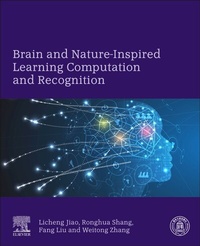
Brain and Nature-Inspired Learning, Computation and Recognition
Published on 21. January 2020
Book
Paperback/Softback
788 pages
978-0-12-819795-0 (ISBN)
Description
Brain and Nature-Inspired Learning, Computation and Recognition presents a systematic analysis of neural networks, natural computing, machine learning and compression, algorithms and applications inspired by the brain and biological mechanisms found in nature. Sections cover new developments and main applications, algorithms and simulations. Developments in brain and nature-inspired learning have promoted interest in image processing, clustering problems, change detection, control theory and other disciplines. The book discusses the main problems and applications pertaining to bio-inspired computation and recognition, introducing algorithm implementation, model simulation, and practical application of parameter setting.
Readers will find solutions to problems in computation and recognition, particularly neural networks, natural computing, machine learning and compressed sensing. This volume offers a comprehensive and well-structured introduction to brain and nature-inspired learning, computation, and recognition.
Readers will find solutions to problems in computation and recognition, particularly neural networks, natural computing, machine learning and compressed sensing. This volume offers a comprehensive and well-structured introduction to brain and nature-inspired learning, computation, and recognition.
More details
Language
English
Place of publication
United States
Target group
Professional and scholarly
Primary audience: Researchers and advanced students in brain and nature-inspired learning, intelligent control, natural computing, machine learning, compressed sensing, signal processing, and image processing; Data scientists and those interested in statistical learning.
Secondary audience: Researchers and postgraduate students in education
Illustrations
Approx. 320 illustrations (240 in full color)
Dimensions
Height: 235 mm
Width: 191 mm
Weight
1860 gr
ISBN-13
978-0-12-819795-0 (9780128197950)
Copyright in bibliographic data and cover images is held by Nielsen Book Services Limited or by the publishers or by their respective licensors: all rights reserved.
Schweitzer Classification
Other editions
Additional editions
Licheng Jiao | Ronghua Shang | Fang Liu
Brain and Nature-Inspired Learning, Computation and Recognition
E-Book
01/2020
Elsevier
€220.00
Available for download
Persons
Licheng Jiao is Distinguished Professor of the School of Artificial Intelligence at Xidian University in Xi'an, China. He is IEEE Fellow, IET Fellow. He is also the vice president of CAAI, the chairman of awards and recognition committee, the Councilor of the Chinese Institute of Electronics, and an expert of academic degrees committee of the state council. Ronghua Shang is Professor of the School of Artificial Intelligence at Xidian University. She has authored or co-authored 5 monographs and 80 papers. Fang Liu is a Professor of the School of Artificial Intelligence at Xidian University. She has authored or co-authored over 10 monographs and over 80 papers. Weitong Zhang is a PhD researcher in the School of Artificial Intelligence at Xidian University. Her research focuses on dynamic complex networks and she has published several papers in the field.
Author
Distinguished Professor, School of Artificial Intelligence, Xidian University, Xi'an, China.
Professor, School of Artificial Intelligence, Xidian University, Xi'an, China
Professor, School of Artificial Intelligence, Xidian University, Xi'an, China
PhD researcher, School of Artificial Intelligence, Xidian University, Xi'an, China
Content
1. Introduction2. The models and structure of neural network3. Theoretical Basis of Natural Computation4. Theoretical basis of machine learning5. Theoretical basis of compressive sensing6. SAR image7. POLSAR Image Classification8. Hyperspectral Image9. Multiobjective Evolutionary Algorithm (MOEA) based Sparse Clustering10. MOEA Based Community Detection11. Evolutionary Computation Based Multiobjective Capacitated Arc Routing Optimizations12. Multiobjective Optimization Algorithm Based Image Segmentation13. Graph regularized Feature Selection based on spectral learning and subspace learning14. Semi-supervised learning based on mixed knowledge information and nuclear norm regularization15. Fast clustering methods based on learning spectral embedding16. Fast clustering methods based on affinity propagation and density-weighted17. SAR image processing based on similarity measure and discriminant feature learning18. Hyperspectral image processing based on sparse learning and sparse graph19. Non-convex compressed sensing framework based on block strategy and overcomplete dictionary20. The sparse representation combined with FCM in compressed sensing21. Compressed sensing by collaborative reconstruction22. Hyperspectral image classification based on spectral information divergence and sparse representation