

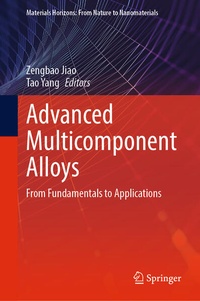
Advanced Multicomponent Alloys
Description
This book integrates aspects of computational materials science, physical metallurgy, alloy design, structure-properties relationships, and applications of advanced multicomponent alloys. It can serve as a textbook for courses on advanced structural and functional materials for undergraduate and graduate students. Notably, the book compiles cutting-edge research on the progress of materials science of multicomponent alloys from fundamentals to engineering applications. It can be of considerable interest for researchers and scientists in the field of materials science and engineering, mechanical engineering, and metallurgy engineering. In addition, this book not only summarizes the compositions, properties, and applications of various types of multicomponent alloys but also presents a complete idea on the efficient design of materials and processes to satisfy targeted performance in materials and structures. Thus, it can also be used as a reference book for engineers and researchers in industries.
More details
Other editions
Additional editions
Persons
Dr. Tao Yang is currently an Assistant Professor at the Department of Materials Science and Engineering in City University of Hong Kong. Dr. YANG has achieved many high-impact researches (H-index of 23), which have been published in various top journals like Science (2 papers as the first author, 1 as the corresponding author), Advanced Materials (1), Materials Today (1), Nature Communications (2), and Acta Materialia (9) and Scripta Materialia (9), etc. His research focuses on the innovative design and fabrication of advanced metallic materials for structural and functional applications, including the high-entropy alloys, intermetallic materials, high-temperature superalloys, deep cryogenic alloys, and electrocatalysis materials. His current work is primarily focused on the control of nanoprecipitation, grain-boundary characters, and atomic structures by using multiple state-of-the-art techniques, such as the 3D atom probe tomography (3D-APT), high-resolution transmission electron microscope (HR-TEM), and 3D printing. He is now responsible for the teaching on materials science to both undergraduate and postgraduate students, like the course of Advanced Structural Materials.