

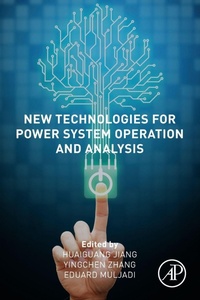
New Technologies for Power System Operation and Analysis
Published on 21. October 2020
Book
Paperback/Softback
388 pages
978-0-12-820168-8 (ISBN)
Description
New Technologies for Power System Operation and Analysis considers the very latest developments in renewable energy integration and system operation, including electricity markets and wide-area monitoring systems and forecasting. Helping readers quickly grasp the essential information needed to address renewable energy integration challenges, this new book looks at basic power system mathematical models, advanced renewable integration and system optimizations from transmission and distribution system sides. Sections cover wind, solar, gas and petroleum, making this a useful reference for all engineers interested in power system operation.
More details
Language
English
Place of publication
San Diego
United States
Publishing group
Elsevier Science Publishing Co Inc
Target group
Professional and scholarly
Modern power system engineers, technology analysers, professional researchers and engineers
Product notice
Paperback (trade)
Illustrations
Approx. 150 illustrations
Dimensions
Height: 229 mm
Width: 152 mm
Thickness: 20 mm
Weight
519 gr
ISBN-13
978-0-12-820168-8 (9780128201688)
Copyright in bibliographic data and cover images is held by Nielsen Book Services Limited or by the publishers or by their respective licensors: all rights reserved.
Schweitzer Classification
Other editions
Additional editions
Huaiguang Jiang | Yingchen Zhang | Eduard Muljadi
New Technologies for Power System Operation and Analysis
E-Book
10/2020
Academic Press
€127.00
Available for download
Persons
Dr. Huaiguang Jiang is a Professor with School of Future Technology in South China University of Technology, focusing on energy technology, smart city, and artificial intelligence for science ?AI4S?, which aims modeling of complex relational structures of large interconnected systems, multi-scale systems such as graphs and networks, ranging from protein interactions within cells to human social interactions in society, to help achieve the strategy of "carbon peak and carbon neutrality".
As an IEEE senior member, he published more than 60 papers in top academic conferences or journals such as IEEE Transactions/CVPR/Applied Energy. He used to work at NREL (National Renewable Energy Laboratory, CO, US) as an research engineer.
Dr. Yingchen Zhang is a group manager leading the Sensing and Predictive Analytics Group of Power System Engineering Center at National Renewable Energy Laboratory. He has more than 10 years of experience in the electric power industry in the areas of power systems sensing and monitoring, operation and planning, and renewable integration at NREL and CAISO. He has authored more than 60 peer-reviewed publications and holds one U.S. patent. His key areas of expertise are in sensing, measurement and data analytics in power systems' applications, advanced energy management systems for future grids. Eduard Muljadi (Fellow, IEEE) received the Ph.D. degree in electrical engineering from the University of Wisconsin, Madison, WI, USA, in 1987. He was a Faculty with the California State University, Fresno, CA, USA, from 1988 to 1992. From 1992 to 2017, he was with the National Renewable Energy Laboratory, Golden, CO, USA. And, in January 2018, he was with Auburn University, Auburn, AL, USA, as the James J. Danaher Distinguished Professor. He holds patents in power conversion for renewable energy. His research interests include electric machines, power electronics and power systems, and renewable energy. Dr. Muljadi is a Member of Eta Kappa Nu and Sigma Xi, and an Editor for the IEEE Transactions on Energy Conversion. He is a Founding Member and the past Chair of Renewable Energy Machines and Systems and the Chair of the Advanced Pumped Storage Hydropower Modeling Task Force within the PES.
As an IEEE senior member, he published more than 60 papers in top academic conferences or journals such as IEEE Transactions/CVPR/Applied Energy. He used to work at NREL (National Renewable Energy Laboratory, CO, US) as an research engineer.
Dr. Yingchen Zhang is a group manager leading the Sensing and Predictive Analytics Group of Power System Engineering Center at National Renewable Energy Laboratory. He has more than 10 years of experience in the electric power industry in the areas of power systems sensing and monitoring, operation and planning, and renewable integration at NREL and CAISO. He has authored more than 60 peer-reviewed publications and holds one U.S. patent. His key areas of expertise are in sensing, measurement and data analytics in power systems' applications, advanced energy management systems for future grids. Eduard Muljadi (Fellow, IEEE) received the Ph.D. degree in electrical engineering from the University of Wisconsin, Madison, WI, USA, in 1987. He was a Faculty with the California State University, Fresno, CA, USA, from 1988 to 1992. From 1992 to 2017, he was with the National Renewable Energy Laboratory, Golden, CO, USA. And, in January 2018, he was with Auburn University, Auburn, AL, USA, as the James J. Danaher Distinguished Professor. He holds patents in power conversion for renewable energy. His research interests include electric machines, power electronics and power systems, and renewable energy. Dr. Muljadi is a Member of Eta Kappa Nu and Sigma Xi, and an Editor for the IEEE Transactions on Energy Conversion. He is a Founding Member and the past Chair of Renewable Energy Machines and Systems and the Chair of the Advanced Pumped Storage Hydropower Modeling Task Force within the PES.
Content
1. Power system basic mathematical model power flow computation static security analysis
2. Renewable energy integration and system operation (focusing on optimization and control)
3. Modern electricity market
4. Wide area monitoring of modern power systems (Big data)
5. Modern forecasting technology
6. Multi-energy sources integration
7. Multi-system integration
2. Renewable energy integration and system operation (focusing on optimization and control)
3. Modern electricity market
4. Wide area monitoring of modern power systems (Big data)
5. Modern forecasting technology
6. Multi-energy sources integration
7. Multi-system integration