

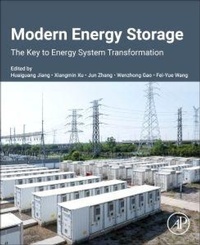
Modern Energy Storage
The Key to Energy System Transformation
Will be published approx. on 22. June 2026
Book
Paperback/Softback
350 pages
978-0-323-95419-8 (ISBN)
Description
Modern Energy Storage: The Key to Energy System Transformation is a unique reference designed to give students and researchers the most advanced information on technologies in energy storage systems.
Energy storage is a complex system, often containing several energy storage techniques to complement each other. This reference covers those techniques by looking at li-ion battery-based energy storage systems and all indispensable technologies in different scenarios or real applications including Compressed Air Storage, Power to gas systems, Pumped Thermal, Liquid Air Storage, Thermochemical storage, and more.
Compiled by global experts and considering latest advances related to full recyclable process, second use, pollution reduction, and low-carbon industry & economy, which will boost the real applications of the energy storage systems. By addressing the current challenges of energy storage technologies and potential solutions, this comprehensive text uses algorithms, methods, and programs as a technical-encyclopedia for energy-storage-related areas such as Electric vehicles, Intelligent Transportation, Environment, and smart cities.
Designed to inform, advise, and create discussion about the energy transition, climate, low carbon power and economy, the contributors provide abundant and valuable materials and references for the students, researchers, engineers, professors in in energy, engineering and environmental areas.
Energy storage is a complex system, often containing several energy storage techniques to complement each other. This reference covers those techniques by looking at li-ion battery-based energy storage systems and all indispensable technologies in different scenarios or real applications including Compressed Air Storage, Power to gas systems, Pumped Thermal, Liquid Air Storage, Thermochemical storage, and more.
Compiled by global experts and considering latest advances related to full recyclable process, second use, pollution reduction, and low-carbon industry & economy, which will boost the real applications of the energy storage systems. By addressing the current challenges of energy storage technologies and potential solutions, this comprehensive text uses algorithms, methods, and programs as a technical-encyclopedia for energy-storage-related areas such as Electric vehicles, Intelligent Transportation, Environment, and smart cities.
Designed to inform, advise, and create discussion about the energy transition, climate, low carbon power and economy, the contributors provide abundant and valuable materials and references for the students, researchers, engineers, professors in in energy, engineering and environmental areas.
More details
Language
English
Place of publication
Oxford
United Kingdom
Publishing group
Elsevier Science & Technology
Target group
College/higher education
Professional and scholarly
Product notice
Paperback (trade)
Unsewn / adhesive bound
Dimensions
Height: 229 mm
Width: 152 mm
ISBN-13
978-0-323-95419-8 (9780323954198)
Copyright in bibliographic data and cover images is held by Nielsen Book Services Limited or by the publishers or by their respective licensors: all rights reserved.
Schweitzer Classification
Persons
Dr. Huaiguang Jiang is a Professor with School of Future Technology in South China University of Technology, focusing on energy technology, smart city, and artificial intelligence for science ?AI4S?, which aims modeling of complex relational structures of large interconnected systems, multi-scale systems such as graphs and networks, ranging from protein interactions within cells to human social interactions in society, to help achieve the strategy of "carbon peak and carbon neutrality".
As an IEEE senior member, he published more than 60 papers in top academic conferences or journals such as IEEE Transactions/CVPR/Applied Energy. He used to work at NREL (National Renewable Energy Laboratory, CO, US) as an research engineer.
Prof. Xiangmin Xu is the President of Foshan University, in China. He was previously Vice President of South China University of Technology and the Dean of the School of Future Technology at the same institution. He is a member of the Teaching Steering Committee for Electronic Information under the Ministry of Education, Director of the Engineering Research Center for Human Data Perception of the Ministry of Education, and Director of the Guangdong Provincial Key Laboratory of Digital Human Twins. His research interests include artificial intelligence and its applications in human health and energy. He has led or undertaken more than 20 projects, including key R&D program projects of the Ministry of Science and Technology, joint funds of the National Natural Science Foundation of China, major projects in Guangdong Province, and key enterprise-commissioned projects. He has published over 70 papers in top journals and conferences in the field, with his most-cited single paper receiving near 4,000 citations, and holds more than 50 authorized invention patents. He won the First Prize of the Guangdong Provincial Natural Science Awards in 2023.
Dr. Jun Zhang is a Professor in the School of Electrical Engineering and Automation, at Wuhan University, in China. He is a Recipient of the Yang Jiachi Science and Technology Award and formerly served as a tenured Associate Professor at the University of Denver, USA. Currently, he is Chair of the IEEE Wuhan Section, Vice Chairman of the Technical Committee on Hybrid Intelligence, Chinese Association of Automation (CAA), Director of the Wuhan Automation Engineering Technology Research Center, Associate Editor of the Journal of Intelligent Science and Technology, Member of the Editorial Board of Acta Automatica Sinica (Chinese and English editions), and Member of the Editorial Board of IEEE Transactions on Computational Social Systems. He has presided over and participated in dozens of national, ministerial and provincial-level research projects, and has won a number of international, ministerial, provincial and industrial awards.
Dr. Wenzhong Gao is a Full Professor of Electrical Engineering, at the University of Denver, Colorado, in the United States. He received his M.S. and Ph.D. degrees in electrical and computer engineering, specializing in electric power engineering, from Georgia Institute of Technology, Atlanta, USA, in 1999 and 2002, respectively. His current teaching and research interests include renewable energy and distributed generation, artificial intelligence applications, microgrid, smart grid, power system protection, power electronics applications in power systems, power system modeling and simulation, and hybrid electric propulsion systems. He is an Associate Editor for IEEE Transactions on Intelligent Systems and Vice Editor in Chief for Journal of Modern Power Systems and Clean Energy. He was an editor of IEEE Transactions on Sustainable Energy.
Prof. Fei-Yue Wang is the State Specially Appointed Expert and the Founding Director of the State Key Laboratory for Management and Control of Complex Systems, Institute of Automation, Chinese Academy of Sciences, in China. He is also a research Professor at the DeSci Center of Parallel Intelligence, Obuda University, Budapest, Hungary. His research focuses on intelligent control, social computing, and knowledge automation, with a particular emphasis on energy and complex systems. He pioneered the concepts of Social Energy and the Parallel Energy initiative, aimed at integrating social intelligence into energy management and optimization. Additionally, his research explores methods and applications for parallel intelligence, social computing, and knowledge automation. He is a Fellow of INCOSE, IFAC, ASME, and AAAS. In 2007, he received the National Prize in Natural Sciences of China, numerous best papers awards from IEEE Transactions, and became an Outstanding Scientist of ACM for his work in intelligent control and social computing. In 2024, he received IEEE CRFID Emily Sopensky Meritorious Service Award, IEEE SMC Lotfi A. Zadeh Pioneer Award, and 2025 IEEE Transportation Technologies Award. In 2025, he received IEEE ITSS Lifetime Achievement Award. Additionally, in 2021, he was selected as the IFAC Pavel J. Nowacki Distinguished Lecturer.
As an IEEE senior member, he published more than 60 papers in top academic conferences or journals such as IEEE Transactions/CVPR/Applied Energy. He used to work at NREL (National Renewable Energy Laboratory, CO, US) as an research engineer.
Prof. Xiangmin Xu is the President of Foshan University, in China. He was previously Vice President of South China University of Technology and the Dean of the School of Future Technology at the same institution. He is a member of the Teaching Steering Committee for Electronic Information under the Ministry of Education, Director of the Engineering Research Center for Human Data Perception of the Ministry of Education, and Director of the Guangdong Provincial Key Laboratory of Digital Human Twins. His research interests include artificial intelligence and its applications in human health and energy. He has led or undertaken more than 20 projects, including key R&D program projects of the Ministry of Science and Technology, joint funds of the National Natural Science Foundation of China, major projects in Guangdong Province, and key enterprise-commissioned projects. He has published over 70 papers in top journals and conferences in the field, with his most-cited single paper receiving near 4,000 citations, and holds more than 50 authorized invention patents. He won the First Prize of the Guangdong Provincial Natural Science Awards in 2023.
Dr. Jun Zhang is a Professor in the School of Electrical Engineering and Automation, at Wuhan University, in China. He is a Recipient of the Yang Jiachi Science and Technology Award and formerly served as a tenured Associate Professor at the University of Denver, USA. Currently, he is Chair of the IEEE Wuhan Section, Vice Chairman of the Technical Committee on Hybrid Intelligence, Chinese Association of Automation (CAA), Director of the Wuhan Automation Engineering Technology Research Center, Associate Editor of the Journal of Intelligent Science and Technology, Member of the Editorial Board of Acta Automatica Sinica (Chinese and English editions), and Member of the Editorial Board of IEEE Transactions on Computational Social Systems. He has presided over and participated in dozens of national, ministerial and provincial-level research projects, and has won a number of international, ministerial, provincial and industrial awards.
Dr. Wenzhong Gao is a Full Professor of Electrical Engineering, at the University of Denver, Colorado, in the United States. He received his M.S. and Ph.D. degrees in electrical and computer engineering, specializing in electric power engineering, from Georgia Institute of Technology, Atlanta, USA, in 1999 and 2002, respectively. His current teaching and research interests include renewable energy and distributed generation, artificial intelligence applications, microgrid, smart grid, power system protection, power electronics applications in power systems, power system modeling and simulation, and hybrid electric propulsion systems. He is an Associate Editor for IEEE Transactions on Intelligent Systems and Vice Editor in Chief for Journal of Modern Power Systems and Clean Energy. He was an editor of IEEE Transactions on Sustainable Energy.
Prof. Fei-Yue Wang is the State Specially Appointed Expert and the Founding Director of the State Key Laboratory for Management and Control of Complex Systems, Institute of Automation, Chinese Academy of Sciences, in China. He is also a research Professor at the DeSci Center of Parallel Intelligence, Obuda University, Budapest, Hungary. His research focuses on intelligent control, social computing, and knowledge automation, with a particular emphasis on energy and complex systems. He pioneered the concepts of Social Energy and the Parallel Energy initiative, aimed at integrating social intelligence into energy management and optimization. Additionally, his research explores methods and applications for parallel intelligence, social computing, and knowledge automation. He is a Fellow of INCOSE, IFAC, ASME, and AAAS. In 2007, he received the National Prize in Natural Sciences of China, numerous best papers awards from IEEE Transactions, and became an Outstanding Scientist of ACM for his work in intelligent control and social computing. In 2024, he received IEEE CRFID Emily Sopensky Meritorious Service Award, IEEE SMC Lotfi A. Zadeh Pioneer Award, and 2025 IEEE Transportation Technologies Award. In 2025, he received IEEE ITSS Lifetime Achievement Award. Additionally, in 2021, he was selected as the IFAC Pavel J. Nowacki Distinguished Lecturer.
Editor
South China University of Technology, China
President, Foshan University, China
School of Electrical Engineering and Automation, Wuhan University, China
Department of Electrical & Computer Engineering, University of Denver, Colorado, USA
Institute of Automation, Chinese Academy of Sciences, Beijing, China
Content
1. History and development of Energy Storage
2. Energy Storage basic
3. Fundamentals of Lithium-ion battery
4. Advanced Researches of Lithium-ion Battery
5. Real Applications of Lithium-ion Battery
6. Mechanical and Electrical Energy Storage
7. Chemical and Biological Energy Storage
8. Advanced Technologies in Energy Storage
9. Low Carbon Development and Impactions with Energy Storage
2. Energy Storage basic
3. Fundamentals of Lithium-ion battery
4. Advanced Researches of Lithium-ion Battery
5. Real Applications of Lithium-ion Battery
6. Mechanical and Electrical Energy Storage
7. Chemical and Biological Energy Storage
8. Advanced Technologies in Energy Storage
9. Low Carbon Development and Impactions with Energy Storage