

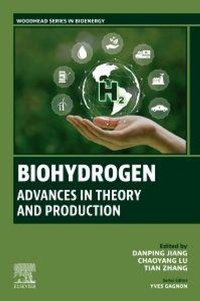
Biohydrogen
Advances in Theory and Production
Will be published approx. on 1. October 2026
Book
Paperback/Softback
275 pages
978-0-443-27686-6 (ISBN)
Description
Biohydrogen: Advances in Theory and Production is a comprehensive guide to the theory and methodology of biohydrogen production, highlighting its potential to contribute to a sustainable and eco-friendly society. The book explores the environmental advantages of biohydrogen over other energy sources and its role in reducing CO2 emissions, making it a crucial component in the transition to renewable energy. It systematically introduces the production processes, including biophotolysis, microbial electrolysis cells, photo-fermentation, dark fermentation, and combined dark-photo fermentation.
Each chapter discusses a different method for biohydrogen production, covering the theory and methodology, substrate types, reactor structures, operational parameters, and net zero effects. The book also includes case studies of actual biohydrogen production projects, providing practical insights and real-world applications for each production method. Additionally, it provides an economic analysis and sustainability of biohydrogen production, comparing different methods via life cycle assessment and discussing the environmental and socio-economic risks.
Each chapter discusses a different method for biohydrogen production, covering the theory and methodology, substrate types, reactor structures, operational parameters, and net zero effects. The book also includes case studies of actual biohydrogen production projects, providing practical insights and real-world applications for each production method. Additionally, it provides an economic analysis and sustainability of biohydrogen production, comparing different methods via life cycle assessment and discussing the environmental and socio-economic risks.
More details
Series
Language
English
Place of publication
United States
Publishing group
Elsevier - Health Sciences Division
Target group
Professional and scholarly
Dimensions
Height: 229 mm
Width: 152 mm
ISBN-13
978-0-443-27686-6 (9780443276866)
Copyright in bibliographic data and cover images is held by Nielsen Book Services Limited or by the publishers or by their respective licensors: all rights reserved.
Schweitzer Classification
Persons
Dr. Danping Jiang was a joint-training PhD student between Henan Agricultural University and The Ohio State University (USA). Her research focuses on bioenergy production including biohydrogen production, biomethane production, and biomethanol production. She has also authored or co-authored more than 50 papers in the leading refereed journals, edited a book focusing on bioenergy production, and contributed 5 book chapters. Her experience in bioenergy production and her network of experts on the topic will help the identification of suitable and important researchers with specific reference to biohydrogen production.
Dr. Chaoyang Lu engages in research on biohydrogen production, bioreactor design, and biomass energy conversion. Until now, he has presided over 13 national and provincial scientific research projects. He has also published 2 International Patent and 11 Chinese patents. As the first author, he has published more than 20 academic papers on Applied energy, Bioresource Technology, etc. Additionally, he has published one English academic monograph and one Chinese academic monograph.
Tian Zhang is a lecturer of Agricultural Biological Environment and Energy Engineering at the Department of Mechanical and Electrical Engineering, The Henan Agricultural University.
Her research mainly focuses on biohydrogen production, especially nanoparticle enhanced photo-fermentative hydrogen production. She has authored or co-authored more than 30 papers in the leading refereed journals, and participated in the writing of 3 books. Her experience in bioenergy production and her network of experts on the topic will help the identification of suitable and important researchers with specific reference to biohydrogen production.
Dr. Chaoyang Lu engages in research on biohydrogen production, bioreactor design, and biomass energy conversion. Until now, he has presided over 13 national and provincial scientific research projects. He has also published 2 International Patent and 11 Chinese patents. As the first author, he has published more than 20 academic papers on Applied energy, Bioresource Technology, etc. Additionally, he has published one English academic monograph and one Chinese academic monograph.
Tian Zhang is a lecturer of Agricultural Biological Environment and Energy Engineering at the Department of Mechanical and Electrical Engineering, The Henan Agricultural University.
Her research mainly focuses on biohydrogen production, especially nanoparticle enhanced photo-fermentative hydrogen production. She has authored or co-authored more than 30 papers in the leading refereed journals, and participated in the writing of 3 books. Her experience in bioenergy production and her network of experts on the topic will help the identification of suitable and important researchers with specific reference to biohydrogen production.
Content
1. Introduction-Hydrogen
2. Biohydrogen Production from Biophotolysis
3. Microbial Electrolysis Cell for Biohydrogen Production
4. Dark Fermentation Biohydrogen Production from Organic Matters
5. Photo-Fermentation Biohydrogen Production from Organic Matters
6. Combined Dark-Photo Fermentation Biohydrogen Production from Organic Matters
7. Prospects of Biohydrogen
2. Biohydrogen Production from Biophotolysis
3. Microbial Electrolysis Cell for Biohydrogen Production
4. Dark Fermentation Biohydrogen Production from Organic Matters
5. Photo-Fermentation Biohydrogen Production from Organic Matters
6. Combined Dark-Photo Fermentation Biohydrogen Production from Organic Matters
7. Prospects of Biohydrogen