

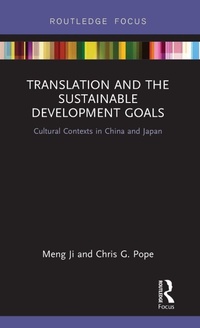
Translation and the Sustainable Development Goals
Cultural Contexts in China and Japan
1st Edition
Published on 19. February 2019
Book
Hardback
8 pages
978-0-367-20072-5 (ISBN)
Description
This book offers insight into the use of empirical diffusionist models for analysis of cross-cultural and cross-national communication, translation and adaptation of the United Nation's (UN) Sustainable Development Goals (SDGs).
The book looks at three social analytical instruments of particular utility for the cross-national study of the translation and diffusion of global sustainable development discourses in East Asia (China and Japan). It explains the underlying hypothesis that, in the transmission and adaptation of global SDGs in different national contexts, three large groups of social actors encompassing sources of information, mediating actors and socio-industrial end-users form, shape and contribute to the complex, latent networks of social engagement. It illuminates how the distribution within these networks largely determines the level and breadth of the diffusion of global SDGs and their associated environmentalist norms.
This book is an essential read for anyone interested in sustainable growth and development, as well as global environmental politics.
The book looks at three social analytical instruments of particular utility for the cross-national study of the translation and diffusion of global sustainable development discourses in East Asia (China and Japan). It explains the underlying hypothesis that, in the transmission and adaptation of global SDGs in different national contexts, three large groups of social actors encompassing sources of information, mediating actors and socio-industrial end-users form, shape and contribute to the complex, latent networks of social engagement. It illuminates how the distribution within these networks largely determines the level and breadth of the diffusion of global SDGs and their associated environmentalist norms.
This book is an essential read for anyone interested in sustainable growth and development, as well as global environmental politics.
More details
Series
Language
English
Place of publication
London
United Kingdom
Publishing group
Taylor & Francis Ltd
Target group
College/higher education
General and Postgraduate
Illustrations
3 s/w Abbildungen, 3 s/w Zeichnungen, 21 s/w Tabellen
21 Tables, black and white; 3 Line drawings, black and white; 3 Illustrations, black and white
Dimensions
Height: 222 mm
Width: 145 mm
Thickness: 11 mm
Weight
304 gr
ISBN-13
978-0-367-20072-5 (9780367200725)
Copyright in bibliographic data and cover images is held by Nielsen Book Services Limited or by the publishers or by their respective licensors: all rights reserved.
Schweitzer Classification
Other editions
Additional editions
Meng Ji | Chris G. Pope
Translation and the Sustainable Development Goals
Cultural Contexts in China and Japan
Book
09/2020
1st Edition
Routledge
€30.94
Shipment within 15-20 days
Meng Ji | Chris G. Pope
Translation and the Sustainable Development Goals
Cultural Contexts in China and Japan
E-Book
02/2019
1st Edition
Routledge
€32.99
Available for download
Meng Ji | Chris G. Pope
Translation and the Sustainable Development Goals
Cultural Contexts in China and Japan
E-Book
02/2019
Routledge
€32.99
Available for download
Persons
Meng Ji is Associate Professor at the School of Languages and Cultures at The University of Sydney.
Chris G. Pope is Assistant Professor at Kyoto Women's University, specializing in East Asian politics and communication.
Chris G. Pope is Assistant Professor at Kyoto Women's University, specializing in East Asian politics and communication.
Content
Introduction. 1. The Growing Sustainability Discourse. 2. Social Diffusion of the Sustainability Discourse. 3. Current Developments towards Renewable Energy. 4. Development of Clean Energy in China and Japan. 5. Translation. 6. Multi-Sectoral Interaction for Social Diffusion of SDGs. 7. Corpus Research Methodologies. 8. Sustainable Living Discourse in China. 9. Diffusion of Sustainable Living Discourse in China and Japan. Conclusion. Appendices. References.