

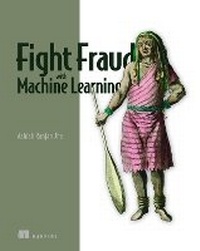
Fight Fraud with Machine Learning
Published on 4. March 2026
Book
Paperback/Softback
387 pages
978-1-63343-822-4 (ISBN)
Description
Fraudsters adapt daily; your defenses must evolve even faster. Stop revenue leaks before they cripple your business. Move beyond rules and guesswork toward data-driven certainty. Turn raw transaction streams into clear, actionable fraud signals. Master proven Python workflows used by top fintech security teams. Guard customers, profits, and reputation with confidence.
Rule-based foundations: Build quick wins and create reliable baselines for later models.
Classical algorithms: Use logistic regression and decision trees to flag card and transaction anomalies.
Ensemble power: Apply random forests and gradient boosted trees for higher recall with fewer false positives.
Deep learning: Deploy neural networks, vision transformers, and graph CNNs to catch modern, multi-channel attacks.
Real datasets: Follow complete, annotated Python notebooks ready for adaptation to your production stack.
Evaluation playbook: Measure accuracy, precision, recall, and cost impact to justify every security investment.
Fight Fraud with Machine Learning by Ashish Ranjan Jha is a guide that combines academic research with battle-tested industry practice. Jha draws on a decade at Oracle, Sony, Revolut, and Tractable to deliver clear, reproducible solutions.
The book progresses from simple rules to cutting-edge deep-learning approaches, each chapter adding complexity and capability. Step-by-step labs, code listings, and annotated diagrams let readers learn by doing. Case studies span credit cards, KYC, and social bots, illustrating breadth and depth.
Finish the final chapter ready to deploy robust models that slash fraud losses, impress auditors, and protect customer trust. Your new skill set will translate directly into safer products and stronger career prospects.
Ideal for data scientists, ML engineers, and fraud-prevention product managers comfortable with Python.
Rule-based foundations: Build quick wins and create reliable baselines for later models.
Classical algorithms: Use logistic regression and decision trees to flag card and transaction anomalies.
Ensemble power: Apply random forests and gradient boosted trees for higher recall with fewer false positives.
Deep learning: Deploy neural networks, vision transformers, and graph CNNs to catch modern, multi-channel attacks.
Real datasets: Follow complete, annotated Python notebooks ready for adaptation to your production stack.
Evaluation playbook: Measure accuracy, precision, recall, and cost impact to justify every security investment.
Fight Fraud with Machine Learning by Ashish Ranjan Jha is a guide that combines academic research with battle-tested industry practice. Jha draws on a decade at Oracle, Sony, Revolut, and Tractable to deliver clear, reproducible solutions.
The book progresses from simple rules to cutting-edge deep-learning approaches, each chapter adding complexity and capability. Step-by-step labs, code listings, and annotated diagrams let readers learn by doing. Case studies span credit cards, KYC, and social bots, illustrating breadth and depth.
Finish the final chapter ready to deploy robust models that slash fraud losses, impress auditors, and protect customer trust. Your new skill set will translate directly into safer products and stronger career prospects.
Ideal for data scientists, ML engineers, and fraud-prevention product managers comfortable with Python.
Reviews / Votes
Overall, if you're serious about modern fraud detection, from tabular ML to deep-fake audio, you'll dog-ear plenty of pages and keep this book within arm's reach.Manav Kapoor, Senior Technical Product Manager, Amazon
This book aligns very well with the growing interest in using machine learning and AI to detect and prevent fraud. It covers a wide range of practical use cases that reflect real-world challenges across industries, from identity fraud and document forgery to transaction monitoring and phishing detection.
Hatim Kagalwala, Applied Scientist, Amazon
More details
Language
English
Place of publication
New York
United States
Target group
Professional and scholarly
Product notice
Paperback (trade)
Unsewn / adhesive bound
Weight
463 gr
ISBN-13
978-1-63343-822-4 (9781633438224)
Copyright in bibliographic data and cover images is held by Nielsen Book Services Limited or by the publishers or by their respective licensors: all rights reserved.
Schweitzer Classification
Other editions
Additional editions
Ashish Ranjan Jha
Fight Fraud with Machine Learning
E-Book
approx. 01/2027
Simon + Schuster LLC
€43.51
Not yet available
Person
Ashish Ranjan Jha is a veteran machine-learning engineer known for turning complex fraud problems into practical solutions. With ten years at Oracle, Sony, Revolut, and Tractable, he brings clarity and real-world rigor to every page. Jha distills enterprise-scale ML experience into actionable guidance that helps readers stop fraud fast.
Content
1 WHAT IS FRAUD AND FRAUD DETECTION?
PART 1: LEARNING THE BASICS
2 RULE-BASED FRAUD DETECTION: A PHISHING EXAMPLE
3 FRAUD DETECTION ON TABULAR DATA USING CLASSICAL ML
4 DEEP LEARNING FOR FRAUD DETECTION
PART 2: MULTIMODAL AI FOR SOPHISTICATED FRAUD
5 DETECTING PHISHING WITH LLM
6 DOCUMENT FORGERY DETECTION USING COMPUTER VISION
7 KYC FRAUD DETECTION USING DEEP LEARNING
8 DETECT VOICE FAKING USING TRANSFORMERS
9 ANTI-MONEY LAUNDERING FOR BITCOIN TRANSACTIONS USING GRAPH ATTENTION NETWORK
APPENDIXES
APPENDIX A: FUNDAMENTALS OF CLASSICAL ML FOR FRAUD DETECTION
APPENDIX B: RUNDOWN OF VARIOUS CLASSICAL ML MODELS FOR PHISHING DETECTION
APPENDIX C: DETECT FAKE INSURANCE CLAIMS USING DIFFERENT IMPLEMENTATIONS OF GRADIENT- BOOSTED TREES
PART 1: LEARNING THE BASICS
2 RULE-BASED FRAUD DETECTION: A PHISHING EXAMPLE
3 FRAUD DETECTION ON TABULAR DATA USING CLASSICAL ML
4 DEEP LEARNING FOR FRAUD DETECTION
PART 2: MULTIMODAL AI FOR SOPHISTICATED FRAUD
5 DETECTING PHISHING WITH LLM
6 DOCUMENT FORGERY DETECTION USING COMPUTER VISION
7 KYC FRAUD DETECTION USING DEEP LEARNING
8 DETECT VOICE FAKING USING TRANSFORMERS
9 ANTI-MONEY LAUNDERING FOR BITCOIN TRANSACTIONS USING GRAPH ATTENTION NETWORK
APPENDIXES
APPENDIX A: FUNDAMENTALS OF CLASSICAL ML FOR FRAUD DETECTION
APPENDIX B: RUNDOWN OF VARIOUS CLASSICAL ML MODELS FOR PHISHING DETECTION
APPENDIX C: DETECT FAKE INSURANCE CLAIMS USING DIFFERENT IMPLEMENTATIONS OF GRADIENT- BOOSTED TREES