

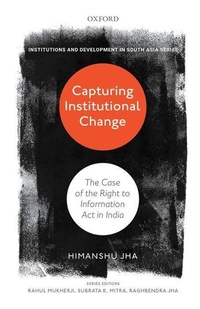
Capturing Institutional Change
The Case of the Right to Information Act in India
Published on 27. January 2021
Book
Hardback
344 pages
978-0-19-012478-6 (ISBN)
Description
Institutions are norms that undergird organizations and are reflected in laws and practices. Over time, institutions take root and persist as they are path dependent and thus change resistant. Therefore, it is puzzling when institutions change. One such puzzle has been the enactment of the Right to Information (RTI) Act in India in 2005, which brought about institutional change by transforming the 'information regime'. Why did the government upend the norm of secrecy, which had historically been entrenched within the Indian State? This book uses archival material, internal government documents, and interviews to understand the why and how of institutional change. It demonstrates that the institutional change resulted from 'ideas' emerging gradually and incrementally, leading to a 'tipping point'.
About the IDSA Series: This series interrogates the interplay between globalization, the state, and social forces in the making and un-making of institutions in South Asia. Why do institutions persist and change? Do we need to transcend materialism and dwell in ideas and culture as well to understand why institutions perform and fail?
The first book in the Institutions and Development in South Asia series, this volume studies the historical institutionalism in the information regime in India by presenting an alternative narrative about the evolution of the RTI Act.
About the IDSA Series: This series interrogates the interplay between globalization, the state, and social forces in the making and un-making of institutions in South Asia. Why do institutions persist and change? Do we need to transcend materialism and dwell in ideas and culture as well to understand why institutions perform and fail?
The first book in the Institutions and Development in South Asia series, this volume studies the historical institutionalism in the information regime in India by presenting an alternative narrative about the evolution of the RTI Act.
Reviews / Votes
Himanshu Jha has written an illuminating account of how India enacted fundamental changes to the country's information regime... The deeper understanding this book provides about how India's information regime was liberalized may aid the process of restoring the rights that have so quickly eroded. * Rob Jenkins, Pacific Affairs *More details
Series
Language
English
Place of publication
New Delhi
India
Product notice
sewn/stitched
Cloth over boards
Illustrations
Tables, 10
Dimensions
Height: 221 mm
Width: 145 mm
Thickness: 30 mm
Weight
499 gr
ISBN-13
978-0-19-012478-6 (9780190124786)
Copyright in bibliographic data and cover images is held by Nielsen Book Services Limited or by the publishers or by their respective licensors: all rights reserved.
Schweitzer Classification
Other editions
Additional editions

E-Book
09/2020
1st Edition
OUP
€62.70
Available for download
Persons
Himanshu Jha is with the Department of Political Science, South Asia Institute at the Heidelberg University. Jha's most recent research explores the why, how, and what of institutional change. His current research interests lies in the area of institutional change, governance, distributive politics, state capacity, bureaucratic culture and the politics of climate change.
Content
- Series Introduction
- Introduction
- 1. Nascent Ideas to Embedded Norms: Ideational Churning Within the State
- 2. Changing State Thinking: Policy Movement Towards Right To Information
- 3. Constitutional Interpretation by the Judiciary: Right to Know Inherent In Article 19 (1) (A)
- 4. Social and Political Processes of State and Society: Progressive Ideas and the Emergence of Epistemic Community
- 5. Do Global Norms Matter?
- Appendices
- Bibliography
- Index
- About the Author