

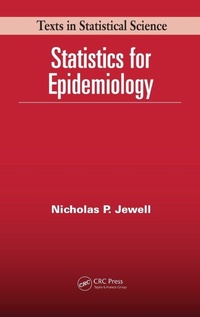
Statistics for Epidemiology
1st Edition
Published on 26. August 2003
Book
Hardback
350 pages
978-1-58488-433-0 (ISBN)
Description
Statistical ideas have been integral to the development of epidemiology and continue to provide the tools needed to interpret epidemiological studies. Although epidemiologists do not need a highly mathematical background in statistical theory to conduct and interpret such studies, they do need more than an encyclopedia of "recipes."
Statistics for Epidemiology achieves just the right balance between the two approaches, building an intuitive understanding of the methods most important to practitioners and the skills to use them effectively. It develops the techniques for analyzing simple risk factors and disease data, with step-by-step extensions that include the use of binary regression. It covers the logistic regression model in detail and contrasts it with the Cox model for time-to-incidence data. The author uses a few simple case studies to guide readers from elementary analyses to more complex regression modeling. Following these examples through several chapters makes it easy to compare the interpretations that emerge from varying approaches.
Written by one of the top biostatisticians in the field, Statistics for Epidemiology stands apart in its focus on interpretation and in the depth of understanding it provides. It lays the groundwork that all public health professionals, epidemiologists, and biostatisticians need to successfully design, conduct, and analyze epidemiological studies.
Statistics for Epidemiology achieves just the right balance between the two approaches, building an intuitive understanding of the methods most important to practitioners and the skills to use them effectively. It develops the techniques for analyzing simple risk factors and disease data, with step-by-step extensions that include the use of binary regression. It covers the logistic regression model in detail and contrasts it with the Cox model for time-to-incidence data. The author uses a few simple case studies to guide readers from elementary analyses to more complex regression modeling. Following these examples through several chapters makes it easy to compare the interpretations that emerge from varying approaches.
Written by one of the top biostatisticians in the field, Statistics for Epidemiology stands apart in its focus on interpretation and in the depth of understanding it provides. It lays the groundwork that all public health professionals, epidemiologists, and biostatisticians need to successfully design, conduct, and analyze epidemiological studies.
Reviews / Votes
"Jewell's book can certainly be included in any group of useful books on statistics in epidemiology. It actually might be the one with which I would start."-Technometrics, February 2005, Vol. 47, No. 1
"This is a useful and thought-provoking book written by an expert in the field, providing a very valuable supplement to more introductory texts as well as a guide to more advanced sources. "
-Journal of the Royal Statistics Society
"...It is a good companion text ... The numerous worked examples and references to further reading at the end of each chapter are very good ... I would find the book a useful reference for the teacher of statistical methods for epidemiology ..."
-Statistics in Medicine, 2005
"Good points of the book are the exercises, comments and further reading at the end of each chapter, the availability of the data sets used ... and the extensive discussion of confounding ... this is a good, well-written piece of work."
-Pharmaceutical Statistics, 2004
"This book is excellent; a real breakthrough in texts on statistics in epidemiology, especially in its attention to causation and bias."
-Sander Greenland, Department of Epidemiology, UCLA
"Using examples, this experienced statistician identifies scientific issues and clearly links them to statistical approaches. Statistical theory and formality are grounded in manageable yet realistic examples. Coverage includes the basics and important topics such as measurement error and causal analysis. The book has excellent references, an informative index and glossary."
-ISI Short Book Reviews, August 2004
More details
Series
Language
English
Place of publication
Oxford
United States
Publishing group
Taylor & Francis Inc
Target group
College/higher education
Undergraduate
Illustrations
47 s/w Abbildungen, 116 s/w Tabellen
116 Tables, black and white; 47 Illustrations, black and white
Dimensions
Height: 240 mm
Width: 161 mm
Thickness: 23 mm
Weight
690 gr
ISBN-13
978-1-58488-433-0 (9781584884330)
Copyright in bibliographic data and cover images is held by Nielsen Book Services Limited or by the publishers or by their respective licensors: all rights reserved.
Schweitzer Classification
Other editions
Additional editions

Jewell P.
Statistics for Epidemiology
Book
06/2004
Chapman & Hall/CRC
€98.20
Article exhausted; check different version
Nicholas P. Jewell
Statistics for Epidemiology
E-Book
08/2003
1st Edition
Chapman & Hall/CRC
€165.99
Available for download
Nicholas P. Jewell
Statistics for Epidemiology
E-Book
08/2003
1st Edition
Chapman and Hall
€165.99
Available for download
Nicholas P. Jewell
Statistics for Epidemiology
Other
Chapman and Hall/CRC
€111.01
The article will not be published
Person
Nicholas P. Jewell
Content
Introduction. Measures of Disease Occurrence. The Role of Probability on Observational Studies. Measures of Disease-Exposure Association. Study Designs. Assessing Significance in a 2 x 2 Table. Estimation and Inference for Measures of Association. Causal Inference and Extraneous Factors: Confounding and Interaction. Control of Extraneous Factors. Interaction. Exposures at Several Discrete Levels. Regression Models Relating Exposure to Disease. Estimation of Logistic Regression Model Parameters. Confounding and Interaction Within Logistic Regression Mode. Epilogue - the Examples.