

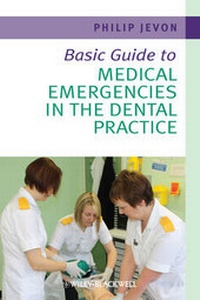
Basic Guide to Medical Emergencies in the Dental Practice
1st Edition
Published on 18. December 2009
Book
Paperback/Softback
216 pages
978-1-4051-9784-7 (ISBN)
Description
The Basic Guide to Medical Emergencies in the Dental Practice is a must have book for all dental care professionals.
Written in a clear and accessible style, chapters cover such key topics as patient assessment, adult resuscitation, respiratory and cardiac disorders, paediatric emergencies, emergency equipment and law and ethics.
* Illustrated in full colour throughout
* Follows Resuscitation Council's Guidelines
* Accessible, full colour guide
* Handy format for easy reference and portability
* Evidence-based.
Reviews / Votes
"I would recommend this book to dental profes-sionals who want to use current best practices and principles in the man-agement of medical emergencies in the dental practice. It would also be a helpful study aid to those taking under-graduate or royal college examinations. I know that I would have found it to be very helpful indeed." ( British Dental Journal , 26 October 2013) "What sets this textbook apart is its extremely well organized chapters... That is why this book is helpful, either for one who is learning emergency care for the first time or for one who simply desires to review techniques." ( Journal of the Massachusetts Dental Society, 1 July 2013) "This is a 200-page paperback, in a handy, slightly larger than AS size, and it is well-illustrated in full colour." ( BDA News , April 2010)More details
Series
Edition
1., Auflage
Language
English
Place of publication
Chicester
United Kingdom
Publishing group
John Wiley and Sons Ltd
Target group
Professional and scholarly
Illustrations
col. ill
Dimensions
Height: 23.5 cm
Width: 16.2 cm
Thickness: 11 mm
Weight
426 gr
ISBN-13
978-1-4051-9784-7 (9781405197847)
Schweitzer Classification
Other editions
Additional editions
E-Book
07/2013
Wiley-Blackwell
€31.99
Available for download
Person
Phil Jevon is Resuscitation Officer/Clinical Skills Lead at Manor Hospital, Walsall. He is a Resuscitation Council (UK) ALS, EPLS, ILS, PILS, NLS Instructor and is an Honorary Clinical Lecturer at the Birmingham School of Medicine.
Content
Foreword by Karen Elley.
Acknowledgements.
1 Medical emergencies and resuscitation in the dental practice: an overview.
Introduction.
Concept of the chain of survival.
Incidence of medical emergencies in dental practice.
General dental council guidelines on medical emergencies.
Resuscitation council (UK) statement.
ABCDE assessment of the sick patient.
Medical risk assessment in general dental practice.
Principles of safer handling during cardiopulmonary resuscitation.
Procedure for calling 999 for an ambulance.
Conclusion.
References.
2 Resuscitation equipment in the dental practice.
Introduction.
Recommended minimum resuscitation equipment in the dental practice
Checking resuscitation equipment and drugs.
Checking resuscitation equipment following use.
Conclusion.
References.
3 Recognition of the sick patient: the ABCDE approach.
Introduction.
Clinical signs of acute illness.
The ABCDE approach.
General principles of the ABCDE approach.
The ABCDE approach to the sick patient.
Principles of pulse oximetry.
Procedure for administering oxygen to the acutely ill patient.
Procedure for recording blood pressure.
Conclusion.
References.
4 Respiratory disorders.
Introduction.
Management of acute asthma attack.
Management of hyperventilation.
Management of exacerbation of chronic obstructive pulmonary disease.
Procedure for using an inhaler.
Procedure for using a spacer device.
Conclusion.
References.
5 Cardiac disorders.
Introduction.
Management of angina.
Management of myocardial infarction.
Management of palpitations.
Management of syncope.
Conclusion.
References.
6 Neurological disorders.
Introduction.
Management of a generalised tonic-clonic seizure.
Management of stroke.
Management of altered level of consciousness.
Procedure for placing a patient in the recovery position.
Spinal injury.
Conclusion.
References.
7 Endocrine disorders.
Introduction.
Management of hypoglycaemia.
Procedure for blood glucose measurement using a glucometer.
Management of adrenal insufficiency.
Conclusion.
References.
8 Anaphylaxis.
Introduction.
Definition.
Incidence.
Pathophysiology.
Causes.
Clinical features and diagnosis.
Treatment.
Conclusion.
References.
9 Cardiopulmonary resuscitation in the dental practice.
Introduction.
Resuscitation council (UK) automated external defibrillation algorithm.
Procedure for cardiopulmonary resuscitation in the dental chair.
Procedure for performing chest compressions.
Conclusion.
References.
10 Airway management and ventilation.
Introduction.
Causes of airway obstruction.
Recognition of airway obstruction.
Simple techniques to open and clear the airway.
Use of oropharyngeal airway.
Principles of ventilation.
Treatment of foreign body airway obstruction.
Conclusion.
References.
11 Automated external defibrillation.
Introduction.
Ventricular fibrillation.
Physiology of defibrillation.
Factors affecting successful defibrillation.
Safety issues and defibrillation.
Procedure for automated external defibrillation.
Conclusion.
References.
12 Paediatric emergencies.
Introduction.
ABCDE assessment of a sick child.
Principles of paediatric resuscitation.
Placing a child into the recovery position.
Management of foreign body airway obstruction.
Conclusion.
References.
13 Professional and legal issues.
Introduction.
The scope of a dental professional's accountability.
Legal requirements for consent and acting in a patient's best interests.
Duty of confidence owed to patients by dental professionals.
Conclusion.
References.
Index.