

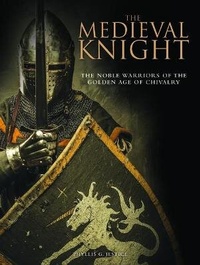
The Medieval Knight
The Noble Warriors of the Golden Age of Chivalry
Published on 14. November 2018
Book
Hardback
224 pages
978-1-78274-680-5 (ISBN)
Description
"Knighthood lies above eternity; it doesn't live off fame, but rather deeds."
Knights were the ultimate warriors in European warfare for a period of almost 500 years. From the mid eleventh century to the early 1500s, these highly trained, elite fighters dominated European battlefields with the power of the charge, a shock tactic that few enemies could withstand. But knights were more than just fighting machines: through the chivalric code, they were expected to be able to play music, write verse, be arbiters of the law, and practice courtly love - as well as support their lord and protect the people.
Arranged thematically, The Medieval Knight examines every aspect of knighthood, including training, fighting techniques, arms and armour, the various knightly orders, and the decline of the knights' dominance on the battlefield.
Cold-blooded killer or noble protector and romantic lover? Dragon slayer or terrorizer of poor folk? The knightly ideal remains a part of European culture to this day, a symbol of high ideals and noble conduct. The Medieval Knight explores the reality of what it meant to be a heavily-armed and armoured fighting man in an era when military prowess was the ultimate good. Illustrated with more than 200 colour and black-and- white photographs, maps and artworks, The Medieval Knight is an expertly written account of the elite fighting men who have long captured the popular imagination.
Knights were the ultimate warriors in European warfare for a period of almost 500 years. From the mid eleventh century to the early 1500s, these highly trained, elite fighters dominated European battlefields with the power of the charge, a shock tactic that few enemies could withstand. But knights were more than just fighting machines: through the chivalric code, they were expected to be able to play music, write verse, be arbiters of the law, and practice courtly love - as well as support their lord and protect the people.
Arranged thematically, The Medieval Knight examines every aspect of knighthood, including training, fighting techniques, arms and armour, the various knightly orders, and the decline of the knights' dominance on the battlefield.
Cold-blooded killer or noble protector and romantic lover? Dragon slayer or terrorizer of poor folk? The knightly ideal remains a part of European culture to this day, a symbol of high ideals and noble conduct. The Medieval Knight explores the reality of what it meant to be a heavily-armed and armoured fighting man in an era when military prowess was the ultimate good. Illustrated with more than 200 colour and black-and- white photographs, maps and artworks, The Medieval Knight is an expertly written account of the elite fighting men who have long captured the popular imagination.
More details
Series
Language
English
Place of publication
United Kingdom
Publishing group
Amber Books Ltd
Target group
Young adult
Interest Age: From 14 to 99 years
Product notice
With printed dust jacket
Illustrations
Index; Line drawings, black and white; Halftones, color; Halftones, black and white; Illustrations, color
Dimensions
Height: 291 mm
Width: 219 mm
Thickness: 20 mm
Weight
1250 gr
ISBN-13
978-1-78274-680-5 (9781782746805)
Copyright in bibliographic data and cover images is held by Nielsen Book Services Limited or by the publishers or by their respective licensors: all rights reserved.
Schweitzer Classification
Person
Phyllis G. Jestice is professor of medieval European history at the College of Charleston in Charleston, South Carolina. A devoted teacher, Jestice enjoys writing for both academic and popular audiences. She is the author of Queens, Pharaohs and The Medieval Knight, while her most recent monograph is Imperial Ladies of the Ottonian Dynasty: Women and Rule in Tenth-century Germany.
Content
Chapter 1: Origins of the Knight
King's bodyguard * Huscarls * Elite mounted warriors * Myth and legend: Arthur and the Round Table
Chapter 2: Chivalric Code
Knightly ethic (versed in music, poetry, law) * Courtly love * Knight in medieval literature (The Song of Roland, Parzifal)
Chapter 3: Training and Fighting Techniques
Becoming a Page * The Squire * Jousting and the Tourney * Mounted combat * Fighting on foot
Chapter 4: Armour and Weapons
The development of weapons and armour * Armour: chainmail, plate armour, types of helmet * Weapons: the lance, spear, long sword, axe, mace, spiked ball
Chapter 5: The Charge
Through the charge, heavily-armoured knights and men-at-arms could be an incredibly high-impact weapon on the battlefield. However, it could also go disastrously wrong. Examples successful charges: Hastings (1066), Arsuf
(1191), Muret (1213), Tannenberg (1410); examples of unsuccessful charges: Hattin (1187), Leignitz (1241), Nicopolis (1396), Agincourt (1415).
Chapter 6: Knightly Orders
Knights Templars * Knights Hospitallers * Knights of St John * Teutonic knights * Order of Santiago
Chapter 7: Epilogue: The End of the Knight
Introduction of missile weapons (longbow, gunpowder weapons) * Pole arms * New dominance of infantry warfare * Changing ethics in warfare
Glossary
Bibliography
Index
King's bodyguard * Huscarls * Elite mounted warriors * Myth and legend: Arthur and the Round Table
Chapter 2: Chivalric Code
Knightly ethic (versed in music, poetry, law) * Courtly love * Knight in medieval literature (The Song of Roland, Parzifal)
Chapter 3: Training and Fighting Techniques
Becoming a Page * The Squire * Jousting and the Tourney * Mounted combat * Fighting on foot
Chapter 4: Armour and Weapons
The development of weapons and armour * Armour: chainmail, plate armour, types of helmet * Weapons: the lance, spear, long sword, axe, mace, spiked ball
Chapter 5: The Charge
Through the charge, heavily-armoured knights and men-at-arms could be an incredibly high-impact weapon on the battlefield. However, it could also go disastrously wrong. Examples successful charges: Hastings (1066), Arsuf
(1191), Muret (1213), Tannenberg (1410); examples of unsuccessful charges: Hattin (1187), Leignitz (1241), Nicopolis (1396), Agincourt (1415).
Chapter 6: Knightly Orders
Knights Templars * Knights Hospitallers * Knights of St John * Teutonic knights * Order of Santiago
Chapter 7: Epilogue: The End of the Knight
Introduction of missile weapons (longbow, gunpowder weapons) * Pole arms * New dominance of infantry warfare * Changing ethics in warfare
Glossary
Bibliography
Index