

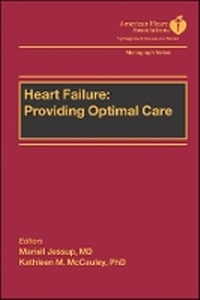
Heart Failure
Providing Optimal Care
1st Edition
Will be published approx. on 21. August 2003
Book
Hardback
280 pages
978-1-4051-0375-6 (ISBN)
Description
The objective of this text is to synthesise the research based clinical treatment strategies that have been found to be most effective in the clinical management of heart failure as a disease. Incorporating recommendations from state of the art guidelines, the text will comprehensively address both in-patient management of acute exacerbations, and out-patient management to improve survival, quality of life, and functional status. The editors are active members of the American Heart Association and influential councils on clinical cardiology and cardiovascular medicine, and have assembled a team of contributors prominent in the field of heart failure and transplantation. They aim, through this publication, to translate the findings of recent research into a practical clinical framework for physicians caring for patients on a daily basis.
More details
Series
Language
English
Place of publication
Hoboken
United Kingdom
Publishing group
John Wiley and Sons Ltd
Target group
Professional and scholarly
Dimensions
Height: 236 mm
Width: 160 mm
Thickness: 22 mm
Weight
653 gr
ISBN-13
978-1-4051-0375-6 (9781405103756)
Copyright in bibliographic data and cover images is held by Nielsen Book Services Limited or by the publishers or by their respective licensors: all rights reserved.
Schweitzer Classification
Other editions
Additional editions
E-Book
05/2008
Wiley-Blackwell
€97.99
Available for download
Persons
Mariell Jessup Hospital of the University of Pennsylvania. In addition to being prominent in the field of heart failure and transplantation, the editors are active in the AHA and appropriate councils on clinical cardiology and cardiovascular medicine.
Content
Preface. Chapter 1: Heart Failure as a National Heath Problem: The Burden of Heart Failure.
Chapter 2: Heart Failure Guidelines and Disease Management.
Chapter 3: Managed Care and Heart Failure.
Chapter 4: Defining Heart Failure: Systolic versus Diastolic Dysfunction, Differential Diagnosis, Initial Testing.
Chapter 5: Serial Clinical Assessment of the Patient with Heart Failure.
Chapter 6: Treatment Goals for Heart Failure Patients in Critical Care.
Chapter 7: Managing Complicated In-patients: Co-morbidities and the Frail Elderly.
Chapter 8: Transition from Hospital to Home: Interdisciplinary Management Models.
Chapter 9: Living with Heart Failure: Promoting Adherence, Managing Symptoms, and Optimizing Function.
Chapter 10: Pharmacologic Management: Achieving Target Doses and Managing Interactions.
Chapter 11: Continuum of Care: Prevention to End of Life.
Chapter 12: Surgical Management of Heart Failure.
Chapter 13: The Management of Heart Failure's Electrical Complications: Device Therapy.
Chapter 14: Moving Ahead with Heart Failure: What does the Future Hold?
Chapter 2: Heart Failure Guidelines and Disease Management.
Chapter 3: Managed Care and Heart Failure.
Chapter 4: Defining Heart Failure: Systolic versus Diastolic Dysfunction, Differential Diagnosis, Initial Testing.
Chapter 5: Serial Clinical Assessment of the Patient with Heart Failure.
Chapter 6: Treatment Goals for Heart Failure Patients in Critical Care.
Chapter 7: Managing Complicated In-patients: Co-morbidities and the Frail Elderly.
Chapter 8: Transition from Hospital to Home: Interdisciplinary Management Models.
Chapter 9: Living with Heart Failure: Promoting Adherence, Managing Symptoms, and Optimizing Function.
Chapter 10: Pharmacologic Management: Achieving Target Doses and Managing Interactions.
Chapter 11: Continuum of Care: Prevention to End of Life.
Chapter 12: Surgical Management of Heart Failure.
Chapter 13: The Management of Heart Failure's Electrical Complications: Device Therapy.
Chapter 14: Moving Ahead with Heart Failure: What does the Future Hold?