

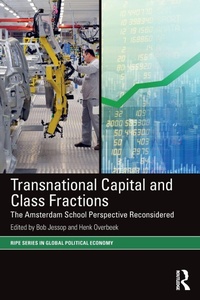
Transnational Capital and Class Fractions
The Amsterdam School Perspective Reconsidered
1st Edition
Published on 23. August 2018
Book
Paperback/Softback
300 pages
978-0-8153-6960-8 (ISBN)
Description
Emerging in the late 1970s, the Amsterdam School's (AS) most distinctive contribution to international political economy was the systematic incorporation of the Marxian concept of capital fractions into the study of international politics. Contending that politics in advanced capitalist countries takes place in a fundamentally transnationalized space in which the distinction between 'domestic' and 'international' has blurred, it shows how in this space, politics is structured by competing comprehensive concepts of control.
Presenting a concise and instructive introduction to the origins, development and significance of this distinct approach, this book provides a unique overview of the School's contemporary significance for the field. Offering a new generation of critical scholars the opportunity to become acquainted at first hand with some of the contributions that have shaped the work of the AS, the contributions present critical commentaries, discussing the merits and shortcomings of the AS from a variety of perspectives, and undertake a (self-) critical evaluation of the current place and value of the AS framework in the broader landscape of approaches to the study of contemporary capitalism.
Written for scholars and students alike, it will be of interest to those working in international political economy, international relations and political science, political sociology, European studies and branches of academic economics such as regulation theory and institutional economics.
Presenting a concise and instructive introduction to the origins, development and significance of this distinct approach, this book provides a unique overview of the School's contemporary significance for the field. Offering a new generation of critical scholars the opportunity to become acquainted at first hand with some of the contributions that have shaped the work of the AS, the contributions present critical commentaries, discussing the merits and shortcomings of the AS from a variety of perspectives, and undertake a (self-) critical evaluation of the current place and value of the AS framework in the broader landscape of approaches to the study of contemporary capitalism.
Written for scholars and students alike, it will be of interest to those working in international political economy, international relations and political science, political sociology, European studies and branches of academic economics such as regulation theory and institutional economics.
More details
Series
Language
English
Place of publication
New York
United States
Publishing group
Taylor & Francis Inc
Target group
College/higher education
Illustrations
3 s/w Abbildungen, 3 s/w Zeichnungen, 10 s/w Tabellen
10 Tables, black and white; 3 Line drawings, black and white; 3 Illustrations, black and white
Dimensions
Height: 234 mm
Width: 156 mm
Thickness: 18 mm
Weight
497 gr
ISBN-13
978-0-8153-6960-8 (9780815369608)
Copyright in bibliographic data and cover images is held by Nielsen Book Services Limited or by the publishers or by their respective licensors: all rights reserved.
Schweitzer Classification
Other editions
Additional editions
Bob Jessop | Henk Overbeek
Transnational Capital and Class Fractions
The Amsterdam School Perspective Reconsidered
Book
08/2018
1st Edition
Routledge
€207.00
Shipment within 15-20 days
Bob Jessop | Henk Overbeek
Transnational Capital and Class Fractions
The Amsterdam School Perspective Reconsidered
E-Book
08/2018
1st Edition
Routledge
€55.49
Available for download
Bob Jessop | Henk Overbeek
Transnational Capital and Class Fractions
The Amsterdam School Perspective Reconsidered
E-Book
08/2018
1st Edition
Routledge
€55.49
Available for download
Persons
Bob Jessop is Distinguished Professor of Sociology and Co-Director of the Cultural Political Economy Research Centre at Lancaster University.
Henk Overbeek is Emeritus Professor of International Relations. He has taught international relations and international political economy at the Vrije Universiteit Amsterdam since 1999.
Henk Overbeek is Emeritus Professor of International Relations. He has taught international relations and international political economy at the Vrije Universiteit Amsterdam since 1999.
Content
Introduction - Political economy, capital fractions, transnational class formation: The intellectual pedigree of the Amsterdam School Part I The Amsterdam School: Key contributions 1 The Dutch bourgeoisie between the two world wars (1979) 2 Class formation at the international level (1979) 3 Finance capital and the crisis in Britain (1980) 4 The international corporate elite (1982) 5 Transnational class agency and European governance: The case of the European Round Table of Industrialists (2000) 6 Asymmetrical regulation and multidimensional governance in the European Union (2004) Part II Critical commentaries 7 Class fractions and hegemonic concepts of control 8 Losing control? The Amsterdam School travels East 9 The Amsterdam School and its implications for Chinese scholars 10 Reconsidering the 'dangerous liaisons' between China and neoliberalism and its impact in Latin America and Caribbean countries 11 Saying Goodbye? Tracing my itinerary from Amsterdam to Beijing 12 Reflections on the Amsterdam School and the transnational capitalist class 13 Theories of imperialism: Rivalries and unity 14 Nationalist populism within the Lockean heartland 15 Out of Amsterdam! Beyond the boundaries of (transnational) capitalist class formation 16 The Amsterdam School: Gender as a blind spot? 17 The Amsterdam School, critical realism and the study of 'deep structures' 18 Confronting global governance after the historical turn in IR 19 Network analysis and the Amsterdam School: An unfulfilled promise? PART III The Amsterdam School and the Political Economy of Contemporary Capitalism 20 A transnational analysis of the current crisis 21 Putting the Amsterdam School in its place