

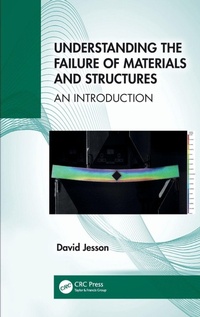
Understanding the Failure of Materials and Structures
An Introduction
1st Edition
Published on 11. September 2024
Book
Hardback
12 pages
978-0-367-36840-1 (ISBN)
Description
Understanding the Failure of Materials and Structures introduces practical aspects of mechanical characterisation of materials and structures. It gives those with little or no prior experience insight into the process of developing everyday products, issues behind some high-profile failures, and tools to begin planning a programme of research.
Written in an easily accessible manner, the work discusses fundamentals of the physical world, highlighting the range of materials used and varied applications, and offers a brief history of materials development. It covers the role of materials structure in controlling materials properties and describes mechanical properties, such as stress, strain, stiffness, fracture, and fatigue. The book also features information on various modes of testing and strain measurement. It provides some discussion on topics that go beyond well-behaved test coupons, with thoughts on biomechanics, megastructures, and testing for applications in extreme environments. Finally, it covers how materials fail and the future of physical testing.
With minimal theory and mathematics, this work presents the fundamentals of mechanical characterisation of materials and structures in a manner accessible to the novice materials investigator and the layperson interested in the science behind materials engineered for use in common and advanced products.
Written in an easily accessible manner, the work discusses fundamentals of the physical world, highlighting the range of materials used and varied applications, and offers a brief history of materials development. It covers the role of materials structure in controlling materials properties and describes mechanical properties, such as stress, strain, stiffness, fracture, and fatigue. The book also features information on various modes of testing and strain measurement. It provides some discussion on topics that go beyond well-behaved test coupons, with thoughts on biomechanics, megastructures, and testing for applications in extreme environments. Finally, it covers how materials fail and the future of physical testing.
With minimal theory and mathematics, this work presents the fundamentals of mechanical characterisation of materials and structures in a manner accessible to the novice materials investigator and the layperson interested in the science behind materials engineered for use in common and advanced products.
More details
Language
English
Place of publication
London
United Kingdom
Publishing group
Taylor & Francis Ltd
Target group
Professional and scholarly
Professional Practice & Development
Illustrations
1 s/w Tabelle, 31 s/w Zeichnungen, 32 s/w Abbildungen, 1 s/w Photographie bzw. Rasterbild
1 Tables, black and white; 31 Line drawings, black and white; 1 Halftones, black and white; 32 Illustrations, black and white
Dimensions
Height: 240 mm
Width: 161 mm
Thickness: 14 mm
Weight
429 gr
ISBN-13
978-0-367-36840-1 (9780367368401)
Copyright in bibliographic data and cover images is held by Nielsen Book Services Limited or by the publishers or by their respective licensors: all rights reserved.
Schweitzer Classification
Other editions
Additional editions
Book
approx. 07/2026
1st Edition
CRC Press
€66.00
Not yet published
E-Book
09/2024
1st Edition
CRC Press
€92.49
Available for download
E-Book
09/2024
1st Edition
CRC Press
€92.49
Available for download
Person
David Jesson is a Materials Scientist by profession, training, and inclination: he is a Fellow of the Institute of Materials, Minerals, and Mining, and is both a Chartered Engineer and a Chartered Scientist. Following an undergraduate degree in Materials Science and Engineering from the University of Surrey, he undertook research leading to a PhD on the effects of nanoscale phases for the toughening of composite materials. On completion of his doctorate, he took a post as a Postdoctoral Research Fellow investigating the impact of in-service degradation on the performance of cast iron assets in the water industry, eventually leading into fifteen years of research and laboratory management. In 2021 he left academia to join the Materials Performance Group at Frazer-Nash Consultancy.
Content
1. Learning from Failure 2. Why Break Things? 3. Materials Science 101 4. Defects and Degradation 5. Mechanical Properties I: Strain, Stress, Stiffness 6. Mechanical Properties II: Toughness and Fracture Toughness 7. Fatigue, Wear, Creep, and Note on Corrosion 8. Testing Modes and Application of Load 9. How to Measure Strain 10. Strain Rate Dependence: Why It Matters How Fast You Test 11. The Use of Statistics 12. Models vs. Reality 13. Biomechanics 14. Non-destructive Evaluation 15. Questions for the Future