

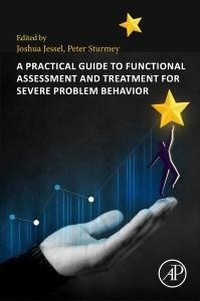
A Practical Guide to Functional Assessment and Treatment for Severe Problem Behavior
Published on 29. October 2024
Book
Paperback/Softback
338 pages
978-0-443-21769-2 (ISBN)
Description
A Practical Guide to Functional Assessment and Treatment for Severe Problem Behavior discusses how to utilize functional assessment and function-based treatment for patients with severe problem behaviors. The book begins by defining problem behavior, contrasting functional and structural definitions, and clearly reviewing the term "severe". The second section, Functional Assessment of Problem Behavior, reviews three different assessments in detail, providing sample questionnaires, methods for interviewing and brief bonus videos. The third section, Function-Based Treatments, outlines three main treatment options, including comprehensive and trauma-informed strategies and outline information on collecting, graphing, and analyzing treatment data.
The final section, Promoting Sustainability and Compassionate Care will review strategies to implement these assessments and treatments in a culturally relevant and compassionate way.
The final section, Promoting Sustainability and Compassionate Care will review strategies to implement these assessments and treatments in a culturally relevant and compassionate way.
More details
Language
English
Place of publication
San Diego
United States
Publishing group
Elsevier Science Publishing Co Inc
Target group
Professional and scholarly
Product notice
Paperback (trade)
Unsewn / adhesive bound
Dimensions
Height: 229 mm
Width: 150 mm
Thickness: 18 mm
Weight
540 gr
ISBN-13
978-0-443-21769-2 (9780443217692)
Copyright in bibliographic data and cover images is held by Nielsen Book Services Limited or by the publishers or by their respective licensors: all rights reserved.
Schweitzer Classification
Other editions
Additional editions
Joshua Jessel | Peter Sturmey
A Practical Guide to Functional Assessment and Treatment for Severe Problem Behavior
E-Book
10/2024
Elsevier
€130.00
Available for download
Persons
Dr. Joshua Jessel completed his master's degree at the University of Maryland, Baltimore County where he worked with individuals who exhibited severe problem behavior on the neurobehavioral inpatient unit of the Kennedy Krieger Institute. He went on to earn his doctoral degree at Western New England University with his primary research focusing on the assessment and treatment of problem behavior with autistic children. Dr. Jessel continued to extend this line of research as a postdoctoral fellow at a clinic in Texas where he oversaw nearly 100 children admitted to an outpatient program. Dr. Jessel has currently authored over 50 research articles and chapters and continues his scholarship as an assistant professor at Queens College in New York City. I have worked with children and adults with developmental disabilities for over 30 years as a volunteer; camp counselor; researcher; clinical psychologist in the British National Health Service; Chief Psychologist in developmental centers in Texas; consultant for many community services; and consultant to the states of Louisiana and Wyoming. I have been involved in professional training in Britain, Louisiana State University and now Queens College. It has always struck me that children and adults with developmental disabilities would have a better life, be happier, more autonomous and valued by other people if their staff and family members got a little help to do few simple things -interact positively and often, use contingent reinforcement accurately, teach a few simple skills and be more sensitive to preferences. I also believe that if these happened consistently, staff and family members would feel more competent.
Editor
The Graduate Center and Department of Psychology, Queens College, City University of New York, New York, NY, United States and Department of Applied Disabilities Studies, Brock University, St. Catharines, Ontario, Canada
The Graduate Center and Department of Psychology, Queens College, City University of New York, New York, NY, United States and Department of Applied Disabilities Studies, Brock University, St. Catharines, Ontario, Canada
Content
Part 1: Introduction to Behavioral Assessment and Intervention
1. Problem Behavior
2. Applied Behavior Analysis and Problem Behavior
3. A Perspective on Today's Applied Behavior Analysis
4. Prevention and Behavioral Hygiene Procedures
Part 2: Functional Assessment of Problem Behavior
5. Indirect Assessments
6. Descriptive Assessments
7. Functional Analysis
8. Practical Considerations
Part 3: Function-Based Treatments
9. Foundational Treatment Components of Function-Based Interventions
10. Conemporary Intervention Approaches when Addressing Dangerous Behavior
11. Addressing Severe Problem Behavior without Clear Socially Mediated Functions
12. ABA Meets Psychopharmacology: The Interaction of Two Methodologies
Part 4: Promoting Sustainability and Compassionate Care
13. Application Considerations for Compassionate, Culturally Responsive and Trauma-Informed Behavioral Practices
14. Professionals / Caregiver Training
15. Implementation Considerations
16. Collaborating with Relevant Stakeholders
1. Problem Behavior
2. Applied Behavior Analysis and Problem Behavior
3. A Perspective on Today's Applied Behavior Analysis
4. Prevention and Behavioral Hygiene Procedures
Part 2: Functional Assessment of Problem Behavior
5. Indirect Assessments
6. Descriptive Assessments
7. Functional Analysis
8. Practical Considerations
Part 3: Function-Based Treatments
9. Foundational Treatment Components of Function-Based Interventions
10. Conemporary Intervention Approaches when Addressing Dangerous Behavior
11. Addressing Severe Problem Behavior without Clear Socially Mediated Functions
12. ABA Meets Psychopharmacology: The Interaction of Two Methodologies
Part 4: Promoting Sustainability and Compassionate Care
13. Application Considerations for Compassionate, Culturally Responsive and Trauma-Informed Behavioral Practices
14. Professionals / Caregiver Training
15. Implementation Considerations
16. Collaborating with Relevant Stakeholders