

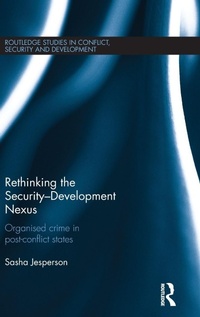
Rethinking the Security-Development Nexus
Organised Crime in Post-Conflict States
1st Edition
Published on 24. November 2016
Book
Hardback
210 pages
978-1-138-20008-1 (ISBN)
Description
This book critically examines the security-development nexus through an analysis of organised crime responses in post-conflict states.
As the trend has evolved, the security-development nexus has received significant attention from policymakers as a new means to address security threats. Integrating the traditionally separate areas of security and development, the nexus has been promoted as a new strategy to achieve a comprehensive, people-centred approach. Despite the enthusiasm behind the security-development nexus, it has received significant criticism. This book investigates four tensions that influence the integration of security and development to understand why it has failed to live up to expectations. The book compares two case studies of internationally driven initiatives to address organised crime as part of post-conflict reconstruction in Sierra Leone and Bosnia. Examination of the tensions reveals that actors addressing organised crime have attempted to move away from a security approach, resulting in incipient integration between security and development, but barriers remain. Rather than discarding the nexus, this book explores its unfulfilled potential.
This book will be of much interest to students of war and conflict studies, development studies, criminology, security studies and IR in general.
As the trend has evolved, the security-development nexus has received significant attention from policymakers as a new means to address security threats. Integrating the traditionally separate areas of security and development, the nexus has been promoted as a new strategy to achieve a comprehensive, people-centred approach. Despite the enthusiasm behind the security-development nexus, it has received significant criticism. This book investigates four tensions that influence the integration of security and development to understand why it has failed to live up to expectations. The book compares two case studies of internationally driven initiatives to address organised crime as part of post-conflict reconstruction in Sierra Leone and Bosnia. Examination of the tensions reveals that actors addressing organised crime have attempted to move away from a security approach, resulting in incipient integration between security and development, but barriers remain. Rather than discarding the nexus, this book explores its unfulfilled potential.
This book will be of much interest to students of war and conflict studies, development studies, criminology, security studies and IR in general.
More details
Series
Language
English
Place of publication
London
United Kingdom
Publishing group
Taylor & Francis Ltd
Target group
College/higher education
Professional and scholarly
Illustrations
8 s/w Zeichnungen
8 Line drawings, black and white
Dimensions
Height: 240 mm
Width: 161 mm
Thickness: 16 mm
Weight
487 gr
ISBN-13
978-1-138-20008-1 (9781138200081)
Copyright in bibliographic data and cover images is held by Nielsen Book Services Limited or by the publishers or by their respective licensors: all rights reserved.
Schweitzer Classification
Other editions
Additional editions
E-Book
12/2016
Routledge
€60.49
Available for download
E-Book
12/2016
Routledge
€60.49
Available for download
Person
Sasha Jesperson is Research Fellow at the Royal United Services Institute, and has a PhD in Government from the London School of Economics, UK.
Content
Introduction: The Security-Development Nexus: An Uneasy Relationship
1. A Critical Analysis of the Security-Development Nexus
2. Tensions in the Security-Development Nexus
3. Addressing Organised Crime Through the Security-Development Nexus in Sierra Leone and Bosnia
4. Tensions in the Security-Development Nexus: Sierra Leone
5. Tensions in the Security-Development Nexus: Bosnia
6. Inhibiting Integration?
Conclusion
1. A Critical Analysis of the Security-Development Nexus
2. Tensions in the Security-Development Nexus
3. Addressing Organised Crime Through the Security-Development Nexus in Sierra Leone and Bosnia
4. Tensions in the Security-Development Nexus: Sierra Leone
5. Tensions in the Security-Development Nexus: Bosnia
6. Inhibiting Integration?
Conclusion