

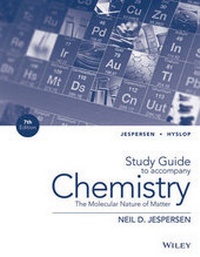
Chemistry: The Molecular Nature of Matter, Study Guide
Published on 17. February 2014
Book
Paperback/Softback
528 pages
978-1-118-70508-7 (ISBN)
Description
The Study Guide to accompany Chemistry: The Molecular Nature of Matter, 7th Edition. Jespersen s Chemistry: The Molecular Nature of Matter, 7th Edition provides readers with the necessary practice, support, instruction and assessment that is required for learning and teaching the content of a General Chemistry course. This text provides the forum for problem solving and concept mastery of chemical phenomena that leads to proficiency and success. The Seventh Edition includes revisions to key content coverage areas and concepts and the addition of more Analyzing & Solving Multi-Concept problems and examples throughout the text. An increased emphasis has also been placed on the intimate relationship that exists between structure at the submicroscopic molecular level and the observable macroscopic properties of matter. Jespersen provides readers with a clear, concise and easy to understand General Chemistry resource.
More details
Edition
7th Edition
Language
English
Place of publication
New York
United States
Target group
College/higher education
Dimensions
Height: 274 mm
Width: 213 mm
Thickness: 23 mm
Weight
1043 gr
ISBN-13
978-1-118-70508-7 (9781118705087)
Copyright in bibliographic data and cover images is held by Nielsen Book Services Limited or by the publishers or by their respective licensors: all rights reserved.
Schweitzer Classification
Other editions
Previous edition
Neil D. Jespersen | James E. Brady | Alison Hyslop
Chemistry
The Molecular Nature of Matter Study Guide
Book
12/2011
6th Edition
Wiley
€130.19
Article exhausted; check for reprint
Persons
Neil Jespersen, Professor, St. Johns University, brings a wealth of writing and teaching experience to this project as a co-author. He has worked with Jim Brady and taught with the Brady textbook for his entire teaching career, providing him with great insight into its strengths and weaknesses as he develops the 6th edition. Neil also brings a wealth of experience and connections as an ACS member that is active on several committees including a Chemical Education committee.
Content
Chapter 0: A Very Brief History of Chemistry Chapter 1: Scientific Measurements
Chapter 2: Elements, Compounds, and the Periodic Table
Chapter 3: The Mole and Stoichiometry
Chapter 4: Molecular View of Reactions in Aqueous Solutions
Chapter 5: Oxidation-Reduction Reactions
Chapter 6: Energy and Chemical Change
Chapter 7: The Quantum Mechanical Atom
Chapter 8: The Basics of Chemical Bonding
Chapter 9: Theories of Bonding and Structure
Chapter 10: Properties of Gases
Chapter 11: Intermolecular Attractions and the Properties of Liquids and Solids
Chapter 12: Mixtures at the Molecular Level: Properties of Solutions
Chapter 13: Chemical Kinetics
Chapter 14: Chemical Equilibrium
Chapter 15: Acids and Bases, A Molecular Look
Chapter 16: Acid-Base Equilibria in Aqueous Solutions
Chapter 17: Solubility and Simultaneous Equilibria
Chapter 18: Thermodynamics
Chapter 19: Electrochemistry
Chapter 20: Nuclear Reactions and Their Role in Chemistry
Chapter 21: Metal Complexes
Chapter 22: Organic Compounds, Polymers, and Biochemicals
Chapter 2: Elements, Compounds, and the Periodic Table
Chapter 3: The Mole and Stoichiometry
Chapter 4: Molecular View of Reactions in Aqueous Solutions
Chapter 5: Oxidation-Reduction Reactions
Chapter 6: Energy and Chemical Change
Chapter 7: The Quantum Mechanical Atom
Chapter 8: The Basics of Chemical Bonding
Chapter 9: Theories of Bonding and Structure
Chapter 10: Properties of Gases
Chapter 11: Intermolecular Attractions and the Properties of Liquids and Solids
Chapter 12: Mixtures at the Molecular Level: Properties of Solutions
Chapter 13: Chemical Kinetics
Chapter 14: Chemical Equilibrium
Chapter 15: Acids and Bases, A Molecular Look
Chapter 16: Acid-Base Equilibria in Aqueous Solutions
Chapter 17: Solubility and Simultaneous Equilibria
Chapter 18: Thermodynamics
Chapter 19: Electrochemistry
Chapter 20: Nuclear Reactions and Their Role in Chemistry
Chapter 21: Metal Complexes
Chapter 22: Organic Compounds, Polymers, and Biochemicals