

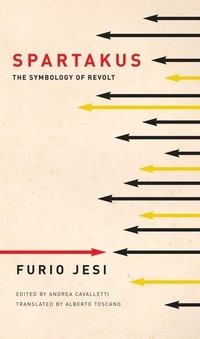
Spartakus
The Symbology of Revolt
Will be published approx. on 26. January 2024
Book
Paperback/Softback
180 pages
978-1-80309-362-8 (ISBN)
Description
A crucial text at the intersection of history and philosophy in twentieth-century Italy.
On December 29, 1918, the Spartakus League, a Marxist revolutionary movement, rose up in Germany calling for an end to class rule by the bourgeoisie. Massive demonstrations followed and more than 500,000 Berliners took to the streets in January-only to be crushed by police and anticommunist paramilitary troops. Several leaders of the Spartakus League were killed and the revolt was quashed.
Through a detailed reconstruction of the events of that bloody winter, historian and critic Furio Jesi recasts our understanding of a foundational political difference-revolt or revolution? Drawing on a deep reserve of literary sources like Brecht, Eliade, Dostoyevsky, and Mann, Jesi outlines a uniquely incisive phenomenology of revolt that distinguishes between the purposeful historical temporality of revolution and the suspension of time that marks a revolt. This edition also includes an essay on the politics of time and revolution by Rosa Luxemburg, a founding leader of the Spartakus League.
On December 29, 1918, the Spartakus League, a Marxist revolutionary movement, rose up in Germany calling for an end to class rule by the bourgeoisie. Massive demonstrations followed and more than 500,000 Berliners took to the streets in January-only to be crushed by police and anticommunist paramilitary troops. Several leaders of the Spartakus League were killed and the revolt was quashed.
Through a detailed reconstruction of the events of that bloody winter, historian and critic Furio Jesi recasts our understanding of a foundational political difference-revolt or revolution? Drawing on a deep reserve of literary sources like Brecht, Eliade, Dostoyevsky, and Mann, Jesi outlines a uniquely incisive phenomenology of revolt that distinguishes between the purposeful historical temporality of revolution and the suspension of time that marks a revolt. This edition also includes an essay on the politics of time and revolution by Rosa Luxemburg, a founding leader of the Spartakus League.
Reviews / Votes
"Jesi always manages to stamp out the barriers between the categories on which the fragile certainties of Italian ideology had been based: rationalism/irrationalism; myth/history; laicism/religiousness; left/ right; militant criticism/academia." -- Giorgio AgambenMore details
Series
Language
English
Place of publication
Greenford
United Kingdom
Target group
Professional and scholarly
Dimensions
Height: 370 mm
Width: 218 mm
Thickness: 15 mm
Weight
232 gr
ISBN-13
978-1-80309-362-8 (9781803093628)
Copyright in bibliographic data and cover images is held by Nielsen Book Services Limited or by the publishers or by their respective licensors: all rights reserved.
Schweitzer Classification
Persons
Furio Jesi (1941-80) was an Egyptologist, historian of religions, literary critic, and pioneering theorist on the role of myth in literature, politics, and culture. Alberto Toscano teaches in the Department of Sociology, Goldsmiths College, University of London. He is the author of Fanaticism and The Theatre of Production, and the translator of several books by Alain Badiou.
Content
Introduction
Andrea Cavalletti
Subversion and Memory
The Suspension of Historical Time
The Symbols of Power
Drums in the Night
The Untimeliness of Revolt
Appendix 1
Appendix 2
Andrea Cavalletti
Subversion and Memory
The Suspension of Historical Time
The Symbols of Power
Drums in the Night
The Untimeliness of Revolt
Appendix 1
Appendix 2