

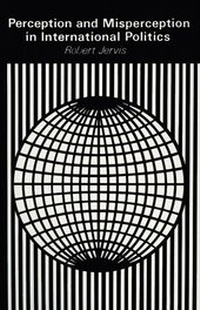
Perception and Misperception in International Politics
The Architecture of Washington, D.C. Volume 2
Published on 21. November 1976
Book
Paperback/Softback
464 pages
978-0-691-10049-4 (ISBN)
Description
This study of perception and misperception in foreign policy was a landmark in the application of cognitive psychology to political decision making. The New York Times called it, in an article published nearly ten years after the book's appearance, "the seminal statement of principles underlying political psychology." The perspective established by Jervis remains an important counterpoint to structural explanations of international politics, and from it has developed a large literature on the psychology of leaders and the problems of decision making under conditions of incomplete information, stress, and cognitive bias. Jervis begins by describing the process of perception (for example, how decision makers learn from history) and then explores common forms of misperception (such as overestimating one's influence). Finally, he tests his ideas through a number of important events in international relations from nineteenth- and twentieth-century European history. In a contemporary application of Jervis's ideas, some argue that Saddam Hussein invaded Kuwait in 1990 in part because he misread the signals of American leaders with regard to the independence of Kuwait.
Also, leaders of the United States and Iraq in the run-up to the most recent Gulf War might have been operating under cognitive biases that made them value certain kinds of information more than others, whether or not the information was true. Jervis proved that, once a leader believed something, that perception would influence the way the leader perceived all other relevant information.
Also, leaders of the United States and Iraq in the run-up to the most recent Gulf War might have been operating under cognitive biases that made them value certain kinds of information more than others, whether or not the information was true. Jervis proved that, once a leader believed something, that perception would influence the way the leader perceived all other relevant information.
Reviews / Votes
"The best statement of the psychological position in the literature on international politics. Highly readable, informative, and thought-provoking."--Library JournalMore details
Series
Language
English
Place of publication
New Jersey
United States
Target group
Professional and scholarly
College/higher education
Product notice
Paperback (trade)
Dimensions
Height: 235 mm
Width: 152 mm
Weight
652 gr
ISBN-13
978-0-691-10049-4 (9780691100494)
Copyright in bibliographic data and cover images is held by Nielsen Book Services Limited or by the publishers or by their respective licensors: all rights reserved.
Schweitzer Classification
Other editions
New editions
Book
05/2017
Princeton University Press
€123.80
Article not available at the moment
Book
05/2017
Princeton University Press
€37.50
Shipment within 10-20 days