

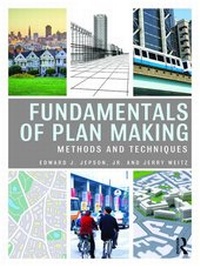
Fundamentals of Plan Making
Methods and Techniques
1st Edition
Published on 30. November 2015
Book
Paperback/Softback
228 pages
978-1-138-02436-6 (ISBN)
Description
Urban and regional planning programs aspire to prepare practitioners to write and implement plans, primarily at the local level of government. These programs are very much "professional" in their aspirations, as opposed to research oriented. Yet, academic planning programs often place greater emphasis on theory than practice. For decades, the planning academy has acknowledged a major disconnect between what the planning academy teaches students and the techniques and skills needed to be a successful professional practitioner.
Fundamentals of Plan Making will give planning students an understanding of research design as it applies to planning, develop familiarity with various data sources, and help them acquire knowledge and the ability to conduct basic planning analyses such as population projections, housing needs assessments, development impact analyses, and land use plans. Students will also learn how to implement the various citizen participation methods used by planners and develop an appreciation of the values and roles of practicing planners.
In Fundamentals of Plan Making, Edward Jepson and Jerry Weitz bring their extensive experience as practicing academics and give planning students the practical, hands on tools they need to implement the various methods used to create and implement real plans and policies. Its chapters on transportation, housing, environment, economic development and other core development topics also make it a handy reference for planning practitioners.
Fundamentals of Plan Making will give planning students an understanding of research design as it applies to planning, develop familiarity with various data sources, and help them acquire knowledge and the ability to conduct basic planning analyses such as population projections, housing needs assessments, development impact analyses, and land use plans. Students will also learn how to implement the various citizen participation methods used by planners and develop an appreciation of the values and roles of practicing planners.
In Fundamentals of Plan Making, Edward Jepson and Jerry Weitz bring their extensive experience as practicing academics and give planning students the practical, hands on tools they need to implement the various methods used to create and implement real plans and policies. Its chapters on transportation, housing, environment, economic development and other core development topics also make it a handy reference for planning practitioners.
Reviews / Votes
"This wide-ranging and up-to-date text describes the fundamental analyses, data sources, and processes that go into preparing a comprehensive plan. It will benefit both students and practitioners concerned with helping communities to plan their futures. Jepson and Weitz have done an outstanding job of researching the practice, methods, and literature of plan-making." -David R. Godschalk, University of North Carolina"Ed Jepson and Jerry Weitz provide an excellent, comprehensive and coordinated source of the full range of basic methods and techniques for preparing a comprehensive plan. Every planning practitioner, educator and student will want to keep this volume close at hand." -Philip Berke, Texas A&M University
"Jepson and Weitz cover in detail the important elements of how and why to create a comprehensive plan. The authors provide sound advice for planning students and practitioners in a straight-forward, well-organized, and nicely illustrated book. The exercises in the book are especially helpful for students." - Tom Daniels, University of Pennsylvania
"Fundamentals of Plan Making is an ambitious book about many of the methods and analyses that create the foundation for a successful comprehensive plan. Written by two of planning's foremost practitioner-scholars, Fundamentals of Plan Making is an excellent addition to the bookshelves of both planning professionals and students new to the field." -Tim Chapin, Florida State University?
"Fundamentals of Planning by Edward J. Jepson and Jerry Weitz is a heroic job of condensing into 10 chapters the many skills and abilities involved in creating a comprehensive plan. The authors aim to reconnect planning education with planning practice. With step-by-step instruction in methods and techniques, the book may serve practitioners as well as students and those preparing for the AICP exam." - Harold Henderson, Planning Magazine
"Overall, Fundamentals of Plan Making - Methods and Techniques is a thorough understanding of the urban planning process and it explains the paths most often used to create, analysis and implement these plans...
The text covers all bases and explains the principles and connections. Students and practitioners will want to include this text in their book shelves alongside other urban planning books. It will help when working with concepts and practical issues, and provide a useful reference for keeping urban planning projects on track toward successful completion." - Jeff Thurston, 3D Visualization World 2017
"The unique value of the book comes from the complete but concise and practical way it uses to guide the reader through the core methods of planning. Jepson and Weitz offer a step-by-step approach to plan making, unlocking and underscoring the plan's logic while providing the reader with a straightforward instruction manual." - Evangeline R. Linkous, University of South Florida (Journal of Planning Education and Research)
More details
Language
English
Place of publication
London
United Kingdom
Publishing group
Taylor & Francis Ltd
Target group
College/higher education
Illustrations
91 s/w Tabellen, 53 s/w Zeichnungen
53 Line drawings, black and white; 91 Tables, black and white
Dimensions
Height: 246 mm
Width: 189 mm
Weight
544 gr
ISBN-13
978-1-138-02436-6 (9781138024366)
Copyright in bibliographic data and cover images is held by Nielsen Book Services Limited or by the publishers or by their respective licensors: all rights reserved.
Schweitzer Classification
Other editions
New editions
Book
12/2020
2nd Edition
Routledge
€71.60
Shipment within 15-20 days
Additional editions
Book
12/2015
1st Edition
Routledge
€252.55
Withdrawn from sale
Persons
Edward J. Jepson, Jr. is a member of the American Institute of Certified Planners (AICP) and holds a Master of Regional Planning (MRP) degree from the Pennsylvania State University and a Doctor of Philosophy (Ph.D.) degree in Urban and Regional Planning from the University of Wisconsin, Madison. Over the past 30 years, he has worked as the executive director of two nonprofit development organizations, a community planning and development consultant, a planning professor at the University of Tennessee, and an adjunct professor at East Carolina University, the University of Western Georgia and the University of Oregon. His research and scholarly work has focused on planning for sustainability and his teaching experience includes courses on planning methods, economic development, planning theory, urban studies, and environmental planning.
Jerry Weitz is a Fellow of the American Institute of Certified Planners (FAICP) and holds a Ph.D. in urban studies, a Master of City Planning degree, and a Bachelor of Arts degree in Political Science and History. He has worked for city, county, regional, and state governments during his career, which spans 30 years. Since 2001, as president and principal of his own planning consulting firm, Jerry Weitz & Associates, Inc., he has prepared numerous local comprehensive plans and land-use regulations. From 2010 to 2015, he was associate professor and director of the urban and regional planning program at East Carolina University in Greenville, NC, where he taught land-use planning, land-use regulation, historic preservation planning, planning practice studio, and ecological landscape planning. From 2001 to 2014, Weitz was editor of the only member publication of the American Institute of Certified Planners (AICP), Practicing Planner.
Jerry Weitz is a Fellow of the American Institute of Certified Planners (FAICP) and holds a Ph.D. in urban studies, a Master of City Planning degree, and a Bachelor of Arts degree in Political Science and History. He has worked for city, county, regional, and state governments during his career, which spans 30 years. Since 2001, as president and principal of his own planning consulting firm, Jerry Weitz & Associates, Inc., he has prepared numerous local comprehensive plans and land-use regulations. From 2010 to 2015, he was associate professor and director of the urban and regional planning program at East Carolina University in Greenville, NC, where he taught land-use planning, land-use regulation, historic preservation planning, planning practice studio, and ecological landscape planning. From 2001 to 2014, Weitz was editor of the only member publication of the American Institute of Certified Planners (AICP), Practicing Planner.
Content
1. An Introduction to the Comprehensive Plan 2. Data Retrieval and Management For Community Analyses 3. Demographic Analysis 4. Housing Analysis 5. Economic Analysis 6. Environmental Analysis 7. Community Facilities and Services Analysis 8. Transportation System Analysis 9. Land Use Analysis 10. The Process of Plan Making