

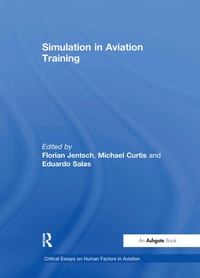
Simulation in Aviation Training
1st Edition
Published on 18. March 2011
Book
Hardback
540 pages
978-0-7546-2887-3 (ISBN)
Description
Simulations have been a fixture of aviation training for many years. Advances in simulator technology now enable modern flight simulation to mimic very closely the look and feel of real world flight operations. In spite of this, responsible researchers, trainers, and simulation developers should look beyond mere simulator fidelity to produce meaningful training outcomes. Optimal simulation training development can unquestionably benefit from knowledge and understanding of past, present, and future research in this topic area. As a result, this volume of key writings is invaluable as a reference, to help guide exploration of critical research in the field. By providing a mix of classic articles that stand the test of time, and recent writings that illuminate current issues, this volume informs a broad range of topics relevant to simulation training in aviation.
More details
Series
Language
English
Place of publication
London
United Kingdom
Publishing group
Taylor & Francis Ltd
Target group
Professional and scholarly
Dimensions
Height: 246 mm
Width: 174 mm
Weight
1224 gr
ISBN-13
978-0-7546-2887-3 (9780754628873)
Copyright in bibliographic data and cover images is held by Nielsen Book Services Limited or by the publishers or by their respective licensors: all rights reserved.
Schweitzer Classification
Other editions
Additional editions
Florian Jentsch | Michael Curtis
Simulation in Aviation Training
E-Book
05/2017
Routledge
€403.99
Available for download
Florian Jentsch | Michael Curtis
Simulation in Aviation Training
E-Book
05/2017
Routledge
€403.99
Available for download
Persons
Florian Jentsch, Michael Curtis and Eduardo Salas, University of Central Florida, USA
Content
Contents: Introduction; Part I Using Simulation for Training: Aircraft simulation and pilot training, Paul W. Caro; Adopting the instructional science paradigm to encompass in virtual environments, D. Dorsey, G. Campbell and S. Russell; It's not how much you have but how you use it: toward a rational use of simulation to support aviation training, Eduardo Salas, Clint A. Bowers and Lori Rhodenizer; Rapidly reconfigurable event-set based line operational evaluation scenarios, Clint Bowers, Florian Jentsch, David Baker, Carolyn Prince and Eduardo Salas; Simulation design for training and assessment, Stephen Alessi. Part II Simulation Fidelity: Quality criteria for simulator images: a literature review, Pieter Padmos and Maarten V. Milders; Transfer of skill from a computer game trainer to flight, Daniel Gopher, Maya Weil and Tal Bareket; Evidence for the validity of PC-based simulations in studying aircrew coordination, Florian Jentsch and Clint A. Bowers; Fidelity and validity of simulator training, N. Dahlstrom, S. Dekker, R. van Winsen and J. Nyce. Part III Physiological Responses and Simulation Sickness: A literature survey for virtual environments: military flight simulator visual systems and simulator sickness, Randy Pausch, Thomas Crea and Matthew Conway; Simulator sickness is polygenic and polysymptomatic: implications for research, Robert S. Kennedy and Jennifer E. Fowlkes; Simulator platform motion: the need revisited, Judith BA1/4rki-Cohen, Nancy N. Soja and Thomas Longridge. Part IV Simulation as Training and Method: Training high-performance skills: fallacies and guidelines, Walter Schneider; Part-task training for tracking and manual control, Dennis C. Wightman and Gavan Lintern; Transfer of landing skills in beginning flight training, Gavan Lintern, Stanley N. Roscoe, Jefferson M. Koonce and Leon D. Segal; Individual and team decision making under stress: theoretical underpinnings, Janice A. Cannon-Bowers and Eduardo Salas; Evaluating the effectiveness of flight simulators for training combat skills: a review, Herbert H. Bell and Wayne L. Waag. Part V Training Evaluation Using Simulation: Training effectiveness evaluation, R.T. Hays and M.J. Singer; The reliability of instructor evaluations of crew performance: good news and not so good news, Michael T. Brannick, Carolyn Prince and Eduardo Salas; Continuous concurrent feedback degrades skill learning: implications for training and simulation, Richard A. Schmidt and Gabriele Wulf; Performance measurement in simulation-based training: a review and best practice, Eduardo Salas, Michael A. Rosen, Janet D. Held and Johnny J. Weissmuller. Part VI Simulation Beyond Aviation: The use of simulation for training teamwork skills in health care: how low can you go?, J.M. Beaubien and D.P. Baker; The complexity of team training: what we have learned from aviation and its application to medicine, W.R. Hamman; Constructs of simulation evaluation, Andrew Hale Feinstein and Hugh M. Cannon; Games, motivation and learning: a research and practice model, Rosemary Garris, Robert Ahlers and James E. Driskell; Name index.