

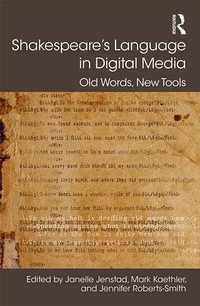
Shakespeare's Language in Digital Media
Old Words, New Tools
1st Edition
Published on 4. January 2018
Book
Hardback
216 pages
978-1-4724-2797-7 (ISBN)
Description
The authors of this book ask how digital research tools are changing the ways in which practicing editors historicize Shakespeare's language. Scholars now encounter, interpret, and disseminate Shakespeare's language through an increasing variety of digital resources, including online editions such as the Internet Shakespeare Editions (ISE), searchable lexical corpora such as the Early English Books Online-Text Creation Partnership (EEBO-TCP) or the Lexicons of Early Modern English (LEME) collections, high-quality digital facsimiles such as the Folger Shakespeare Library's Digital Image Collection, text visualization tools such as Voyant, apps for reading and editing on mobile devices, and more.
What new insights do these tools offer about the ways Shakespeare's words made meaning in their own time? What kinds of historical or historicizing arguments can digital editions make about Shakespeare's language? A growing body of work in the digital humanities allows textual critics to explore new approaches to editing in digital environments, and enables language historians to ask and answer new questions about Shakespeare's words. The authors in this unique book explicitly bring together the two fields of textual criticism and language history in an exploration of the ways in which new tools are expanding our understanding of Early Modern English.
What new insights do these tools offer about the ways Shakespeare's words made meaning in their own time? What kinds of historical or historicizing arguments can digital editions make about Shakespeare's language? A growing body of work in the digital humanities allows textual critics to explore new approaches to editing in digital environments, and enables language historians to ask and answer new questions about Shakespeare's words. The authors in this unique book explicitly bring together the two fields of textual criticism and language history in an exploration of the ways in which new tools are expanding our understanding of Early Modern English.
More details
Series
Language
English
Place of publication
London
United Kingdom
Publishing group
Taylor & Francis Ltd
Target group
College/higher education
Illustrations
21 s/w Abbildungen, 6 s/w Photographien bzw. Rasterbilder, 11 s/w Zeichnungen, 4 s/w Tabellen
4 Tables, black and white; 11 Line drawings, black and white; 6 Halftones, black and white; 21 Illustrations, black and white
Dimensions
Height: 234 mm
Width: 156 mm
Weight
460 gr
ISBN-13
978-1-4724-2797-7 (9781472427977)
Copyright in bibliographic data and cover images is held by Nielsen Book Services Limited or by the publishers or by their respective licensors: all rights reserved.
Schweitzer Classification
Other editions
Additional editions
Janelle Jenstad | Mark Kaethler | Jennifer Roberts-Smith
Shakespeare's Language in Digital Media
Old Words, New Tools
Book
03/2020
1st Edition
Routledge
€60.65
Shipment within 15-20 days
Janelle Jenstad | Mark Kaethler | Jennifer Roberts-Smith
Shakespeare's Language in Digital Media
Old Words, New Tools
E-Book
12/2017
Routledge
€68.49
Available for download
Janelle Jenstad | Mark Kaethler | Jennifer Roberts-Smith
Shakespeare's Language in Digital Media
Old Words, New Tools
E-Book
12/2017
Routledge
€68.49
Available for download
Persons
Janelle Jenstad is Associate Professor in the Department of English, University of Victoria, Canada.
Mark Kaethler is an English Instructor at Medicine Hat College, Canada.
Jennifer Roberts-Smith is Assistant Professor and Associate Chair, Theatre and Performance in the Department of Drama and Speech Communication, University of Waterloo, Canada.
Mark Kaethler is an English Instructor at Medicine Hat College, Canada.
Jennifer Roberts-Smith is Assistant Professor and Associate Chair, Theatre and Performance in the Department of Drama and Speech Communication, University of Waterloo, Canada.
Content
Introduction (Jennifer Roberts-Smith) Part I Old words through new tools: re-reading Shakespeare with EEBO-TCP and LEME 1. Beyond the OED loop: digital resources and the Arden 3 Cymbeline (Valerie Wayne) 2. Shakespeare's hard words, and our hard senses (Ian Lancashire and Elisa Tersigni) 3. Terms of art in law and herbals (Daniel Aureliano Newman) 4. "Strangers enfranchised": Shakespeare's Hamlet and the mother tongue (Elizabeth Bernath) Part II Old words, new worlds: Shakespeare's language in digital editions 5. Text, performance, and multidisciplinarity: on a digital edition of King Leir (Andrew Griffin) 6. A digital parallel-text approach to performance historiography (Toby Malone) Part III Olds words, new codes: Shakespeare and the language of markup 7. Storing and accessing knowledge: digital tools for the study of early modern drama (Laura Estill and Andie Silva) 8. Past texts, present tools, and future critics: toward rhetorical schematics (Michael Ullyot and Adam Bradley) 9. Internet Shakespeare Editions and the infinite (editorial) others: supporting critical tagsets for linked editions (Diane Jakacki) Afterwords: Playful provocations for editing Shakespeare's language in digital media