

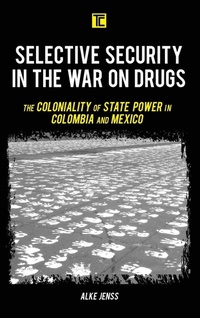
Selective Security in the War on Drugs
The Coloniality of State Power in Colombia and Mexico
Published on 15. January 2023
Book
Hardback
298 pages
978-1-5381-5109-9 (ISBN)
Description
Paramilitaries, crime, and tens of thousands of disappeared persons-the so-called war on drugs has perpetuated violence in Latin America, at times precisely in regions of economic growth. Legal and illegal economy are difficult to distinguish. A failure of state institutions to provide security for its citizens does not sufficiently explain this.
Selective Security in the War on Drugs analyzes authoritarian neoliberalism in the war on drugs in Colombia and Mexico. It interprets the "security projects" of the 2000s-when the security provided by the state became ever more selective-as embedded in processes of land appropriation, transformed property relations, and global capital accumulation. By zooming in on security practices in Colombia and Mexico in that decade and juxtaposing the two contexts, this book offers a detailed analysis of the role of the state in violence. To what extent and for whom do states produce order and disorder? Which social forces support and drive such state practices?
Expanding the literature on authoritarian neoliberalism and the coloniality of state power-thus linking political economy to postcolonial approaches-the book builds a theoretical lens to study state security practices. Different social groups, enjoying differentiated access to the state, influenced the state discourse on crime to very different extents. Security practices-which oscillated between dispersed organization by a multiplicity of actors and institutionalization with the military-materialized as horrific insecurity for social groups thought of as disposable. In tendency, putting security centerstage disabled dissent. The "security projects" exacerbated contradictions driven by a particular economic model and simultaneously criminalized precisely those that this model had already radically disadvantaged.
Selective Security in the War on Drugs analyzes authoritarian neoliberalism in the war on drugs in Colombia and Mexico. It interprets the "security projects" of the 2000s-when the security provided by the state became ever more selective-as embedded in processes of land appropriation, transformed property relations, and global capital accumulation. By zooming in on security practices in Colombia and Mexico in that decade and juxtaposing the two contexts, this book offers a detailed analysis of the role of the state in violence. To what extent and for whom do states produce order and disorder? Which social forces support and drive such state practices?
Expanding the literature on authoritarian neoliberalism and the coloniality of state power-thus linking political economy to postcolonial approaches-the book builds a theoretical lens to study state security practices. Different social groups, enjoying differentiated access to the state, influenced the state discourse on crime to very different extents. Security practices-which oscillated between dispersed organization by a multiplicity of actors and institutionalization with the military-materialized as horrific insecurity for social groups thought of as disposable. In tendency, putting security centerstage disabled dissent. The "security projects" exacerbated contradictions driven by a particular economic model and simultaneously criminalized precisely those that this model had already radically disadvantaged.
Reviews / Votes
Theoretically innovative and empirically detailed, this book offers a fresh take on the 'war on drugs' in Latin America. By asking, 'for whom do states produce order and disorder?' Alke Jenss reveals the classed, raced, and gendered social struggles that lie at the heart of contemporary security policies. This text stands as a vital contribution for understanding the basis of state violence in the region. -- Chris Hesketh, Oxford Brookes University This book is an extraordinarily valuable contribution to our understanding of the failed 'war on drugs.' It provides new and theoretically sophisticated insights from both Colombia and Mexico and a fascinating focus on the role of the state security apparatuses and their selective deployment in reproducing colonial violence and capitalist extractivist imaginaries. This book succeeds in its ambitious combination of political economy analyses with decolonial ones. -- Julie Cupples, University of Edinburgh Alke Jenss's book-which, through a systematic comparison between Colombia and Mexico, considers state and state policies as producers of violence in the context of the war on drugs-is bound to become a fundamental reference for state, Latin American, and violence scholars. Empirically rich and theoretically dense, it presents a convincing story about the ways in which global forces-the 'war on drugs,' neoliberalism, etc.-interacted with post-colonial states and regional and local dynamics to produce specific power distributions and extraordinarily brutal outcomes. -- Francisco Gutierrez Sanin, Universidad Nacional de ColombiaMore details
Series
Language
English
Place of publication
United States
Publishing group
Bloomsbury Publishing Plc
Target group
Professional and scholarly
Illustrations
8 b/w illustrations;
Dimensions
Height: 235 mm
Width: 157 mm
Thickness: 22 mm
Weight
637 gr
ISBN-13
978-1-5381-5109-9 (9781538151099)
Copyright in bibliographic data and cover images is held by Nielsen Book Services Limited or by the publishers or by their respective licensors: all rights reserved.
Schweitzer Classification
Other editions
Additional editions
Alke Jenss
Selective Security in the War on Drugs
The Coloniality of State Power in Colombia and Mexico
E-Book
01/2023
1st Edition
Rowman & Littlefield Publishers
€90.99
Available for download
Alke Jenss
Selective Security in the War on Drugs
The Coloniality of State Power in Colombia and Mexico
E-Book
01/2023
1st Edition
Bloomsbury eBooks US
€90.99
Available for download
Person
Alke Jenss is senior researcher at Arnold-Bergstraesser Institute Freiburg.
Content
Acknowledgments
Acronyms and Abbreviations
Chapter 1: Selective Security, the Coloniality of State Power, and Dispersed Coercion
Chapter 2: Wielding Power: Class, Race, and Politics
Chapter 3: Supporting Repression: The Coloniality of Dispersed Coercion
Chapter 4: Blurred Boundaries: A Continuum of Legal-Illegal Practices
Chapter 5: Security Narratives: Generals, Patrones, and Criminals
Chapter 6: Selective Security: Unstable Alliances,(Il)Legal Lawmaking, and the Silencing of Dissent
Chapter 7: The Law, the Land, and the Gun: The Coloniality of State Power in Making Private Property
Chapter 8: Enduring Violence
Bibliography
Notes
About the Author
Acronyms and Abbreviations
Chapter 1: Selective Security, the Coloniality of State Power, and Dispersed Coercion
Chapter 2: Wielding Power: Class, Race, and Politics
Chapter 3: Supporting Repression: The Coloniality of Dispersed Coercion
Chapter 4: Blurred Boundaries: A Continuum of Legal-Illegal Practices
Chapter 5: Security Narratives: Generals, Patrones, and Criminals
Chapter 6: Selective Security: Unstable Alliances,(Il)Legal Lawmaking, and the Silencing of Dissent
Chapter 7: The Law, the Land, and the Gun: The Coloniality of State Power in Making Private Property
Chapter 8: Enduring Violence
Bibliography
Notes
About the Author