

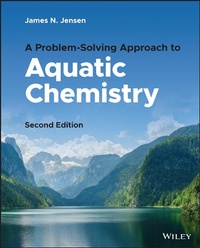
A Problem-Solving Approach to Aquatic Chemistry
Published on 16. March 2023
Book
Hardback
704 pages
978-1-119-88434-7 (ISBN)
Description
Enables civil and environmental engineers to understand the theory and application of aquatic equilibrium chemistry
The second edition of A Problem-Solving Approach to Aquatic Chemistry provides a detailed introduction to aquatic equilibrium chemistry, calculation methods for systems at equilibrium, applications of aquatic chemistry, and chemical kinetics. The text directly addresses two required ABET program outcomes in environmental engineering: "... chemistry (including stoichiometry, equilibrium, and kinetics)" and "material and energy balances, fate and transport of substances in and between air, water, and soil phases."
The book is very student student-centered, with each chapter beginning with an introduction and ending with a summary that reviews the chapter's main points. To aid in reader comprehension, important terms are defined in context and key ideas are summarized. Many thought-provoking discussion questions, worked examples, and end of chapter problems are also included. Each part of the text begins with a case study, a portion of which is addressed in each subsequent chapter, illustrating the principles of that chapter. In addition, each chapter has an Historical Note exploring connections with the people and cultures connected to topics in the text.
A Problem-Solving Approach to Aquatic Chemistry includes:
Fundamental concepts, such as concentration units, thermodynamic basis of equilibrium, and manipulating equilibria
Solutions of chemical equilibrium problems, including setting up the problems and algebraic, graphical, and computer solution techniques
Acid-base equilibria, including the concepts of acids and bases, titrations, and alkalinity and acidity
Complexation, including metals, ligands, equilibrium calculations with complexes, and applications of complexation chemistry
Oxidation-reduction equilibria, including equilibrium calculations, graphical approaches, and applications
Gas-liquid and solid-liquid equilibrium, with expanded coverage of the effects of global climate change
Other topics, including chemical kinetics of aquatic systems, surface chemistry, and integrative case studies
For advanced/senior undergraduates and first-year graduate students in environmental engineering courses, A Problem-Solving Approach to Aquatic Chemistry serves as an invaluable learning resource on the topic, with a variety of helpful learning resources included throughout to ensure information retention and the ability to apply covered concepts in practical settings.
The second edition of A Problem-Solving Approach to Aquatic Chemistry provides a detailed introduction to aquatic equilibrium chemistry, calculation methods for systems at equilibrium, applications of aquatic chemistry, and chemical kinetics. The text directly addresses two required ABET program outcomes in environmental engineering: "... chemistry (including stoichiometry, equilibrium, and kinetics)" and "material and energy balances, fate and transport of substances in and between air, water, and soil phases."
The book is very student student-centered, with each chapter beginning with an introduction and ending with a summary that reviews the chapter's main points. To aid in reader comprehension, important terms are defined in context and key ideas are summarized. Many thought-provoking discussion questions, worked examples, and end of chapter problems are also included. Each part of the text begins with a case study, a portion of which is addressed in each subsequent chapter, illustrating the principles of that chapter. In addition, each chapter has an Historical Note exploring connections with the people and cultures connected to topics in the text.
A Problem-Solving Approach to Aquatic Chemistry includes:
Fundamental concepts, such as concentration units, thermodynamic basis of equilibrium, and manipulating equilibria
Solutions of chemical equilibrium problems, including setting up the problems and algebraic, graphical, and computer solution techniques
Acid-base equilibria, including the concepts of acids and bases, titrations, and alkalinity and acidity
Complexation, including metals, ligands, equilibrium calculations with complexes, and applications of complexation chemistry
Oxidation-reduction equilibria, including equilibrium calculations, graphical approaches, and applications
Gas-liquid and solid-liquid equilibrium, with expanded coverage of the effects of global climate change
Other topics, including chemical kinetics of aquatic systems, surface chemistry, and integrative case studies
For advanced/senior undergraduates and first-year graduate students in environmental engineering courses, A Problem-Solving Approach to Aquatic Chemistry serves as an invaluable learning resource on the topic, with a variety of helpful learning resources included throughout to ensure information retention and the ability to apply covered concepts in practical settings.
More details
Edition
2nd Edition
Language
English
Place of publication
New York
United States
Target group
Professional and scholarly
Dimensions
Height: 266 mm
Width: 208 mm
Thickness: 45 mm
Weight
1682 gr
ISBN-13
978-1-119-88434-7 (9781119884347)
Copyright in bibliographic data and cover images is held by Nielsen Book Services Limited or by the publishers or by their respective licensors: all rights reserved.
Schweitzer Classification
Other editions
Additional editions
James N. Jensen
A Problem-Solving Approach to Aquatic Chemistry
E-Book
12/2022
2nd Edition
Wiley
€103.99
Available for download
James N. Jensen
A Problem-Solving Approach to Aquatic Chemistry
E-Book
12/2022
2nd Edition
Wiley
€103.99
Available for download
Previous edition
James N. Jensen
A Problem Solving Approach to Aquatic Chemistry
Book
02/2003
Wiley
Unfortunately, price unknown
Article exhausted; check for reprint
Person
James N. Jensen is Professor in the Department of Civil, Structural and Environmental Engineering at the State University of New York at Buffalo.
Content
Part I: Fundamental Concepts
Chapter 1: Getting Started with the Fundamental Concepts
Chapter 2: Concentration Units
Chapter 3: Thermodynamic Basis of Equilibrium
Chapter 4: Manipulating Equilibria
Part II: Solving Chemical Equilibrium Problems
Chapter 5: Getting Started with Solving Chemical Equilibrium Problems
Chapter 6: Setting Up Chemical Equilibrium Problems
Chapter 7: Algebraic Solutions to Chemical Equilibrium Problems
Chapter 8: Graphical Solutions to Chemical Equilibrium Problems
Chapter 9: Computer Solutions to Chemical Equilibrium Problems
Part III: Acid-Base Equilibria in Homogenous Aqueous Systems
Chapter 10: Getting Started with Acid-Base Equilibria in Homogeneous Aqueous Systems
Chapter 11: Acids and Bases
Chapter 12: Titrations
Chapter 13: Alkalinity and Acidity
Part IV: Other Equilibria in Homogeneous Aqueous Systems
Chapter 14: Getting Started with Other Equilibria in Homogeneous Aqueous Systems
Chapter 15: Complexation
Chapter 16: Oxidation and Reduction
Part V: Heterogeneous Systems
Chapter 17: Getting Started with Heterogeneous Systems
Chapter 18: Gas-Liquid Equilibria
Chapter 19: Solid-Liquid Equilibria
Part VI: Beyond Simple, Dilute Systems at Equilibrium
Chapter 20: Getting Started with Beyond Dilute Solutions at Equilibrium
Chapter 21: Thermodynamics Revisited: The Effects of Ionic Strength Temperature, and Pressure
Chapter 22: Aquatic Chemistry of Surfaces
Chapter 23: Chemical Kinetics of Aquatic Systems
Chapter 24: Putting It All Together: Integrated Case Studies in Aquatic Systems
Appendices
Appendix A: Background Information
Appendix B: Equilibrium Revisited
Appendix C: Summary of Procedures
Appendix D: Selected Equilibrium Constants
Appendix E: Animations and Example Spreadsheet Files
Appendix F: Nanoql SE
Chapter 1: Getting Started with the Fundamental Concepts
Chapter 2: Concentration Units
Chapter 3: Thermodynamic Basis of Equilibrium
Chapter 4: Manipulating Equilibria
Part II: Solving Chemical Equilibrium Problems
Chapter 5: Getting Started with Solving Chemical Equilibrium Problems
Chapter 6: Setting Up Chemical Equilibrium Problems
Chapter 7: Algebraic Solutions to Chemical Equilibrium Problems
Chapter 8: Graphical Solutions to Chemical Equilibrium Problems
Chapter 9: Computer Solutions to Chemical Equilibrium Problems
Part III: Acid-Base Equilibria in Homogenous Aqueous Systems
Chapter 10: Getting Started with Acid-Base Equilibria in Homogeneous Aqueous Systems
Chapter 11: Acids and Bases
Chapter 12: Titrations
Chapter 13: Alkalinity and Acidity
Part IV: Other Equilibria in Homogeneous Aqueous Systems
Chapter 14: Getting Started with Other Equilibria in Homogeneous Aqueous Systems
Chapter 15: Complexation
Chapter 16: Oxidation and Reduction
Part V: Heterogeneous Systems
Chapter 17: Getting Started with Heterogeneous Systems
Chapter 18: Gas-Liquid Equilibria
Chapter 19: Solid-Liquid Equilibria
Part VI: Beyond Simple, Dilute Systems at Equilibrium
Chapter 20: Getting Started with Beyond Dilute Solutions at Equilibrium
Chapter 21: Thermodynamics Revisited: The Effects of Ionic Strength Temperature, and Pressure
Chapter 22: Aquatic Chemistry of Surfaces
Chapter 23: Chemical Kinetics of Aquatic Systems
Chapter 24: Putting It All Together: Integrated Case Studies in Aquatic Systems
Appendices
Appendix A: Background Information
Appendix B: Equilibrium Revisited
Appendix C: Summary of Procedures
Appendix D: Selected Equilibrium Constants
Appendix E: Animations and Example Spreadsheet Files
Appendix F: Nanoql SE