

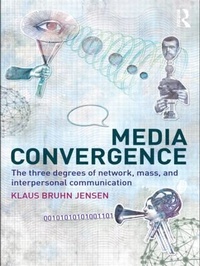
Media Convergence
The Three Degrees of Network, Mass and Interpersonal Communication
1st Edition
Published on 12. January 2010
Book
Paperback/Softback
198 pages
978-0-415-48204-2 (ISBN)
Description
The development of digital media presents a unique opportunity to reconsider what communication is, and what individuals, groups, and societies might hope to accomplish through new as well as old media. At a time when digital media still provoke both utopian and dystopian views of their likely consequences, Klaus Bruhn Jensen places these 'new' media in a comparative perspective together with 'old' mass media and face-to-face communication, restating the two classic questions of media studies: what do media do to people, and what do people do with media?
Media Convergence makes a distinction between three general types of media: the human body enabling communication in the flesh; the technically reproduced means of mass communication; and the digital technologies facilitating interaction one-to-one, one-to-many, as well as many-to-many.
Features include:
case studies, including mobile phones in everyday life, the Muhammad cartoons controversy and climate change as a global challenge for human communication and political action
diagrams, figures, and tables summarizing key concepts beyond standard 'models of communication'
systematic cross-referencing. Major terms are highlighted and cross-referenced throughout, with key concepts defined in margin notes.
Media Convergence makes a distinction between three general types of media: the human body enabling communication in the flesh; the technically reproduced means of mass communication; and the digital technologies facilitating interaction one-to-one, one-to-many, as well as many-to-many.
Features include:
case studies, including mobile phones in everyday life, the Muhammad cartoons controversy and climate change as a global challenge for human communication and political action
diagrams, figures, and tables summarizing key concepts beyond standard 'models of communication'
systematic cross-referencing. Major terms are highlighted and cross-referenced throughout, with key concepts defined in margin notes.
Reviews / Votes
In this compact and smart volume, Klaus Bruhn Jensen has done two essential things: shown us how rich the pragmatist tradition is for understanding communication and torn down the Berlin wall between interpersonal and mass communication. Media Convergence provides us with a trusty Virgil for navigating the digital jungle! - John D. Peters, The University of Iowa, USAMore details
Language
English
Place of publication
London
United Kingdom
Publishing group
Taylor & Francis Ltd
Target group
College/higher education
Product notice
Paperback (UK-B)
Dimensions
Height: 234 mm
Width: 156 mm
Weight
380 gr
ISBN-13
978-0-415-48204-2 (9780415482042)
Copyright in bibliographic data and cover images is held by Nielsen Book Services Limited or by the publishers or by their respective licensors: all rights reserved.
Schweitzer Classification
Other editions
New editions
Klaus Bruhn Jensen
Media Convergence
The Three Degrees of Network, Mass, and Interpersonal Communication
Book
03/2022
2nd Edition
Routledge
€60.10
Shipment within 10-20 days
Additional editions
Klaus Bruhn Jensen
Media Convergence
The Three Degrees of Network, Mass and Interpersonal Communication
Book
01/2010
1st Edition
Routledge
€193.45
Article exhausted; check for reprint
Person
Klaus Bruhn Jensen is Professor at the University of Copenhagen, Denmark. Recent publications include A Handbook of Media and Communication Research (2002) and International Encyclopedia of Communication (12 vols, 2008), for which he served as Area Editor of Communication Theory and Philosophy. Current research interests include internet studies, mobile media, and communication theory.
Content
List of illustrations. Preface. Part One - A Critique of Communication 1. Introduction: Communication - The Very Idea 2. Erro, Ergo Sum - Communication and Pragmatism in the History of Ideas 3. Differences that Make a Difference - The Art and Science of Media and Communication Research Part Two - Media of Three Degrees 4. Media Matters - The Material Conditions of Communication 5. Media Meanings - The Discourses, Genres, and Modalities of Communication 6. Media Institutions - Between Agency and Structure Part Three - The Double Hermeneutics of Media and Communication Research 7. Media of Science - Doing Communication Research 8. The Future of Communication - Pragmatism between Modernism and Postmodernism. References. Index