

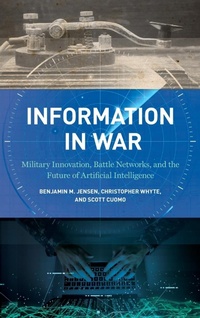
Information in War
Military Innovation, Battle Networks, and the Future of Artificial Intelligence
Published on 3. October 2022
Book
Hardback
320 pages
978-1-64712-263-8 (ISBN)
Description
An in-depth assessment of innovations in military information technology informs hypothetical outcomes for artificial intelligence adaptations
In the coming decades, artificial intelligence (AI) could revolutionize the way humans wage war. The military organizations that best innovate and adapt to this AI revolution will likely gain significant advantages over their rivals. To this end, great powers such as the United States, China, and Russia are already investing in novel sensing, reasoning, and learning technologies that will alter how militaries plan and fight. The resulting transformation could fundamentally change the character of war.
In Information in War, Benjamin Jensen, Christopher Whyte, and Scott Cuomo provide a deeper understanding of the AI revolution by exploring the relationship between information, organizational dynamics, and military power. The authors analyze how militaries adjust to new information communication technology historically to identify opportunities, risks, and obstacles that will almost certainly confront modern defense organizations as they pursue AI pathways to the future. Information in War builds on these historical cases to frame four alternative future scenarios exploring what the AI revolution could look like in the US military by 2040.
In the coming decades, artificial intelligence (AI) could revolutionize the way humans wage war. The military organizations that best innovate and adapt to this AI revolution will likely gain significant advantages over their rivals. To this end, great powers such as the United States, China, and Russia are already investing in novel sensing, reasoning, and learning technologies that will alter how militaries plan and fight. The resulting transformation could fundamentally change the character of war.
In Information in War, Benjamin Jensen, Christopher Whyte, and Scott Cuomo provide a deeper understanding of the AI revolution by exploring the relationship between information, organizational dynamics, and military power. The authors analyze how militaries adjust to new information communication technology historically to identify opportunities, risks, and obstacles that will almost certainly confront modern defense organizations as they pursue AI pathways to the future. Information in War builds on these historical cases to frame four alternative future scenarios exploring what the AI revolution could look like in the US military by 2040.
Reviews / Votes
Jensen, Whyte, and Cuomo's thought-provoking book is less about the promise of the military uses of AI and more about why that promise may not be realized. * Foreign Affairs * The authors, coming from different institutional backgrounds, have written a short book that is more than the sum of its parts. * Choice *More details
Language
English
Place of publication
Washington, DC
United States
Target group
Professional and scholarly
US School Grade: College Graduate Student and over
Illustrations
Not illustrated
Dimensions
Height: 229 mm
Width: 152 mm
Weight
544 gr
ISBN-13
978-1-64712-263-8 (9781647122638)
Copyright in bibliographic data and cover images is held by Nielsen Book Services Limited or by the publishers or by their respective licensors: all rights reserved.
Schweitzer Classification
Other editions
Additional editions
Benjamin M. Jensen | Christopher Whyte | Scott Cuomo
Information in War
Military Innovation, Battle Networks, and the Future of Artificial Intelligence
E-Book
10/2022
Georgetown University Press
€48.99
Available for download
Persons
Benjamin M. Jensen is a professor at the Marine Corps University's School of Advanced Warfighting, a senior fellow at the Center for Strategic and International Studies, and an officer in the US Army Reserves with multiple deployments.
Christopher Whyte is an assistant professor at the Wilder School of Government and Public Affairs at Virginia Commonwealth University.
Lt. Col. Scott Cuomo (USMC) is a veteran of the wars in Iraq and Afghanistan, served as the Marine Corps representative on the National Security Commission on Artificial Intelligence, and is currently assigned to the Office of the Secretary of Defense for Policy focused on Strategy and Force Development.
Christopher Whyte is an assistant professor at the Wilder School of Government and Public Affairs at Virginia Commonwealth University.
Lt. Col. Scott Cuomo (USMC) is a veteran of the wars in Iraq and Afghanistan, served as the Marine Corps representative on the National Security Commission on Artificial Intelligence, and is currently assigned to the Office of the Secretary of Defense for Policy focused on Strategy and Force Development.
Content
List of Illustrations
Preface
1. Will Artificial Intelligence Change War?
2. An Information Theory of Military Innovation
3. The Uncertain Rise of Radar
4. Creating the First Computerized Battle Network
5. The Revolution in Military Affairs
6. The Global Battle Network
7. Using the Past to Chart Alternative Futures
Bibliography
Index
About the Authors
Preface
1. Will Artificial Intelligence Change War?
2. An Information Theory of Military Innovation
3. The Uncertain Rise of Radar
4. Creating the First Computerized Battle Network
5. The Revolution in Military Affairs
6. The Global Battle Network
7. Using the Past to Chart Alternative Futures
Bibliography
Index
About the Authors