

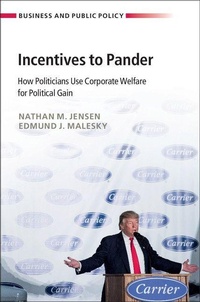
Incentives to Pander
How Politicians Use Corporate Welfare for Political Gain
Published on 15. March 2018
Book
Hardback
268 pages
978-1-108-41890-4 (ISBN)
Description
Policies targeting individual companies for economic development incentives, such as tax holidays and abatements, are generally seen as inefficient, economically costly, and distortionary. Despite this evidence, politicians still choose to use these policies to claim credit for attracting investment. Thus, while fiscal incentives are economically inefficient, they pose an effective pandering strategy for politicians. Using original surveys of voters in the United States, Canada and the United Kingdom, as well as data on incentive use by politicians in the US, Vietnam and Russia, this book provides compelling evidence for the use of fiscal incentives for political gain and shows how such pandering appears to be associated with growing economic inequality. As national and subnational governments surrender valuable tax revenue to attract businesses in the vain hope of long-term economic growth, they are left with fiscal shortfalls that have been filled through regressive sales taxes, police fines and penalties, and cuts to public education.
Reviews / Votes
'The puzzle of investment incentives like tax breaks and regulatory exemptions is that although they are generally inefficient, governments around the world - from Kansas to Vietnam - use them to attract investors. In this provocative and wide-ranging book, Jensen and Malesky show that politicians choose these policies because they reap political benefits from doing so. By identifying the political logic that drives inefficient policies, this book reveals how citizens may press for better policymaking.' Thomas Pepinsky, Cornell University, New York 'Is all politics local? In this intriguing study, Jensen and Malesky show that though separated by geography and political systems, politicians in the United States, Canada, Russia, and Vietnam all use fiscal policy to generate and sustain political support. The authors masterfully weave a variety of evidence - individual level surveys and original data on policymakers' incentives - to show how short term fiscal policies often have dramatically negative long term consequences.' David Leblang, University of VirginiaMore details
Series
Language
English
Place of publication
Cambridge
United Kingdom
Target group
Professional and scholarly
Illustrations
Worked examples or Exercises
Dimensions
Height: 235 mm
Width: 157 mm
Thickness: 19 mm
Weight
549 gr
ISBN-13
978-1-108-41890-4 (9781108418904)
Copyright in bibliographic data and cover images is held by Nielsen Book Services Limited or by the publishers or by their respective licensors: all rights reserved.
Schweitzer Classification
Other editions
Additional editions
Nathan M. Jensen | Edmund J. Malesky
Incentives to Pander
How Politicians Use Corporate Welfare for Political Gain
Book
06/2019
Cambridge University Press
€49.00
Shipment within 15-20 days
E-Book
03/2018
Cambridge University Press
€24.49
Available for download
Nathan M. Jensen | Edmund J. Malesky
Incentives to Pander
How Politicians Use Corporate Welfare for Political Gain
E-Book
02/2018
Cambridge University Press
€29.49
Available for download
Persons
Nathan M. Jensen is Professor of Government at the University of Texas, Austin. His research focusses on government economic development strategies, firm non-market strategies and business-government relations, as well as the politics of oil and natural resources, political risk in emerging markets, trade policy, and international institutions. Edmund Malesky is a Professor of Political Economy and the Associate Chair of the Political Science Department at Duke University, North Carolina. He is a noted specialist in economic development, authoritarian institutions, and comparative political economy in Vietnam and has published extensively in leading political science and economic journals.
Content
1. Introduction: the global competition for capital meets local politics; 2. A theory of the political use of investment incentives; 3. Incentives and the competition for investment within countries and around the world; 4. The economic case against investment incentives; 5. Economic or political competition? Allocation and oversight of US incentives; 6. Money for money: campaign contributions in exchange for financial incentives?; 7. Political pandering in the United States: a survey experiment on incentives and investment; 8. Pandering upward: tax incentives and credit claiming in authoritarian countries; 9. The distributional effects of investment incentives; 10. Potential policy solutions to the pandering problem; 11. Final thoughts.