

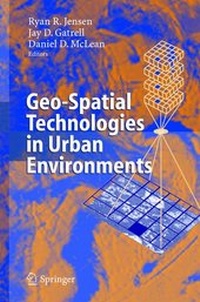
Geo-Spatial Technologies in Urban Environments
Policy, Practice, and Pixels
2nd Edition
Published on 22. October 2004
Book
Hardback
XVI, 176 pages
978-3-540-22263-7 (ISBN)
Description
This book demonstrates the application of remote-sensing data and geographic information systems to the exploration of issues often ignored by the mainstream community of geo-technical specialists such as urban forestry, urban traffic, migration or quality of life in urban areas. Case studies show how environmental science and planning, sociology, landscape ecology and architecture can benefit from employing remote-sensing data and GIS.
More details
Edition
2nd ed.
Language
English
Place of publication
Heidelberg
Germany
Publishing group
Springer Berlin
Target group
College/higher education
Professional and scholarly
Illustrations
14
45 s/w Abbildungen, 14 s/w Tabellen
45 illus.
Dimensions
Height: 23.5 cm
Width: 15.5 cm
Weight
454 gr
ISBN-13
978-3-540-22263-7 (9783540222637)
DOI
10.1007/b137912
Schweitzer Classification
Other editions
New editions
Ryan R. Jensen | Jay D. Gatrell | Daniel McLean
Geo-Spatial Technologies in Urban Environments
Policy, Practice, and Pixels
Book
01/2007
2nd Edition
Springer
€160.49
Shipment within 10-15 days
Additional editions
Ryan R. Jensen | Jay D. Gatrell | Daniel McLean
Geo-Spatial Technologies in Urban Environments
Policy, Practice, and Pixels
E-Book
08/2005
1st Edition
Springer
€109.99
Available for download
Content
Applying Geospatial Technologies in Urban Environments.- Remote Sensing of Impervious Surfaces and Building Infrastructure.- Policy Implications of Remote Sensing in Understanding Urban Environments: Developing a Wetlands Inventory for Community Decision-Making in Lucas County, Ohio.- Making Spatial Data Usable to the General Public: a Case Study in Tax Mapping.- Modeling Human-Environment Interactions.- The Relationship Between Urban Leaf Area and Summertime Household Energy Usage.- The Urban Environment, Socioeconomic Conditions, and Quality of Life: An Alternative Framework for Understanding and Assessing Environmental Justice.- Image Homogeneity and Urban Demographics: An Integrated Approach to Applied Geo-techniques.- Local Government Perceptions of Urban Forestry.- Satellite Remote Sensing of Urban Heat Islands: Current Practice and Prospects.- Remote Sensing as a Program Assessment Device: The case of Urban Forestry and the Competition for Local Investment.- Urban Sprawl Detection Using Satellite Imagery and Geographically Weighted Regression.- Satellites, Census, and the Quality of Life.- Urban Environmental Approaches: Policy, Application & Method.