

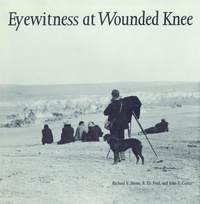
Eyewitness at Wounded Knee
Published on 1. September 2011
Book
Paperback/Softback
232 pages
978-0-8032-3609-7 (ISBN)
Description
On a wintry day in December 1890, near a creek named Wounded Knee on the Pine Ridge Reservation in South Dakota, the Seventh Cavalry of the U.S. Army opened fire on an encampment of Sioux Indians. This assault claimed more than 250 lives, including those of many Indian women and children. The tragedy at Wounded Knee has often been written about, but the existing photographs have received little attention until now.
Eyewitness at Wounded Knee brings together and assesses for the first time some 150 photographs that were made before and immediately after the massacre. Present at the scene were two itinerant photographers, George Trager and Clarence Grant Morelodge, whose work has never before been published. Accompanying commentaries focus on both the Indian and the military sides of the story. Richard E. Jensen analyzes the political and economic quagmire in which the Sioux found themselves after 1877. R. Eli Paul considers the army's role at Wounded Knee. John E. Carter discusses the photographers and also the reporters and relic hunters who were looking to profit from the misfortune of others.
For this Bison Books edition each image has been digitally enhanced and restored, making the photographs as compelling as the event itself. Heather Cox Richardson tells the story behind the endeavor to present a meaningful account of this significant historical event.
Eyewitness at Wounded Knee brings together and assesses for the first time some 150 photographs that were made before and immediately after the massacre. Present at the scene were two itinerant photographers, George Trager and Clarence Grant Morelodge, whose work has never before been published. Accompanying commentaries focus on both the Indian and the military sides of the story. Richard E. Jensen analyzes the political and economic quagmire in which the Sioux found themselves after 1877. R. Eli Paul considers the army's role at Wounded Knee. John E. Carter discusses the photographers and also the reporters and relic hunters who were looking to profit from the misfortune of others.
For this Bison Books edition each image has been digitally enhanced and restored, making the photographs as compelling as the event itself. Heather Cox Richardson tells the story behind the endeavor to present a meaningful account of this significant historical event.
Reviews / Votes
"Although the subject is somber, the vivid photos and well-written text present a full and useful history."-Omaha World-HeraldMore details
Series
Language
English
Place of publication
Nebraska
United States
Publishing group
University of Nebraska Press
Target group
Professional and scholarly
Product notice
Paperback (trade)
Illustrations
150 photographs, 15 illustrations, 2 maps
Dimensions
Height: 241 mm
Width: 235 mm
Thickness: 22 mm
Weight
1019 gr
ISBN-13
978-0-8032-3609-7 (9780803236097)
Copyright in bibliographic data and cover images is held by Nielsen Book Services Limited or by the publishers or by their respective licensors: all rights reserved.
Schweitzer Classification
Persons
Richard E. Jensen is the editor of The Pawnee Mission Letters, 1834-1851 (Nebraska 2010) and two volumes of Voices of the American West (Nebraska 2005). R. Eli Paul is the editor of The Nebraska Indian Wars Reader, 1865-1877 (Nebraska 1998). John E. Carter is a senior research folklorist at the Nebraska State Historical Society and the author of Solomon D. Butcher: Photographing the American Dream (Nebraska 1985). James A. Hanson is the editor of Museum of the Fur Trade's publications and the author of When Skins Were Money: A History of the Fur Trade. Heather Cox Richardson is a professor of history at the University of Massachusetts and the author of Wounded Knee: Party Politics and the Road to an American Massacre.
Content
Introduction - Heather Cox RichardsonForeword - James A. Hanson CHAPTER ONE: Another Look at Wounded Knee - Richard E. JensenCHAPTER TWO: "Your Country Is Surrounded" - R. Eli PaulCHAPTER THREE: Making Pictures for a News-Hungry Nation - John E. Carter THE PHOTOGRAPHS:PreludeThe BattlefieldThe War's EndEpilogue NotesReferencesAcknowledgmentsList of Photograph RepositoriesIndex