

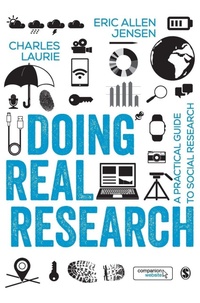
Doing Real Research
A Practical Guide to Social Research
1st Edition
Published on 31. March 2016
Book
Hardback
400 pages
978-1-4462-7387-6 (ISBN)
Description
Challenging the formality and idealized settings of conventional methods teaching and opting instead for a real world approach to social research, this book offers frank, practical advice designed to empower students and researchers alike.
Theoretically robust and with an exhaustive coverage of key methodologies and methods the title establishes the cornerstones of social research. Examples reflect research conducted inside and outside formal university settings and range from the extremes of war torn countries to the complexities of school classrooms.
Supported by a wealth of learning features and tools the textbook and website include:
Video top tips
Podcasts
Full text journal articles
Interviews with researchers conducting field research
Links to external websites and blogs
Student exercises
Real world case studies
Theoretically robust and with an exhaustive coverage of key methodologies and methods the title establishes the cornerstones of social research. Examples reflect research conducted inside and outside formal university settings and range from the extremes of war torn countries to the complexities of school classrooms.
Supported by a wealth of learning features and tools the textbook and website include:
Video top tips
Podcasts
Full text journal articles
Interviews with researchers conducting field research
Links to external websites and blogs
Student exercises
Real world case studies
Reviews / Votes
'I am very impressed by the format of the book and the learning features. The practical step-by-step approach is better than any of the texts we currently use, and the book contains a valuable chapter on risk evaluation in the field, so often absent in research textbooks' -- Barry Turner 'This textbook enables the student-researcher to learn very practical skills to prepare for the research journey. Providing a clear 'how to' guide from research design, ethics, data collection and analysis through to presenting research data, much of what you need to know is here. Accessible and informative, this textbook will inspire students to get into the field and become researchers' -- Teela Sanders 'This book provides such an extensive overview of how to plan, execute and write-up a research project that it will be invaluable for post-graduate students across the humanities. It is rich in detail, comprehensive in coverage and the addition of many real-life examples makes this book extremely accessible for students, teachers and researchers alike' -- Dr Rory Pilossof 'A well-written, easy to read and very practical handbook to guide taught Masters students through all the key stages of their dissertation work' -- Ian Charity 'A well-written book that highlights the different kinds of challenges and risks experienced by researchers and provides practical solutions. It includes valuable tools, strategies and tactics for doing research and overcoming the taken-for-granted difficulties that may potentially affect the viability of any research project' -- Dr Sizwe Phakathi 'This is an easy to follow, practical guide to entering the field of social research. Students will love this introduction, which covers key themes of research without getting bogged down in academic jargon' -- Brady Wagoner 'This research book succinctly presents research in a logical and tangible way that would enable students to engage with the practical application of the research process in an informed way. It is written in a facilitative way that endears the reader to its style, making it an invaluable resource to undergraduate students.' -- Neal Cook This book is beneficial to anyone working in social research, serving as a reminder that we all face the same challenges in our research, wherever we are in our careers. This book is your manager: offering knowledgeable and practical advice; and also your colleague: offering informal and non-judgemental support to help you design and carry out valid, reliable and ethical research. This practical and honest approach meansthat this book does not leave my desk! -- Amy Edwards
More details
Edition
First Edition
Language
English
Place of publication
London
United Kingdom
Target group
College/higher education
Dimensions
Height: 250 mm
Width: 175 mm
Thickness: 26 mm
Weight
867 gr
ISBN-13
978-1-4462-7387-6 (9781446273876)
Copyright in bibliographic data and cover images is held by Nielsen Book Services Limited or by the publishers or by their respective licensors: all rights reserved.
Schweitzer Classification
Other editions
Additional editions
Book
03/2016
1st Edition
SAGE Publications Ltd
€124.60
Shipment within 15-20 days

E-Book
03/2016
1st Edition
SAGE Publications Ltd
€85.49
Available for download

E-Book
03/2016
1st Edition
SAGE Publications Ltd
€85.49
Available for download
Persons
Eric Jensen is an Associate Professor in the Department of Sociology at the University of Warwick. He has two main research specialisms: Public engagement, and media. He also contributes to the development of impact evaluation methodology and social change theory. His research on the impacts of public engagement cuts across a wide range of settings, from zoos to conservation training programmes to museums.
Content
Introduction
PART ONE: LAYING THE FOUNDATIONS
Chapter 1: Research design: Planning for the unknowable, the unexpected and the undesirable
Chapter 2: How to do a literature review: Using existing evidence and ideas to build a foundation
Chapter 3: How to be an ethical researcher
PART TWO: IN THE FIELD
Chapter 4: How to manage risk: Protecting yourself and your equipment
Chapter 5: How to find a representative sample
Chapter 6: How to gain research participation
PART THREE: DATA COLLECTION METHODS
Chapter 7: How to do Survey Research
Chapter 8: How to do interviews and focus groups
Chapter 9: How to use existing data: Challenges and opportunities
PART FOUR: MANAGING AND ANALYZING DATA
Chapter 10: How to manage your data
Chapter 11: How to do qualitative data analysis
Chapter 12: How to do quantitative data analysis
PART FIVE: PRESENTING YOUR RESEARCH
Chapter 13: How to Write up your Research
Concluding Thoughts
PART ONE: LAYING THE FOUNDATIONS
Chapter 1: Research design: Planning for the unknowable, the unexpected and the undesirable
Chapter 2: How to do a literature review: Using existing evidence and ideas to build a foundation
Chapter 3: How to be an ethical researcher
PART TWO: IN THE FIELD
Chapter 4: How to manage risk: Protecting yourself and your equipment
Chapter 5: How to find a representative sample
Chapter 6: How to gain research participation
PART THREE: DATA COLLECTION METHODS
Chapter 7: How to do Survey Research
Chapter 8: How to do interviews and focus groups
Chapter 9: How to use existing data: Challenges and opportunities
PART FOUR: MANAGING AND ANALYZING DATA
Chapter 10: How to manage your data
Chapter 11: How to do qualitative data analysis
Chapter 12: How to do quantitative data analysis
PART FIVE: PRESENTING YOUR RESEARCH
Chapter 13: How to Write up your Research
Concluding Thoughts