

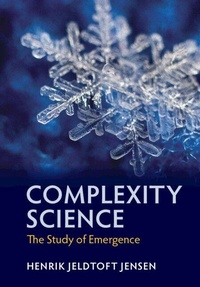
Complexity Science
The Study of Emergence
Published on 17. November 2022
Book
Hardback
458 pages
978-1-108-83476-6 (ISBN)
Description
Ecosystems, the human brain, ant colonies, and economic networks are all complex systems displaying collective behaviour, or emergence, beyond the sum of their parts. Complexity science is the systematic investigation of these emergent phenomena, and stretches across disciplines, from physics and mathematics, to biological and social sciences. This introductory textbook provides detailed coverage of this rapidly growing field, accommodating readers from a variety of backgrounds, and with varying levels of mathematical skill. Part I presents the underlying principles of complexity science, to ensure students have a solid understanding of the conceptual framework. The second part introduces the key mathematical tools central to complexity science, gradually developing the mathematical formalism, with more advanced material provided in boxes. A broad range of end of chapter problems and extended projects offer opportunities for homework assignments and student research projects, with solutions available to instructors online. Key terms are highlighted in bold and listed in a glossary for easy reference, while annotated reading lists offer the option for extended reading and research.
Reviews / Votes
'Henrik Jensen has produced a masterpiece - describing complexity science from the perspective of a universal theory applicable to many different subject areas, and based on fundamental theoretical principles. A clear virtue of the exposition is that many different topics relevant for complex systems are first treated in an easy-going introductory way, while concrete mathematical models and applications are then provided in the second part of the book. This is a well-thought-through textbook that presents complexity science as a whole, rather than as a collection of single topics.' Christian Beck, Queen Mary University of London 'This is a very structured and well-done textbook on complex systems. I am teaching LLMs and NLP for complex systems and it will provide a lot of help with foundations of complexity science that I can use as examples and problems in my classes on LLMs.' Anamaria Berea, George Mason UniversityMore details
Language
English
Place of publication
Cambridge
United Kingdom
Target group
College/higher education
Illustrations
Worked examples or Exercises
Dimensions
Height: 262 mm
Width: 183 mm
Thickness: 27 mm
Weight
1103 gr
ISBN-13
978-1-108-83476-6 (9781108834766)
Copyright in bibliographic data and cover images is held by Nielsen Book Services Limited or by the publishers or by their respective licensors: all rights reserved.
Schweitzer Classification
Other editions
Additional editions
E-Book
11/2022
Cambridge University Press
€48.99
Available for download
Person
Henrik Jeldtoft Jensen is Professor of Mathematical Physics at Imperial College London, and leads the Centre for Complexity Science. He is a prominent expert in complexity science and is involved in a variety of high-profile research projects including the application of co-evolutionary dynamics to the modelling of socio-economical sustainability, finance, cultural evolution, innovation, and cell diversity in cancer tumour growth, and has also worked with the Guildhall School of Music and Drama to identify differences in the neuronal response of audience and performers depending on the mode of performance. He has published two books on self-organized criticality and complex systems.
Content
Part I. Conceptual Foundation of Complexity Science: 1. The Science of Emergence; 2. Conceptual Framework of Emergence; 3. Specific Types of Emergent Behaviour; 4. The Value of Prototypical Models of Emergence; Part II. Mathematical Tools of Complexity Science: 5. Branching Processes; 6. Statistical Mechanics; 7. Synchronisation; 8. Network Theory; 9. Information Theory and Entropy; 10. Stochastic Dynamics and Equations for the Probabilities; 11. Agent-Based Modelling; 12. Intermittency; 13. Tipping Points, Transitions and Forecasting; 14. Concluding Comments and a Look to the Future.