

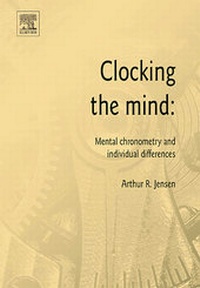
Clocking the Mind
Mental Chronometry and Individual Differences
Published on 10. July 2006
Book
Hardback
286 pages
978-0-08-044939-5 (ISBN)
Description
Mental Chronometry (MC) comprises a variety of techniques for measuring the speed with which the brain processes information.First developed in mid-1800, MC was subsequently eclipsed by more complex and practically useful types of psychometric tests stemming from Alfred Binet. This class of mental tests, however, has no true metric relating the test scores to any specific properties of the brain per se. The scores merely represent an ordinal scale, only ranking individuals according to their overall performance on a variety of complex mental tasks. The resulting scores represent no more than ranks rather than being a true metrical scale of any specific dimension of brain function. Such an ordinal scale, which merely ranks individuals in some defined population, possesses no true scale properties, possessing neither a true zero or equal intervals throughout the scale. This deficiency obstructs the development of a true natural science of mental ability. The present burgeoning interest in understanding individual differences in mental abilities in terms of the natural sciences, biology and the brain sciences in particular, demands direct measures that functionally link brain and behavior. One such natural ratio scale is time itself - the time it takes the brain to perform some elementary cognitive task, measured in milliseconds. After more than 25 years researching MC, Jensen here presents results on an absolute scale showing times for intake of visual and auditory information, for accessing short-term and long-term memory, and other cognitive skills, as a function of age, at yearly intervals from 3 to 80 years. The possible uses of MC in neurological diagnosis and the monitoring of drug effects on cognition, the chronometric study of special time-sensitive talents such as musical performance, and presents a theory of general intelligence, or g, as a function of the rate of oscillation of neural action potentials as measured by chronometric methods. Finally, Jensen urges the world-wide standardization of chronometric methods as necessary for advancing MC as a crucial branch of biopsychological science.
Reviews / Votes
"Jensen's writing is clear and concise, and every chapter is densely packed with information. The historical treatment of chronometry is perhaps most enjoyable, filled with personal anecdotes and unique insight into the politics of 20th century psychology and psychometrics." --Chris Chatham, Developing IntelligenceMore details
Language
English
Place of publication
Oxford
United Kingdom
Publishing group
Elsevier Science & Technology
Target group
Professional and scholarly
Psychologists; Neuroscientists; Statisticians; Social Scientists
Dimensions
Height: 240 mm
Width: 165 mm
Weight
690 gr
ISBN-13
978-0-08-044939-5 (9780080449395)
Copyright in bibliographic data and cover images is held by Nielsen Book Services Limited or by the publishers or by their respective licensors: all rights reserved.
Schweitzer Classification
Other editions
Additional editions
E-Book
07/2006
Elsevier
€99.95
Available for download
Person
Content
A Brief Chronology of Mental Chronometry. Chronometric Terminology and Paradigms. RT as a Function of Experimental Conditions. The Measurement of Chronometric Variables. Chronometry of Mental Development. Chronometry of Cognitive Aging. The Heritability of Chronometric Variables. The Factor Structure of RT in ECTs. Correlated Chronometric and Psychometric Variables. Sensory Intake Speed and Inspection Time. Theory of the Correlation Between Response Time and Intelligence. The Relation of RT to Other Psychological Variables. Clinical and Medical Uses of Chronometry. The Standardization of Chronometry.