

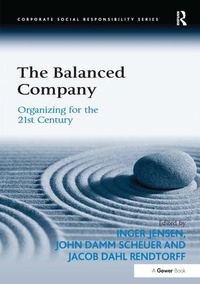
The Balanced Company
Organizing for the 21st Century
1st Edition
Published on 18. December 2013
Book
Hardback
266 pages
978-1-4094-4559-3 (ISBN)
Description
Today's organizations are embedded in global and local network relationships that demand more. They have to consider the importance to customers, investors and employees of being respected in wider society and behaving ethically, so it is increasingly important for companies to reflect systematically on how to balance profits with other criteria when making decisions and acting. In short, they need to learn how to become The Balanced Company. Requiring sustainability in production processes and ethical employment of the work force in suppliers' production facilities, at home and abroad, has resulted in new challenges. Strategists need to make balanced choices about long-term goals and the allocation of resources. They must analyse, understand and adjust strategies to market, political, value and technology-related changes. Communication specialists need to take the value systems and assumptions of stakeholders into consideration. Change specialists need to balance continuity and change. Meanwhile, managers make balanced decisions about control or trust; human resources design jobs to make them attractive as well as motivating, and marketers must consider what is important to consumers and stakeholders. Last but not least, leaders have to acknowledge that there are times when organizations have to be taken out of balance during change. The Balanced Company provides answers to corporately responsible and ethically driven balanced decision making. Read it to help your company and stakeholders identify what can be achieved and what to avoid, and about the processes by which values are taken into account and applied in practice.
Reviews / Votes
'The disastrous fall out from corporate and financial excesses unleashed by decades of deregulation and shareholder value maximization makes it an urgent necessity to develop alternatives to the predominant perceptions of the firm. This book offers an interesting new perspective. The idea of the "balanced firm" provides a framework for improved management of complex stakeholder relationships in companies and organizations.' Klaus Nielsen, Birkbeck, University of London, UKMore details
Series
Language
English
Place of publication
London
United Kingdom
Publishing group
Taylor & Francis Ltd
Target group
Professional and scholarly
Professional Practice & Development
Dimensions
Height: 246 mm
Width: 174 mm
Weight
650 gr
ISBN-13
978-1-4094-4559-3 (9781409445593)
Copyright in bibliographic data and cover images is held by Nielsen Book Services Limited or by the publishers or by their respective licensors: all rights reserved.
Schweitzer Classification
Other editions
Additional editions
E-Book
03/2016
Routledge
€205.99
Available for download
E-Book
03/2016
Routledge
€205.99
Available for download
Persons
Inger Jensen has an MSc. in Psychology and is an associate professor in social psychology and sociology at the Department of Communication, Business and Information Technologies (CBIT) at Roskilde University, Denmark. She is a Board member and former President of EUPRERA (the European Public Relations Education and Research Association) and has published a number of articles and papers. John Damm Scheuer has an MSc. in International Business, a PhD in Organizational Studies and is associate professor in organizational change in the same department. He has authored, edited and contributed to a number of books. Professor Jacob Dahl Rendtorff has a PhD and is a Doctor of Science. He is Professor of Responsibility, Ethics and Legitimacy of Corporations at Roskilde and Head of the Research Group on Management, Change and Corporations. He has been a visiting professor at universities in Europe and the United States and has published several books.
Content
Chapter 1 Introduction, Inger Jensen, John Damm Scheuer, Jacob Dahl Rendtorff; Chapter 2 Balancing Former Opposites as Mutual Preconditions?, Susanne Holmstroem; Chapter 3 A Business Ethics Approach to Balance, Jacob Dahl Rendtorff; Chapter 4 Balancing through Institutionalization, Inger Jensen; Chapter 5 Balancing Business Interests with Government Interests in Corporate Social Responsibility, Karin Buhmann; Chapter 6 Managing Complexity, Anita Mac; Chapter 7 Managing Volunteers as Stakeholders, Jesper Schlamovitz; Chapter 8 The Sociomateriality of Balancing, Niels Christian Mossfeldt Nickelsen; Chapter 9 Balancing through Episodic Learning, John Damm Scheuer; Chapter 10 From Shareholder to Stakeholder Economics?, Poul Wolffsen; Chapter 11 Conclusion: The Balanced Company-Organizing for the Twenty-first Century, John Damm Scheuer, Inger Jensen;