

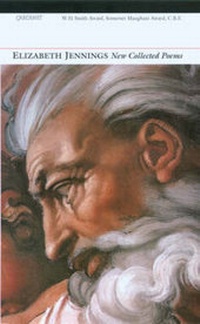
New Collected Poems
Published on 28. February 2002
Book
Paperback/Softback
401 pages
978-1-85754-559-3 (ISBN)
Description
Does history tell stories?from 'Concerning History'
Yes, if the poet listens carefully. Elizabeth Jennings listens carefully, through spiritual, emotional and mental turbulence. She has created an abidingly popular body of poetry, using traditional forms with experimental vigour, keeping her spirit attuned to her art and language. Her vocation is praise, as a lover praises the things made, the makers and the maker.
New Collected Poems incorporates her award winning 1986 Collected Poems, adding from the poems she wrote in the next fifteen years. In that time she found new themes and styles, exploring by means of the verse-essay, the extended sequence, the epistle and love elegy. When experience is extreme, poetry for her is never exorcism, always sacrament, a sharing, a way back form the edge, not over it. As a critic in Every Changing Shape she insisted on continuities in the language if poetry, its contingencies. 'Poets work upon and through each other,' she declared. Within her own work these continuities are brilliant are brilliantly in evidence.
Yes, if the poet listens carefully. Elizabeth Jennings listens carefully, through spiritual, emotional and mental turbulence. She has created an abidingly popular body of poetry, using traditional forms with experimental vigour, keeping her spirit attuned to her art and language. Her vocation is praise, as a lover praises the things made, the makers and the maker.
New Collected Poems incorporates her award winning 1986 Collected Poems, adding from the poems she wrote in the next fifteen years. In that time she found new themes and styles, exploring by means of the verse-essay, the extended sequence, the epistle and love elegy. When experience is extreme, poetry for her is never exorcism, always sacrament, a sharing, a way back form the edge, not over it. As a critic in Every Changing Shape she insisted on continuities in the language if poetry, its contingencies. 'Poets work upon and through each other,' she declared. Within her own work these continuities are brilliant are brilliantly in evidence.
Reviews / Votes
"Some of the finest lyric poetry of the 20th century." --Anne Stevenson, the "Sunday Times"More details
Edition
New edition
Language
English
Place of publication
Manchester
United Kingdom
Target group
College/higher education
Professional and scholarly
Edition type
New edition
Dimensions
Height: 216 mm
Width: 135 mm
Thickness: 30 mm
Weight
527 gr
ISBN-13
978-1-85754-559-3 (9781857545593)
Copyright in bibliographic data and cover images is held by Nielsen Book Services Limited or by the publishers or by their respective licensors: all rights reserved.
Schweitzer Classification
Persons
Elizabeth Jennings was born in Boston, Lincolnshire in 1926, and lived most of her life in Oxford, where she moved in 1932. She was educated at Rye St Antony and Oxford High School before reading English at St Anne's College, Oxford, where she began a B.Litt., but left to pursue a career in copy-editing in London. Returning to Oxford to take up a full-time post as a librarian at the city library, Jennings worked briefly at Chatto and Windus before becoming a full-time poet. Her second volume of poetry, A Way of Looking (1955), won the Somerset Maugham Award, which allowed her to travel to Rome, a city which had an immense impact on her poetry and Roman Catholic faith. While she suffered from physical and mental ill health from her early thirties, Jennings was a popular and widely read poet. She received the W.H. Smith award in 1987 for Collected Poems 1953-1985, and in 1992 was awarded a CBE. She died in Rosebank Care Home, Bampton, in 2001 and is buried in Wolvercote Cemetery, Oxford. Michael Schmidt FRSL, poet, scholar, critic and translator, was born in Mexico in 1947; he studied at Harvard and at Wadham College, Oxford, before settling in England. Among his many publications are several collections of poems and a novel, The Colonist (1981), about a boy's childhood in Mexico. He is general editor of PN Review and founder as well as managing director of Carcanet Press. He lives in Manchester.