

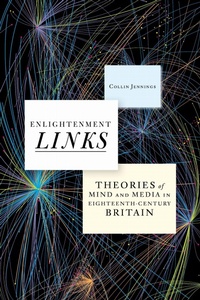
Enlightenment Links
Theories of Mind and Media in Eighteenth-Century Britain
Published on 21. May 2024
Book
Hardback
282 pages
978-1-5036-3797-9 (ISBN)
Description
In this ambitious work, Collin Jennings applies computational methods to eighteenth-century fiction, history, and poetry to reveal the nonlinear courses of reading they produce. Hallmark genres of the British Enlightenment, such as the novel and the stadial history, are typically viewed as narratives of linear progress, emerging from Britain's imperial growth and scientific advancement. Jennings foregrounds Enlightenment links: the paratextual devices, including cross-references, footnotes, and epigraphs, that make words work differently by pointing the reader to places inside and outside the text. Writers and printers combined text and paratext to produce nonlinear paths of reading and polysemous forms of reference that resist simple, causal structures of experience or theories of mind. Alexander Pope, Adam Smith, Ann Radcliffe, and other writers developed genres that operate diagrammatically, with different points of entry and varied relationships between the language and format of books.
Revealing the eighteenth-century genealogy of the digital hyperlinks of today, Enlightenment Links argues that emergent print genres combined language and links to bring forward the associative, circular, and multi-sequential ways in which literature makes language work.
Revealing the eighteenth-century genealogy of the digital hyperlinks of today, Enlightenment Links argues that emergent print genres combined language and links to bring forward the associative, circular, and multi-sequential ways in which literature makes language work.
Reviews / Votes
"This welcome, new scholarly work collects computational studies of reference works, poetry, novels, and nonfiction. The writing is ambitious and exciting, and I came away convinced that the link is a literary device-in fact, one with an eighteenth-century genealogy."-Brad Pasanek, University of Virginia "This study breaks new ground with respect to what we know about the organization of knowledge in the British Enlightenment. Jennings provocatively inverts his historical texts in order to read them as engaging with our current technologies of AI."-Peter de Bolla, University of Cambridge "Enlightenment Links charts a course 'linking' the 21st and 18th centuries that provides sufficiently deep matter for sustained rumination. Recommended."-A. W. Lee, CHOICE "Enlightenment Links is an impressive book. Like its source material, it moves between specific concrete instances and larger, more abstract concepts. In doing so, Collins shows how Enlightenment links served not only to connect texts, but to connect those texts to the world."-Jason Gulya, H-AlbionMore details
Series
Edition
New edition
Language
English
Place of publication
Palo Alto
United States
Target group
College/higher education
Edition type
New edition
Product notice
Cloth
Illustrations
11 tables, 12 figures, 11 halftones
Dimensions
Height: 229 mm
Width: 152 mm
Thickness: 23 mm
Weight
576 gr
ISBN-13
978-1-5036-3797-9 (9781503637979)
Copyright in bibliographic data and cover images is held by Nielsen Book Services Limited or by the publishers or by their respective licensors: all rights reserved.
Schweitzer Classification
Other editions
Additional editions
E-Book
05/2024
Stanford University Press
€139.99
Available for download
Person
Collin Jennings is Assistant Professor of English at Miami University.
Content
Acknowledgments
Introduction: What's in a Link?
1. Cross-References: Shapes of Knowledge in Chambers's Cyclopaedia
2. Footnotes: The Poetics of Progress
3. Indexes: Techniques of Abstraction in the Scottish Philosophical History
4. Epigraphs: Paratextual Spaces in Novels of the 1790s
Conclusion: The Future of Links
Appendix: Data and Methods
Notes
Bibliography
Index
Introduction: What's in a Link?
1. Cross-References: Shapes of Knowledge in Chambers's Cyclopaedia
2. Footnotes: The Poetics of Progress
3. Indexes: Techniques of Abstraction in the Scottish Philosophical History
4. Epigraphs: Paratextual Spaces in Novels of the 1790s
Conclusion: The Future of Links
Appendix: Data and Methods
Notes
Bibliography
Index