

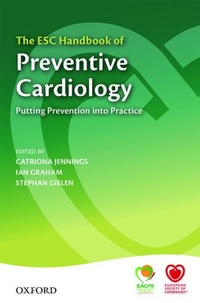
The ESC Handbook of Preventive Cardiology
Putting Prevention into Practice
1st Edition
Published on 28. July 2016
Book
Paperback/Softback
240 pages
978-0-19-967403-9 (ISBN)
Description
The ESC Handbook of Preventive Cardiology is a 'how-to' manual for busy healthcare professionals. Complementing the 2012 Joint European Guidelines on cardiovascular disease prevention and in line with recommendations from the European Association of Preventive Cardiology and it is an invaluable source of tools and skills to assist with the delivery of effective cardiovascular disease prevention.
While acknowledging that cardiovascular disease prevention efforts must be complemented by societal and community based strategies, this handbook focuses on practical strategies that can be used in clinical settings. Concise and easily accessible, it guides readers through the patient and family pathway - from patient identification, recruitment of the patient and family, assessing lifestyle and risk factors, to managing lifestyle change, reducing risk factors, and compliance with cardio-protective drug therapies. Information on how to deliver a health promotion workshop programme and run a supervised exercise programme is also included.
Previously published as Preventive Cardiology: A practical manual and now fully revised and updated and packed with checklists and diagrams, such as risk estimation charts, The ESC Handbook of Preventive Cardiology helps health workers contribute in real and practical ways to the prevention of artherosclerotic cardiovascular disease.
This print edition of The ESC Handbook of Preventive Cardiology, Putting Prevention into Practice comes with access to the online version on Oxford Medicine Online, for as long as the edition is published by Oxford University Press. By activating your unique access code, you can read and annotate the full text online, follow links from the references to primary research materials, and view, enlarge and download all the figures and tables.
While acknowledging that cardiovascular disease prevention efforts must be complemented by societal and community based strategies, this handbook focuses on practical strategies that can be used in clinical settings. Concise and easily accessible, it guides readers through the patient and family pathway - from patient identification, recruitment of the patient and family, assessing lifestyle and risk factors, to managing lifestyle change, reducing risk factors, and compliance with cardio-protective drug therapies. Information on how to deliver a health promotion workshop programme and run a supervised exercise programme is also included.
Previously published as Preventive Cardiology: A practical manual and now fully revised and updated and packed with checklists and diagrams, such as risk estimation charts, The ESC Handbook of Preventive Cardiology helps health workers contribute in real and practical ways to the prevention of artherosclerotic cardiovascular disease.
This print edition of The ESC Handbook of Preventive Cardiology, Putting Prevention into Practice comes with access to the online version on Oxford Medicine Online, for as long as the edition is published by Oxford University Press. By activating your unique access code, you can read and annotate the full text online, follow links from the references to primary research materials, and view, enlarge and download all the figures and tables.
Reviews / Votes
The handbook touches upon all important aspects and issues of preventive cardiology. By ensuring new insights, it facilitates faster identification and more successful resolution of complex organizational problems...this handbook represents a useful resource for all professionals working in the field of prevention, ranging from students of biomedicine and health care workers to administrators of the health care system and media representatives. * Mario Ivanua, Institute for Cardiovascular Prevention and Rehabilitation *More details
Series
Language
English
Place of publication
Oxford
United Kingdom
Target group
Professional and scholarly
Product notice
Paperback (trade)
Unsewn / adhesive bound
Dimensions
Height: 195 mm
Width: 128 mm
Thickness: 12 mm
Weight
256 gr
ISBN-13
978-0-19-967403-9 (9780199674039)
Copyright in bibliographic data and cover images is held by Nielsen Book Services Limited or by the publishers or by their respective licensors: all rights reserved.
Schweitzer Classification
Other editions
Additional editions
Catriona Jennings | Ian Graham | Stephan Gielen
The ESC Handbook of Preventive Cardiology
Putting Prevention into Practice
E-Book
07/2016
1st Edition
OUP eBook
€43.49
Available for download
Catriona Jennings | Ian Graham | Stephan Gielen
The ESC Handbook of Preventive Cardiology
Putting Prevention into Practice
E-Book
06/2016
1st Edition
OUP eBook
€43.49
Available for download
Previous edition
Book
02/2009
Oxford University Press
€35.32
Article exhausted; check for reprint
Persons
Catriona Jennings is a cardiac specialist nurse and the European Research Nurse coordinator for EUROACTION and EUROASPIRE III in the Department of Cardiovascular Medicine at the National Heart and Lung Institute, Imperial College London.
Ian Graham qualified in medicine at Trinity College, Dublin. He trained in the Adelaide and St. Vincent's Hospitals in Dublin, and at Papworth Hospital in Cambridge, England. He held the post of MRC Research Fellow and, later, Director of Research at St. Vincent's Hospital and was also Director of Research at the Irish Heart Foundation. He is past president of the Irish Heart Foundation, the Irish Hyperlipidaemia Association, and of the Dublin University Biological Association. He also founded the Irish Cardiac Surgery Register.
Awards and distinctions have included a Medical Research Council Fellowship, an ISFC Cardiovascular Epidemiology Fellowship, the first Stokes Lectureship in Dublin and an EU Travelling Fellowship at Erasmus University in Rotterdam, and Fellowships of the European Society of Cardiology and of the American College of Chest Physicians. He is an honorary Fellow of Trinity College, Dublin, Ireland.
Stephan Gielen is the Deputy Director & Head of Department of the University Clinic & Clinic for Internal Medicine III in Halle (Saale), Germany. He was President of the European Association of Preventive Cardiology (EAPC) from 2012-2014, and is Speaker of the Working Group of Preventive Cardiology of the German Society of Cardiology, and Vice Speaker of the Working Group on Cardiac Diseases in the Elderly. After his medical education at the University of Bochum, Germany, Harvard Medical School, Boston, and Baylor College of Medicine, Houston, USA, he started his internship at Heidelberg University before moving to Leipzig in 1997.
Ian Graham qualified in medicine at Trinity College, Dublin. He trained in the Adelaide and St. Vincent's Hospitals in Dublin, and at Papworth Hospital in Cambridge, England. He held the post of MRC Research Fellow and, later, Director of Research at St. Vincent's Hospital and was also Director of Research at the Irish Heart Foundation. He is past president of the Irish Heart Foundation, the Irish Hyperlipidaemia Association, and of the Dublin University Biological Association. He also founded the Irish Cardiac Surgery Register.
Awards and distinctions have included a Medical Research Council Fellowship, an ISFC Cardiovascular Epidemiology Fellowship, the first Stokes Lectureship in Dublin and an EU Travelling Fellowship at Erasmus University in Rotterdam, and Fellowships of the European Society of Cardiology and of the American College of Chest Physicians. He is an honorary Fellow of Trinity College, Dublin, Ireland.
Stephan Gielen is the Deputy Director & Head of Department of the University Clinic & Clinic for Internal Medicine III in Halle (Saale), Germany. He was President of the European Association of Preventive Cardiology (EAPC) from 2012-2014, and is Speaker of the Working Group of Preventive Cardiology of the German Society of Cardiology, and Vice Speaker of the Working Group on Cardiac Diseases in the Elderly. After his medical education at the University of Bochum, Germany, Harvard Medical School, Boston, and Baylor College of Medicine, Houston, USA, he started his internship at Heidelberg University before moving to Leipzig in 1997.
Editor
Cardiovascular Specialist Research NurseCardiovascular Specialist Research Nurse, National Heart and Lung Institute, Imperial College London, UK
Professor of Cardiovascular MedicineProfessor of Cardiovascular Medicine, Trinity College, Dublin, Ireland
Deputy Director, Department of Internal Medicine, University Hospital Halle/Saale, Martin-Luther University Halle-Wittenburg, Germany
Content
PART 1. WHAT IS PREVENTION AND WHY DO WE NEED IT?; 1. WHY DO WE NEED CVD PREVENTION?; 2. WHAT IS A HIGH RISK PATIENT?; 3. HOW TO ASSESS RISK; 4. BIOMARKERS IN RISK ASSESSMENT; 5. IMAGING IN RISK ASSESSMENT; 6. ERECTILE DYSFUNCTION AND CARDIOVASCULAR RISK; 7. PRIORITIES AND TARGETS; PART 2. PRACTICAL ASPECTS OF PREVENTION; 8. BEHAVIOURAL STRATEGIES TO SUPPORT AND SUSTAIN LIFESTYLE CHANGE; 9. ENGAGING INDIVIDUALS, FAMILIES AND CARERS IN PREVENTION; 10. SMOKING CESSATION; 11. DIET AND WEIGHT: MAJOR LIFESTYLE CHALLENGES; 12. HELPING PEOPLE TO BECOME MORE PHYSICALLY ACTIVE; 13. BLOOD PRESSURE MANAGEMENT; 14. LIPID MANAGEMENT; 15. BLOOD GLUCOSE MANAGEMENT; 16. DRUG THERAPIES TO REDUCE RISK: EVIDENCE AND PRACTICALITIES; 17. IDENTIFYING AND MANAGING PSYCHOSOCIAL FACTORS; 18. PUTTING EDUCATIONAL STRATEGIES INTO PRACTICE; PART 3. SETTING UP PREVENTIVE CARDIOLOGY INITIATIVES; 19. THE GLOBAL CARE PATHWAY AND HOW IT WORKS IN PRACTICE; 20. EXAMPLES OF THE INITIATIVES IN DIFFERENT CARE SETTINGS:STARTING PREVENTIVE AND REHABILITATIVE CARE IN HOSPITAL; 21. EXAMPLES OF INITIATIVES IN DIFFERENT CARE SETTINGS:COMMUNITY; 22. ENSURING QUALITY OF INTERVENTIONS