

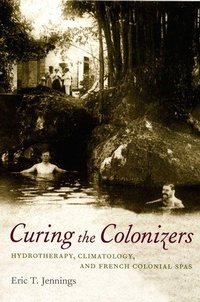
Curing the Colonizers
Hydrotherapy, Climatology, and French Colonial Spas
Will be published approx. on 25. October 2006
Book
Hardback
288 pages
978-0-8223-3808-6 (ISBN)
Description
"Beware! Against the poison that is Africa, there is but one antidote: Vichy." So ran a 1924 advertisement for one of France's main spas. Throughout the French empire, spas featuring water cures, often combined with "climatic" cures, thrived during the nineteenth century and the twentieth. Water cures and high-altitude resorts were widely believed to serve vital therapeutic and even prophylactic functions against tropical disease and the tropics themselves. The Ministry of the Colonies published bulletins accrediting a host of spas thought to be effective against tropical ailments ranging from malaria to yellow fever; specialized guidebooks dispensed advice on the best spas for "colonial ills." Administrators were granted regular furloughs to "take the waters" back home in France. In the colonies, spas assuaged homesickness by creating oases of France abroad. Colonizers frequented spas to maintain their strength, preserve their French identity, and cultivate their difference from the colonized.Combining the histories of empire, leisure, tourism, culture, and medicine, Eric T. Jennings sheds new light on the workings of empire by examining the rationale and practice of French colonial hydrotherapy between 1830 and 1962. He traces colonial acclimatization theory and the development of a "science" of hydrotherapy appropriate to colonial spaces, and he chronicles and compares the histories of spas in several French colonies-Guadeloupe, Madagascar, Tunisia, and REunion-and in France itself. Throughout Curing the Colonizers, Jennings illuminates the relationship between indigenous and French colonial therapeutic knowledge as well as the ultimate failure of the spas to make colonialism physically or morally safe for the French.
Reviews / Votes
"Curing the Colonizers is a thoroughly original, fascinating study. It will complement and immediately stand among the very finest studies of colonialism/imperialism in the past decades."-John Merriman, author of Police Stories: Building the French State, 1815-1851 "Eric T. Jennings's ability to give an in-depth understanding of five very different regions, mastering the primary and secondary literature on all of them, is simply breathtaking. To my knowledge, no one else has managed to write this kind of colonial history, examining the imperial framework as a whole while at the same time giving detailed information about individual colonies."-Tyler Stovall, coeditor of The Color of Liberty: Histories of Race in France "Curing the Colonizers is an impressively researched and beautifully written book that takes Jennings's previous transcolonial work on the Vichy regime overseas in highly original new directions." - Alice L. Conklin (Journal of Modern History) "[A] nuanced, insightful examination of the ideological premises and cultural practices that informed French colonialism in the nineteenth and early twentieth centuries. . . . With this fascinating book, Jennings joins a distinguished group of historians. . . . He further enriches our understanding of Europeans' anxieties about self and security in the alien lands they ruled, casting a fresh eye in turn on the cultural conventions and social practices they marshaled to bolster their sense of confidence and give meaning to their privileged place in the colonial order." - Dane Kennedy (Journal of Colonialism & Colonial History) "[Jennings] manages to bring to life the diverse aspects of these spa resorts, including their role as medical and political centers and tourist destinations. . . . Jennings's elegant study handles these complex issues deftly and with clarity. It is a significant and welcome addition to a growing body of literature on the history of acclimatization in French imperialism." - Mark Harrison (Historical Studies in the Natural Sciences) "This is a very well constructed study, with the case studies rounded off by a measured conclusion. The main themes are clearly argued and demonstrated, the text nicely illustrated with postcards, advertisements and other illustrations. It is a very welcome addition to the growing literature on the spas." - Alastair J. Durie (French History)More details
Language
English
Place of publication
North Carolina
United States
Target group
Professional and scholarly
Product notice
Cloth over boards
Illustrations
24 photos, 5 maps
Dimensions
Height: 241 mm
Width: 160 mm
Thickness: 23 mm
Weight
612 gr
ISBN-13
978-0-8223-3808-6 (9780822338086)
Copyright in bibliographic data and cover images is held by Nielsen Book Services Limited or by the publishers or by their respective licensors: all rights reserved.
Schweitzer Classification
Other editions
Additional editions
E-Book
10/2006
1st Edition
De Gruyter
€198.99
Available for download
Person
Eric T. Jennings is Associate Professor of History and a member of Victoria College at the University of Toronto. He is the author of Vichy in the Tropics: PEtain's National Revolution in Madagascar, Guadeloupe, and Indochina, 1940-1944 and a coeditor, with Jacques Cantier, of L'Empire colonial sous Vichy.
Content
Preface and Acknowledgements ix
Introduction 1
1. Acclimatization, Climatology, and the Possibility of Empire 8
2. Colonial Hydrotherapy 40
3. Highland Hydrotherapy in Guadeloupe 64
4. The Spas and REunion Island: Antechambers to the Tropics 90
5. Leisure and Power at the Spa of Antsirabe, Madagascar 118
6. Korbous, Tunisia: Negating the Hamman 154
7. Vichy: Taking the Waters Back Home 178
Conclusion 211
Archival Abbreviations 215
Notes 217
Bibliography 247
Index 263
Introduction 1
1. Acclimatization, Climatology, and the Possibility of Empire 8
2. Colonial Hydrotherapy 40
3. Highland Hydrotherapy in Guadeloupe 64
4. The Spas and REunion Island: Antechambers to the Tropics 90
5. Leisure and Power at the Spa of Antsirabe, Madagascar 118
6. Korbous, Tunisia: Negating the Hamman 154
7. Vichy: Taking the Waters Back Home 178
Conclusion 211
Archival Abbreviations 215
Notes 217
Bibliography 247
Index 263