

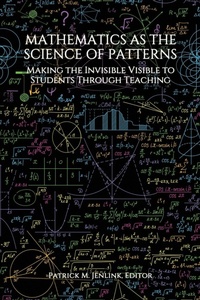
Mathematics as the Science of Patterns
Making the Invisible Visible to Students Through Teaching
Published on 11. February 2022
Book
Paperback/Softback
266 pages
978-1-64802-744-4 (ISBN)
Description
Mathematics as the Science of Patterns: Making the Invisible Visible to Students through Teaching introduces the reader to a collection of thoughtful, research-based works by authors that represent current thinking about mathematics, mathematics education, and the preparation of mathematics teachers. Each chapter focuses on mathematics teaching and the preparation of teachers who will enter classrooms to instruct the next generation of students in mathematics.
The value of patterns to the teaching and learning of mathematics is well understood, both in terms of research and application. When we involve or appeal to pattern in teaching mathematics, it is usually because we are trying to help students to extract greater meaning, or enjoyment, or both, from the experience of learning environments within which they are occupied, and perhaps also to facilitate remembering. As a general skill it is thought that the ability to discern a pattern is a precursor to the ability to generalize and abstract, a skill essential in the early years of learning and beyond.
Research indicates that the larger problem in teaching mathematics does not lie primarily with students; rather it is with the teachers themselves. In order to make changes for students there first needs to be a process of change for teachers. Understanding the place of patterns in learning mathematics is a predicate to understanding how to teach mathematics and how to use pedagogical reasoning necessary in teaching mathematics. Importantly, the lack of distinction created by the pedagogical use of patterns is not immediately problematic to the student or the teacher. The deep-seated cognitive patterns that both teachers and students bring to the classroom require change.
The value of patterns to the teaching and learning of mathematics is well understood, both in terms of research and application. When we involve or appeal to pattern in teaching mathematics, it is usually because we are trying to help students to extract greater meaning, or enjoyment, or both, from the experience of learning environments within which they are occupied, and perhaps also to facilitate remembering. As a general skill it is thought that the ability to discern a pattern is a precursor to the ability to generalize and abstract, a skill essential in the early years of learning and beyond.
Research indicates that the larger problem in teaching mathematics does not lie primarily with students; rather it is with the teachers themselves. In order to make changes for students there first needs to be a process of change for teachers. Understanding the place of patterns in learning mathematics is a predicate to understanding how to teach mathematics and how to use pedagogical reasoning necessary in teaching mathematics. Importantly, the lack of distinction created by the pedagogical use of patterns is not immediately problematic to the student or the teacher. The deep-seated cognitive patterns that both teachers and students bring to the classroom require change.
More details
Language
English
Place of publication
Charlotte
United States
Publishing group
Emerald Publishing Inc
Target group
Professional and scholarly
Dimensions
Height: 234 mm
Width: 156 mm
Thickness: 14 mm
Weight
409 gr
ISBN-13
978-1-64802-744-4 (9781648027444)
Copyright in bibliographic data and cover images is held by Nielsen Book Services Limited or by the publishers or by their respective licensors: all rights reserved.
Schweitzer Classification
Other editions
Additional editions
Patrick M. Jenlink
Mathematics as the Science of Patterns
Making the Invisible Visible to Students Through Teaching
E-Book
02/2022
1st Edition
IAP - Information Age Publishing
€62.33
Available for download
Person
Patrick M. Jenlink, Stephen F. Austin State University
Content
Preface.
Acknowledgments.
Chapter 1. Mathematics-The Science of Patterns: The Importance of Patterns in Teaching and Learning Mathematics; Patrick M. Jenlink.
Chapter 2. Polya Revisited: The Development and Implementation of a Problem-Solving Self-Efficacy Instrument With Preservice Elementary Mathematics Teachers; James Telese and Jair J. Aguilar.
Chapter 3. What Should We Teach in Elementary Mathematics Methods Courses? The Argument for Core Pedagogical Content Knowledge in K-5 Mathematics Teacher Preparation; Courtney Glavich Mayakis and John Williams.
Chapter 4. Effectiveness of Diagnostic Interviews: Preservice Teachers' Patterns of Conceptions in Student Understanding of Number and Operation; Diana L. Moss, Lisa L. Poling, and Tracy Goodson-Epsy.
Chapter 5. Using Visual Representations to Explore Proportional Reasoning With Future Teachers; Sheri Johnson and Rui Kang.
Chapter 6. Patterns and Relationships Within Ratio Contexts: Students' Emerging Ideas Through Tables; Sinem Soezen OEzdogan, Didem Akyuez, and Michelle Stephan.
Chapter 7. Using Worked Examples as a Scalable Practice for Teaching Fraction Magnitude and Fraction Computation; Kathryn J. deVries, Julie L. Booth, Laura K. Young, Christina Areizaga Barbieri, Emunah Mager Garfield, and Kristie J. Newton.
Chapter 8. Expanding a Collective Zone of Proximal Development: Investigating the Potential of Zankov's Lesson With Elementary Students Analyzing Numerical Equalities; Asmund Gjaere and Viktor Freiman.
Chapter 9. Engaging Elementary Preservice Teachers With High Leverage Mathematical Practices; Christopher Nazelli, Deborah Zopf, and S. Asil OEzguen-Koca.
Chapter 10. Number Talks: Engaging Students in Mathematical Reasoning; Dawn Marie Woods.
Epilogue: Recognizing the Special Nature of Mathematics Knowledge for Teaching; Patrick M. Jenlink.
About the Editor and Authors.
Acknowledgments.
Chapter 1. Mathematics-The Science of Patterns: The Importance of Patterns in Teaching and Learning Mathematics; Patrick M. Jenlink.
Chapter 2. Polya Revisited: The Development and Implementation of a Problem-Solving Self-Efficacy Instrument With Preservice Elementary Mathematics Teachers; James Telese and Jair J. Aguilar.
Chapter 3. What Should We Teach in Elementary Mathematics Methods Courses? The Argument for Core Pedagogical Content Knowledge in K-5 Mathematics Teacher Preparation; Courtney Glavich Mayakis and John Williams.
Chapter 4. Effectiveness of Diagnostic Interviews: Preservice Teachers' Patterns of Conceptions in Student Understanding of Number and Operation; Diana L. Moss, Lisa L. Poling, and Tracy Goodson-Epsy.
Chapter 5. Using Visual Representations to Explore Proportional Reasoning With Future Teachers; Sheri Johnson and Rui Kang.
Chapter 6. Patterns and Relationships Within Ratio Contexts: Students' Emerging Ideas Through Tables; Sinem Soezen OEzdogan, Didem Akyuez, and Michelle Stephan.
Chapter 7. Using Worked Examples as a Scalable Practice for Teaching Fraction Magnitude and Fraction Computation; Kathryn J. deVries, Julie L. Booth, Laura K. Young, Christina Areizaga Barbieri, Emunah Mager Garfield, and Kristie J. Newton.
Chapter 8. Expanding a Collective Zone of Proximal Development: Investigating the Potential of Zankov's Lesson With Elementary Students Analyzing Numerical Equalities; Asmund Gjaere and Viktor Freiman.
Chapter 9. Engaging Elementary Preservice Teachers With High Leverage Mathematical Practices; Christopher Nazelli, Deborah Zopf, and S. Asil OEzguen-Koca.
Chapter 10. Number Talks: Engaging Students in Mathematical Reasoning; Dawn Marie Woods.
Epilogue: Recognizing the Special Nature of Mathematics Knowledge for Teaching; Patrick M. Jenlink.
About the Editor and Authors.