

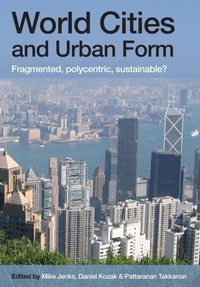
World Cities and Urban Form
Fragmented, Polycentric, Sustainable?
1st Edition
Published on 24. June 2008
Book
Paperback/Softback
374 pages
978-0-415-45186-4 (ISBN)
Description
This book presents new research and theory at the regional scale showing the forms metropolitan regions might take to achieve sustainability. At the city scale the book presents case studies based on the latest research and practice from Europe, Asia and North America, showing how both planning and flagship design can propel cities into world class status, and also improve sustainability. The contributors explore the tension between polycentric and potentially sustainable development, and urban fragmentation in a physical context, but also in a wider cultural, social and economic context.
More details
Language
English
Place of publication
London
United Kingdom
Publishing group
Taylor & Francis Ltd
Target group
College/higher education
Professional and scholarly
Postgraduate, Professional, and Professional Practice & Development
Illustrations
75 s/w Photographien bzw. Rasterbilder, 75 s/w Zeichnungen, 60 s/w Tabellen
60 Tables, black and white; 75 Line drawings, black and white; 75 Halftones, black and white
Dimensions
Height: 244 mm
Width: 170 mm
Thickness: 21 mm
Weight
661 gr
ISBN-13
978-0-415-45186-4 (9780415451864)
Copyright in bibliographic data and cover images is held by Nielsen Book Services Limited or by the publishers or by their respective licensors: all rights reserved.
Schweitzer Classification
Other editions
Additional editions
Mike Jenks | Daniel Kozak | Pattaranan Takkanon
World Cities and Urban Form
Fragmented, Polycentric, Sustainable?
E-Book
12/2013
1st Edition
Routledge
€69.99
Available for download
Mike Jenks | Daniel Kozak | Pattaranan Takkanon
World Cities and Urban Form
Fragmented, Polycentric, Sustainable?
E-Book
12/2013
1st Edition
Routledge
€69.99
Available for download
Mike Jenks | Daniel Kozak | Pattaranan Takkanon
World Cities and Urban Form
Fragmented, Polycentric, Sustainable?
Book
06/2008
1st Edition
Routledge
€263.10
Shipment within 15-20 days
Persons
Mike Jenks is Professor Emeritus and Founder Director of the Oxford Institute for Sustainable Development (OISD) at Oxford Brookes University, United Kingdom.
Daniel Kozak teaches at the Faculty of Architecture, University of Buenos Aires, Argentina, and is also a PhD researcher at OISD, Oxford Brookes University.
Pattaranan Takkanon is Lecturer at the Faculty of Architecture, Kasetsart University, Bangkok, Thailand.
Daniel Kozak teaches at the Faculty of Architecture, University of Buenos Aires, Argentina, and is also a PhD researcher at OISD, Oxford Brookes University.
Pattaranan Takkanon is Lecturer at the Faculty of Architecture, Kasetsart University, Bangkok, Thailand.
Content
Introduction: World cities and urban form Part 1: Theoretical Approaches in a Global Context 1. What is a 'World Class' City? Comparing conceptual specifications of cities in the context of a global urban network 2. Globalisation and the Forms of Cities 3. The World City Hypothesis Revisited: Export and import of urbanity is a dangerous business 4. Sustainability and the 'World Class' City: What is being sustained and for who? 5. Polycentrism and 'Defragmentation': Towards a more sustainable urban form? Part 2: Polycentric Regions and Cities: perspectives from Europe, Asia and North America 6. Promoting Sustainable Urban Form: Implementing urban consolidation policies around the Helsinki Metropolitan Region 7. Spatial Disparities Based on Human and Social Capital 8. The Model Barcelona: 1979-2004 and beyond 9. Sustainable 'World Class' Cities and Glocal Sprawl in Southeast Asian Metropolitans 10. Quality of Life and Spatial Urban Forms of Mega-city Regions in Japan 11. Global Integration, Growth Patterns and Sustainable Development: A case study of the peri-urban area of Shanghai 12. Taichung the Waiting Metropolis and its Campaign towards a 'World Class' City: A case of glocollision, glocoalition or glocalisation? 13. 'World Class' Vancouver: A terminal city re-imagined 14. Planning a 'World Class' City without Zoning: The experience of Houston Part 3: Aspects of Urban Fragmentation 15. Assessing Urban Fragmentation: The emergence of new typologies in central Buenos Aires 16. Tracking Sustainable Urban Forms and Material Flows in Singapore 17. The Right to the City: Stakeholder perspectives of Greater Cairo Metropolitan communities 18. 'World Class' Living? 19. Bangkok's Struggle to Achieve a Successful Transportation System 20. To be or not to be a 'World Class' City? Poverty and urban form in Paris and Bucharest 21. Inner Truth of the Slums in Mega Cities: A scenario from India Conclusion: The Form of Cities to Come?